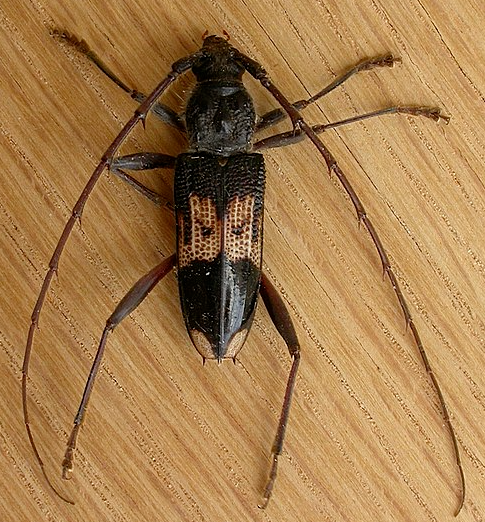
The Eucalyptus Longhorned Borer (Phoracantha semipunctata) is a wood-boring beetle that attacks eucalyptus trees. Native to Australia, it has become an invasive pest in many regions, including parts of North America.
The “Tree-Killer”: Eucalyptus Longhorned Borer
The Eucalyptus Longhorned Borer (Phoracantha semipunctata) is a high-priority invasive pest that has caused significant mortality in U.S. Eucalyptus groves, particularly in California and the Southwest. For Pestipedia.com users, this beetle represents a severe threat to landscape aesthetics and public safety, as infested trees become structurally unstable and prone to falling. Originally from Australia, these borers thrive in the arid United States climate, specifically targeting trees stressed by U.S. droughts.
Technical Identification: Diagnostic Markers
- Phenotype (Adult): Characterized by a slender, shiny dark brown body (approx. 1 inch long) with a distinctive cream-colored zigzag band across the middle of the wing covers. A primary diagnostic key for Pestipedia.com users is the exceptionally long antennae, which can exceed the length of the body.
- Larval Phenotype: The larvae are creamy-white, legless roundheaded borers. They possess powerful mandibles capable of chewing through dense hardwood, creating large, sawdust-filled galleries.
- Exit Holes: A primary diagnostic marker is the oval-shaped exit hole (approx. 10mm wide) in the bark, where the adult has emerged from the tree.
Infestation Impact: Vascular Girdling and Structural Failure
The primary impact of the Eucalyptus Longhorned Borer is the destruction of the cambium layer, which leads to vascular failure.
- Gallery Excavation: Larvae mine the area between the bark and the wood. In the United States, this girdles the tree, cutting off the flow of water and nutrients to the canopy.
- Canopy Dieback: The first sign of infestation in U.S. landscapes is thinning foliage and branch dieback at the top of the tree. This indicates the tree is in active decline.
- Kino (Sap) Oozing: Infested trees often exude thick, reddish-brown sap (kino) as a defense mechanism. If the tree is drought-stressed, it cannot produce enough sap to drown the invading larvae.
Management & Conservation Strategies
Management of the Eucalyptus Longhorned Borer focuses on host vigor and sanitary practices.
| Strategy | Technical Specification | Operational Benefit |
|---|---|---|
| Hydraulic Stress Mitigation | Deep U.S. summer irrigation | Increases the tree’s sap pressure, allowing it to naturally repel boring larvae. |
| Sanitation | Immediate removal and chipping of dead wood | Destroys the larval habitat; prevents spread to healthy groves. |
| Biological Control | Avetianella longoi (Egg Wasps) | Parasitizes borer eggs; provides national suppression in U.S. urban forests. |
- Monitoring: Inspect tree trunks for reddish sap stains and loose bark during the summer. Peeling back bark to reveal winding galleries infestation.
- Cultural Warning: Pestipedia.com recommends avoiding pruning during the borer’s flight season (April to October), as fresh cuts emit volatiles that attract egg-laying females.
Taxonomy and Classification
- Order: Coleoptera
- Family: Cerambycidae
Physical Description
Adults are elongated beetles with long antennae and mottled brown coloration. Larvae are pale, legless grubs that tunnel through wood.
Behavior and Damage
Larvae feed beneath bark, disrupting nutrient flow and weakening trees. Severe infestations can kill trees.
Management
- Maintain tree health
- Remove infested wood
- Monitor stressed trees