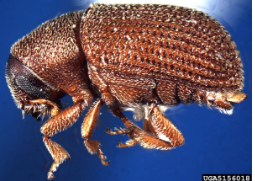
Elm Bark Beetles (genera Scolytus and Hylurgopinus) are small wood-boring beetles whose primary importance lies in their role as vectors of Dutch Elm Disease (DED), caused by the fungi Ophiostoma ulmi and O. novo-ulmi. While the beetles themselves cause only minor feeding and breeding damage, their ability to transmit this lethal fungal disease has resulted in the widespread loss of elm trees across North America and Europe. They are considered the most significant biological threat to elm populations worldwide.
Taxonomy and Classification
Elm bark beetles belong to the family Curculionidae, subfamily Scolytinae, a group commonly referred to as bark beetles. Two of the most important species associated with Dutch Elm Disease transmission are the Smaller European Elm Bark Beetle (Scolytus multistriatus) and the Native Elm Bark Beetle (Hylurgopinus rufipes).
These beetles undergo complete metamorphosis (egg, larva, pupa, adult). Although they feed and reproduce within elm bark, their primary impact comes from carrying fungal spores that infect healthy trees during feeding.
Physical Description
Adult elm bark beetles are very small, measuring approximately 1/8 to 1/4 inch long. They are cylindrical in shape and range in color from reddish-brown to black. Species in the genus Scolytus can be identified by a small spine or projection on the underside of the abdomen.
The larvae are tiny, white, legless grubs that develop beneath the bark. They create feeding tunnels (galleries) in the phloem layer of the tree. These galleries often form distinctive patterns, such as fan-shaped or radiating tunnels, which are key diagnostic signs of infestation.
When adults emerge, they leave behind small, round exit holes often referred to as “shot holes” in the bark.
Distribution and Habitat
Elm bark beetles are widely distributed across regions where elm trees grow, including North America, Europe, and parts of Asia. Their habitat is primarily the inner bark (phloem) of elm trees, where they breed and develop.
They preferentially colonize stressed, weakened, or recently dead trees for reproduction. However, healthy trees are targeted during feeding flights, which is when disease transmission occurs.
Behavior and Life Cycle
Elm bark beetles typically produce one to two generations per year, depending on climate conditions. Adults seek out weakened or dying elm trees to lay eggs. After hatching, larvae tunnel through the phloem, feeding and developing within the tree.
Upon emergence, adult beetles carry spores of Dutch Elm Disease acquired from infected breeding sites. They then fly to healthy elm trees for maturation feeding, where they chew into small twigs and branch crotches.
This feeding activity introduces fungal spores into the tree’s vascular system, initiating infection and ultimately leading to disease progression.
Damage and Disease Impact
The primary damage associated with elm bark beetles is the spread of Dutch Elm Disease, which rapidly kills infected trees.
- Wilting (Flagging): Early symptoms include yellowing and wilting leaves on individual branches.
- Vascular Blockage: The fungus triggers the tree to block its own xylem vessels, preventing water transport.
- Tree Death: Infection spreads quickly, often killing the entire tree within a single growing season.
- Widespread Loss: Elm populations in urban and natural landscapes have declined dramatically due to DED.
Management and Prevention
Effective management focuses on preventing disease transmission rather than controlling the beetles alone.
- Sanitation: Prompt removal and destruction of dead or infected elm wood is the most critical control measure.
- Pruning: Infected branches should be removed well below visible symptoms to prevent spread.
- Fungicide Treatments: Preventative trunk injections can protect high-value trees when applied early.
- Monitoring: Regular inspection helps detect early signs of infestation or disease.
- Pheromone Traps: Used for monitoring beetle populations but not effective as a standalone control method.
Conservation and Research
Elm bark beetles remain central to research efforts aimed at managing Dutch Elm Disease. Current studies focus on breeding disease-resistant elm varieties, improving early detection methods, and refining integrated management strategies to preserve remaining elm populations.