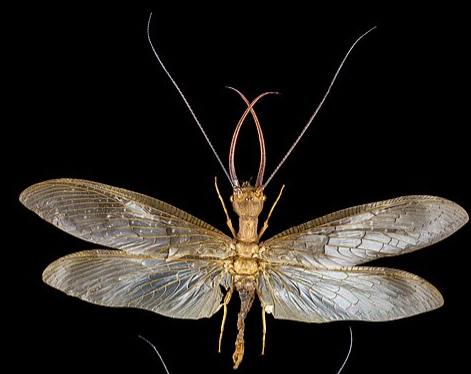
The Eastern Dobsonfly (Corydalus cornutus) is one of the largest and most striking aquatic insects in North America. Belonging to the order Megaloptera, this species is well known for its enormous wingspan, dramatic appearance, and aquatic predatory larvae known as hellgrammites. Although adult dobsonflies may appear intimidating because of their large size and oversized jaws, they are generally harmless to humans and play an important ecological role in freshwater ecosystems.
Taxonomy and Classification
- Order: Megaloptera
- Family: Corydalidae
- Genus: Corydalus
- Species: Corydalus cornutus
The Eastern Dobsonfly belongs to the family Corydalidae, a group of primitive aquatic insects closely associated with streams and rivers. Members of the order Megaloptera are characterized by aquatic larvae and short-lived terrestrial adults.
The species is best known for its larval stage, commonly called the hellgrammite, which is widely recognized by anglers as effective fishing bait and by aquatic ecologists as an indicator of high water quality.
Physical Description
Adult Eastern Dobsonflies are among the largest insects in North America, with wingspans reaching up to 13 centimeters (5 inches). Their bodies are elongated and somewhat flattened, with grayish-brown to dark brown coloration that helps camouflage them against bark and rocky surfaces.
The most recognizable feature is found in the males, which possess enormous curved mandibles that may exceed half the body length. Despite their intimidating appearance, these oversized jaws are relatively weak and are primarily used during courtship and mating competition rather than defense. Females possess shorter but much stronger mandibles capable of delivering a painful pinch if handled carelessly.
Adults also possess:
- Long segmented antennae
- Large membranous wings
- Prominent compound eyes
- Soft elongated abdomens
- Strong legs adapted for climbing vegetation and rocks
The larval hellgrammites are equally distinctive. They are dark brown to black aquatic predators with elongated segmented bodies, lateral abdominal filaments, and large pincers used to capture prey.
Distribution and Habitat
The Eastern Dobsonfly is widely distributed throughout eastern North America, including much of the eastern United States and southern Canada.
This species is strongly associated with:
- Streams
- Rivers
- Freshwater creeks
- Riparian woodlands
- Rocky aquatic habitats
- Well-oxygenated water systems
The larvae require clean, highly oxygenated water to survive and are therefore considered important biological indicators of healthy aquatic ecosystems.
Life Cycle
The Eastern Dobsonfly undergoes complete metamorphosis consisting of egg, larva, pupa, and adult stages.
Egg Stage
Females lay large clusters of eggs on rocks, vegetation, bridges, and structures located above water. Egg masses are coated with a chalky white protective layer that helps reduce predation and desiccation.
Larval Stage (Hellgrammites)
After hatching, larvae drop directly into the water where they begin a prolonged aquatic stage that may last several years. Hellgrammites live beneath rocks and debris in streams where they actively hunt aquatic insects, worms, and small invertebrates.
As predators, hellgrammites play an important role in regulating aquatic insect populations within freshwater ecosystems.
Pupal Stage
Once mature, larvae leave the water and burrow into moist soil or debris near stream banks. They create earthen chambers where pupation occurs.
Adult Stage
Adults emerge primarily during late spring and summer. Their adult lifespan is relatively short, often lasting only a few days to several weeks, during which reproduction becomes their primary focus.
Behavior and Ecology
Eastern Dobsonflies are nocturnal insects and are frequently attracted to outdoor lighting near rivers and streams. Adults are poor fliers despite their large wings and are commonly found resting on walls, tree trunks, or vegetation during daylight hours.
The larval hellgrammites are highly aggressive aquatic predators. They feed on:
- Aquatic insect larvae
- Small crustaceans
- Worms
- Minnows
- Other aquatic invertebrates
Because of their sensitivity to pollution and low oxygen conditions, hellgrammites are commonly used in freshwater biological surveys to assess stream quality.
Human Interaction
Although Eastern Dobsonflies appear intimidating, they are not aggressive toward humans. Adult males are essentially harmless despite their enormous jaws. Females and larvae may bite defensively if handled, but the bites are not medically significant.
Hellgrammites are highly valued by anglers as fishing bait due to their durability and effectiveness at attracting fish species such as bass and trout.
Occasionally, adults may become nuisance insects around outdoor lighting during emergence periods near rivers or streams, but they do not infest homes or damage structures.
Ecological Importance
The Eastern Dobsonfly serves several important ecological functions:
- Predation on aquatic insects
- Contribution to freshwater food webs
- Indicator of clean water systems
- Food source for fish, birds, and amphibians
- Nutrient cycling within aquatic ecosystems
As both predators and prey, these insects help maintain ecological balance in freshwater environments.
Management
No management or control is usually necessary because Eastern Dobsonflies are beneficial aquatic insects.
Protecting stream quality and reducing water pollution are essential for maintaining healthy populations of this species and other aquatic insects.
Conclusion
The Eastern Dobsonfly is one of North America’s most fascinating freshwater insects. Despite its intimidating appearance, it plays an important ecological role as a predator and bioindicator within healthy stream ecosystems. Its aquatic hellgrammite stage contributes significantly to freshwater food webs, while the adults remain a remarkable example of the diversity and specialization found among aquatic insects.