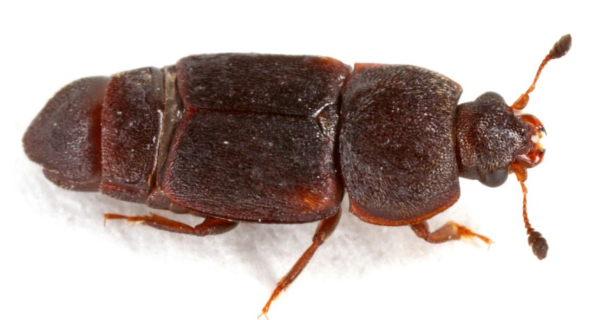
Dusky Sap Beetles (Carpophilus lugubris) are small, dark, shiny beetles that commonly infest fruit and vegetable crops. They are especially associated with sweet corn, tomatoes, strawberries, melons, berries, and tree fruits. Although they often feed on fruit that is already damaged, cracked, overripe, or fermenting, they are important agricultural pests because they contaminate produce and can help spread fungal pathogens that cause rot and mold.
Dusky sap beetles are often considered secondary pests, meaning they frequently invade plant tissue after another pest, weather injury, or ripening damage has opened the crop. However, once present, they can worsen decay, reduce market value, and make fruit or corn ears unsuitable for sale or consumption.
Taxonomy and Classification
- Common Name: Dusky Sap Beetle
- Scientific Name: Carpophilus lugubris
- Order: Coleoptera
- Family: Nitidulidae
- Type: Fruit, vegetable, and sap-feeding crop pest
Dusky sap beetles belong to the family Nitidulidae, commonly called sap beetles. Members of this family are attracted to fermenting plant juices, damaged fruit, decaying organic matter, and stored food materials. They undergo complete metamorphosis, developing through egg, larva, pupa, and adult stages.
Identification and Physical Description
Adult dusky sap beetles are small, oval, and robust, typically measuring about 1/8 to 1/4 inch long. Their bodies are usually dark brown to shiny black, giving them a polished appearance.
Key identifying features include:
- Small, oval body
- Dark brown to black coloration
- Short, clubbed antennae
- Shortened wing covers that leave the tip of the abdomen exposed
The larvae are small, cream-colored, cylindrical grubs. They may have a slightly darker head and small dark projections at the end of the abdomen. Larvae are usually found inside damaged fruit, fermenting plant material, or corn ears where feeding is already underway.
Distribution and Habitat
Dusky sap beetles are widespread across North America and are especially common in regions where sweet corn, berries, tomatoes, and soft fruits are grown. They thrive in agricultural fields, home gardens, orchards, and areas where crop residue or fallen fruit is allowed to accumulate.
Common habitats include:
- Sweet corn fields
- Berry patches
- Tomato and melon plantings
- Orchards
- Cull piles and composting fruit
- Areas with fermenting plant material
Adults overwinter in protected places such as soil debris, leaf litter, under bark, and around stored grain or plant residue. In spring and summer, they become active and move into crops as fruit ripens or becomes damaged.
Behavior and Life Cycle
Dusky sap beetles are strongly attracted to the odor of fermentation. Ripening fruit, cracked tomatoes, damaged corn ears, and overripe berries can quickly draw adults into a field or garden.
The life cycle includes:
- Egg Stage: Females lay eggs on or near damaged, fermenting, or ripening plant material.
- Larval Stage: Larvae hatch and feed inside fruit, corn ears, or decaying plant tissue.
- Pupal Stage: Mature larvae leave the food source and pupate in the soil or nearby debris.
- Adult Stage: Adults emerge, feed, mate, and disperse to new food sources.
In warm weather, development can be rapid, sometimes taking less than a month from egg to adult. Multiple generations may occur during a growing season, especially where damaged fruit and crop debris are continuously available.
Feeding and Damage
Dusky sap beetles damage crops through direct feeding, contamination, and disease spread.
- Direct Feeding: Adults and larvae feed on soft, sugary plant tissues, especially damaged or overripe fruit.
- Corn Damage: Beetles often enter corn ears after corn earworm injury or through exposed silks and damaged kernels.
- Fruit Contamination: Their presence, larvae, frass, and feeding injury make produce unattractive and unsalable.
- Disease Spread: Beetles can carry fungal spores such as Fusarium and Aspergillus, contributing to fruit, ear, and kernel rots.
In sweet corn, dusky sap beetles frequently become a problem after primary damage from Corn Earworms. In fruit crops, they are often found in berries, tomatoes, or melons that have split, bruised, or begun to ferment.
Economic Importance
The economic impact of dusky sap beetles is greatest in crops sold for fresh consumption. Even minor contamination can lead to rejection because customers and processors do not tolerate beetles, larvae, or mold in fruit or corn.
Damage is especially important in:
- Fresh-market sweet corn
- Strawberries and raspberries
- Tomatoes and melons
- Peaches, apples, and other soft tree fruits
Because they are attracted to ripening and damaged produce, infestations often increase close to harvest, when crop value is highest.
Management and Prevention
Effective dusky sap beetle management focuses on sanitation, monitoring, and reducing access to damaged crops.
| Strategy | Purpose | Benefit |
|---|---|---|
| Sanitation | Remove overripe fruit, cull piles, and crop debris | Reduces breeding sites and attractants |
| Primary Pest Control | Manage corn earworms and other fruit-damaging pests | Prevents wounds that attract sap beetles |
| Prompt Harvest | Pick ripe produce before it becomes overripe | Limits fermentation and beetle attraction |
| Fermentation Traps | Use baited traps with molasses, fruit, or yeast mixtures | Helps monitor or reduce adult beetle activity |
In home gardens, frequent harvesting and disposal of damaged produce are often the most practical control methods. In commercial fields, management is usually integrated with broader fruit and corn pest programs.
Prevention
- Remove fallen, cracked, or rotting fruit promptly.
- Keep garden and field edges free of discarded produce.
- Control primary pests that create entry wounds.
- Harvest crops regularly during peak ripening.
- Avoid leaving cull piles near production areas.
- Use baited traps to monitor beetle activity near harvest.
Prevention is especially important because once beetles enter fruit or corn ears, direct control becomes much more difficult.
Conservation and Research
Dusky sap beetles are generalist pests, and research focuses on improving monitoring tools and reducing their role as vectors of fungal pathogens. Fermentation-based attractants are of particular interest because sap beetles respond strongly to odors produced by damaged or decaying plant material.
Research also examines how field sanitation, harvest timing, and control of primary pests can reduce sap beetle pressure without unnecessary pesticide use.
Related Articles
Conclusion
Dusky sap beetles are small but economically important pests of fruit and vegetable crops. Their attraction to fermenting plant material, damaged produce, and ripening crops makes them common near harvest, when crop quality matters most.
Although they often invade after other damage has occurred, their feeding, contamination, and ability to spread fungal pathogens can greatly reduce marketability. Sanitation, prompt harvest, primary pest control, and monitoring are the most important tools for managing dusky sap beetles in gardens, orchards, and commercial fields.