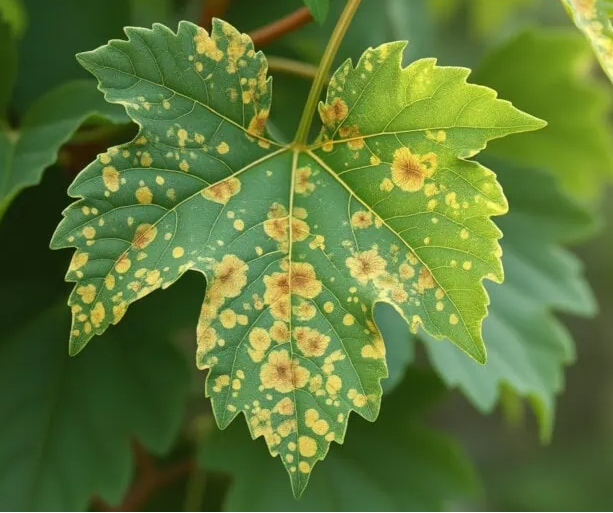
Downy Mildew is not an insect or animal pest, but a highly destructive plant disease caused by parasitic organisms known as Oomycetes (water molds). These fungal-like microorganisms are obligate biotrophs, meaning they can only survive and reproduce on living plant tissue. Despite often being grouped with “pests,” Downy Mildew is more accurately classified as a plant pathogen that can cause severe damage to crops, ornamentals, and greenhouse plants.
This disease affects a wide range of important crops, including grapes, cucumbers, spinach, onions, lettuce, basil, and many ornamental plants. Under favorable conditions, Downy Mildew can spread rapidly and result in significant yield loss or complete crop failure.
Taxonomy and Classification
Downy Mildew pathogens belong to the kingdom Stramenopila and the family Peronosporaceae. Although they resemble fungi, they are taxonomically distinct and more closely related to algae.
Common genera responsible for Downy Mildew diseases include:
- Plasmopara: Affects grapes and other plants
- Peronospora: Infects spinach, onions, and ornamentals
- Pseudoperonospora: Common in cucurbits such as cucumbers and melons
These organisms reproduce both asexually through sporangia and sexually through thick-walled oospores, which allow them to survive unfavorable conditions.
Symptoms and Identification
Downy Mildew is identified by distinctive symptoms that appear on both the upper and lower leaf surfaces.
- Upper Leaf Surface: Yellow, pale, or angular spots that may appear oily or water-soaked. These spots are often limited by leaf veins and eventually turn brown or necrotic.
- Lower Leaf Surface: A characteristic downy or fuzzy growth composed of sporangia. This growth may be white, gray, purple, or bluish, depending on the species.
The pathogen itself grows داخل plant tissue as microscopic filaments called hyphae, extracting nutrients from host cells.
Distribution and Habitat
Downy Mildew diseases are found worldwide and occur wherever susceptible host plants are grown. They are particularly problematic in regions with:
- Cool to moderate temperatures
- High humidity
- Frequent rainfall or leaf wetness
Extended periods of moisture on leaf surfaces are essential for infection and disease development, making greenhouse and irrigated environments especially vulnerable.
Disease Cycle and Spread
The disease cycle begins when oospores (overwintering spores) germinate or when airborne sporangia land on wet plant surfaces. Under favorable conditions, sporangia release motile zoospores that swim across water films and penetrate plant tissue.
Once inside the plant, the pathogen rapidly colonizes leaf tissue and produces new sporangia on the underside of leaves. These spores are easily dispersed by wind, water splash, or المعدات (equipment), allowing the disease to spread quickly.
Because this cycle can repeat rapidly, outbreaks can escalate into epidemics within days under ideal environmental conditions.
Damage and Economic Impact
Downy Mildew can cause severe economic losses in agriculture and horticulture. Key impacts include:
- Defoliation: Leaves die and drop prematurely
- Reduced Photosynthesis: Loss of leaf area limits plant growth
- Yield Loss: Crops fail to develop or mature properly
- Quality Reduction: Produce becomes unmarketable
In crops such as grapes, cucumbers, and leafy greens, severe infections can destroy entire fields if not managed effectively.
Management and Prevention (IPM)
Because infected plant tissue cannot be cured, management of Downy Mildew relies heavily on preventative strategies.
- Moisture Management: Improve air circulation, proper plant spacing, and irrigation timing to reduce leaf wetness.
- Resistant Varieties: Use resistant or tolerant cultivars whenever available.
- Fungicides: Apply protectant or systemic fungicides (including copper-based products or oomycete-specific treatments) before or early in infection.
- Sanitation: Remove and destroy infected plant debris to reduce overwintering spores.
- Monitoring: Use weather-based forecasting models to anticipate disease outbreaks.
Integrated pest management approaches are essential to reduce disease pressure while minimizing chemical use.
Ecological Considerations
Downy Mildew pathogens are naturally occurring organisms that play roles in plant population dynamics. However, in agricultural systems, their impact is often amplified by monoculture practices and favorable environmental conditions.
Balanced ecosystems, proper crop rotation, and reduced humidity can help limit outbreaks.
Conclusion
Downy Mildew is a serious plant disease caused by oomycete pathogens that thrive in cool, moist environments. While not a pest in the traditional sense, it can cause extensive damage to crops and ornamental plants. Early detection, preventative cultural practices, resistant varieties, and timely fungicide applications are critical for effective management. Understanding its lifecycle and environmental requirements is key to minimizing its impact.