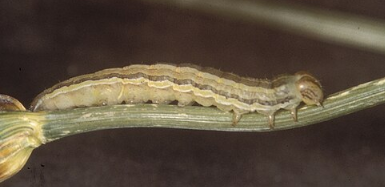
Double-Striped Armyworms (Mythimna unipuncta) are grass-feeding caterpillars known for their ability to cause rapid and widespread damage to lawns, pastures, and cereal crops. These insects are named for their tendency to move and feed in large groups, often appearing to “march” across turf or fields in search of food.
While small populations may go unnoticed, outbreaks can lead to significant defoliation, resulting in dead patches of turf or reduced crop yields.
Quick Facts
- Common Name: Double-Striped Armyworm
- Scientific Name: Mythimna unipuncta
- Family: Noctuidae
- Order: Lepidoptera
- Habitat: Lawns, fields, pastures, grassy areas
- Diet: Grasses and cereal crops
- Status: Turf and crop pest
Taxonomy and Classification
Double-striped armyworms belong to the family Noctuidae, a large group of moths commonly known as owlet moths. Many members of this family produce larvae that are significant agricultural pests.
The larval stage is part of the broader category of plant-feeding caterpillars, while the adult stage is a moth within the group of moths.
They undergo complete metamorphosis, transitioning through egg, larva, pupa, and adult stages.
Identification
Double-striped armyworms can be identified by their distinct physical features:
- Larvae: Green, brown, or gray caterpillars
- Stripes: Two light-colored stripes running lengthwise along the body
- Size: Up to 1.5 inches when fully grown
Larvae are often found feeding in groups and may hide in soil or thatch during the day.
The adult moths are:
- Medium-sized with brown or gray wings
- Typically active at night
- Attracted to lights
Adults are less noticeable than larvae and do not cause plant damage.
Distribution and Habitat
Double-striped armyworms are widely distributed across North America and other regions where grasses are abundant.
Common habitats include:
- Lawns and turfgrass areas
- Pastures and rangelands
- Agricultural fields (corn, wheat, and other cereals)
- Golf courses and sports fields
They thrive in warm conditions and areas with dense grass growth.
Behavior and Life Cycle
These insects follow a complete life cycle:
- Egg: Laid in clusters on grass blades
- Larva: Feeds heavily on foliage
- Pupa: Develops in the soil
- Adult: Emerges to reproduce
Key behavioral traits include:
- Larvae feed primarily at night
- During the day, they hide in soil, thatch, or debris
- Large populations may migrate across turf in groups
Multiple generations may occur per year depending on climate conditions.
Feeding and Damage
The larval stage is responsible for all damage.
Typical feeding behavior includes:
- Chewing grass blades down to the crown
- Creating irregular brown or dead patches in turf
- Defoliating cereal crops and pasture grasses
Signs of infestation include:
- Rapidly expanding brown areas in lawns
- Visible caterpillars in affected areas
- Increased bird activity feeding on larvae
Severe infestations can result in significant economic loss in agricultural systems.
Pest Status
Double-striped armyworms are considered serious turf and crop pests when populations are high.
They are particularly problematic in:
- Residential lawns
- Golf courses and athletic fields
- Pastures and forage systems
- Cereal crop production
Management and Control
Effective control depends on early detection and integrated pest management.
| Strategy | Purpose | Benefit |
|---|---|---|
| Monitoring | Detect larvae early | Prevents severe damage |
| Biological Control | Encourage predators | Natural suppression |
| Cultural Practices | Maintain turf health | Improves resistance |
| Targeted Treatment | Control outbreaks | Reduces populations quickly |
Natural predators such as birds, ground beetles, and parasitic insects can help regulate populations.
Prevention
- Maintain healthy, well-irrigated turfgrass
- Monitor lawns and fields regularly during warm months
- Encourage beneficial insects and wildlife
- Reduce excessive thatch where larvae may hide
Preventative care is key to minimizing the impact of infestations.
Related Articles
Conclusion
Double-striped armyworms are destructive turf and crop pests capable of causing rapid and widespread damage under favorable conditions. Their group feeding behavior and high reproductive potential make them particularly challenging during outbreaks.
Through consistent monitoring, proper lawn and crop care, and integrated pest management strategies, their impact can be effectively minimized and controlled.