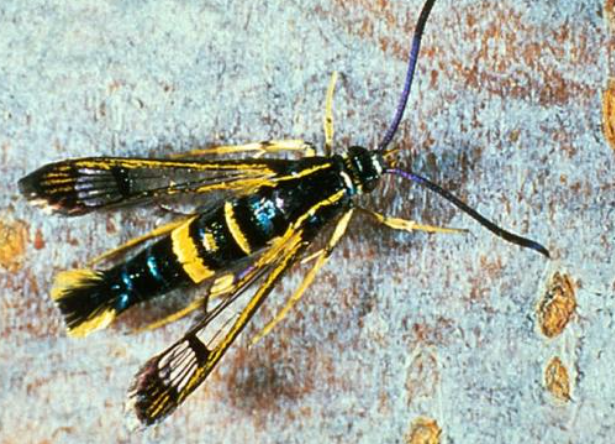
Dogwood Borer (Synanthedon scitula) is a clearwing moth species whose larvae are destructive wood-boring pests of ornamental trees, particularly dogwoods. This insect is widely regarded as one of the most significant pests affecting flowering dogwood trees in North America, though it also attacks other hardwood species such as apple, oak, and hickory.
The primary damage is caused by the larval stage, which tunnels beneath the bark and disrupts the tree’s vascular system, weakening overall health and increasing susceptibility to disease and environmental stress.
Taxonomy and Classification
- Order: Lepidoptera
- Family: Sesiidae
- Genus: Synanthedon
- Species: Synanthedon scitula
Dogwood borers belong to the family Sesiidae, commonly known as clearwing moths. These moths are notable for their resemblance to wasps, an example of Batesian mimicry that helps deter predators.
Physical Description
Dogwood borers have distinct features at both the adult and larval stages:
- Adults: Slender, wasp-like moths with narrow bodies and transparent wings
- Coloration: Dark with yellow or orange markings resembling stinging insects
- Size: Approximately 1/2 inch in length
The larvae are:
- Creamy white to light pink caterpillars
- Soft-bodied and legged
- Typically found beneath bark within feeding tunnels
This hidden larval stage is responsible for the majority of damage.
Distribution and Habitat
Dogwood borers are widely distributed throughout eastern North America and are especially common in:
- Residential landscapes
- Urban and suburban plantings
- Forests with native dogwood trees
- Orchards and managed tree plantings
They are strongly associated with injured or stressed trees, as females prefer to lay eggs on damaged bark or pruning wounds.
Behavior and Life Cycle
Dogwood borers undergo complete metamorphosis with four life stages:
- Egg
- Larva (boring stage)
- Pupa
- Adult moth
Key life cycle behaviors include:
- Females lay eggs on bark wounds, cracks, or rough surfaces
- Larvae hatch and bore into the bark, feeding on cambium tissue
- Larval development may take several months
- Pupation occurs within the tunnel beneath the bark
- Adults emerge through small exit holes to reproduce
There is typically one generation per year, although timing may vary based on climate.
Feeding and Damage
The larvae feed on the cambium layer, which is essential for nutrient and water transport within the tree.
Common signs of infestation include:
- Frass: Sawdust-like material near entry holes
- Swollen or cracked bark
- Girdling damage that restricts nutrient flow
- Branch dieback and reduced vigor
Over time, repeated infestations can:
- Weaken tree structure
- Increase susceptibility to disease
- Reduce ornamental value
Young or stressed trees are particularly vulnerable to severe damage.
Pest Status
Dogwood borers are considered serious ornamental tree pests. While rarely fatal on their own, their damage can significantly reduce tree health and longevity, especially when combined with other stress factors such as drought or disease.
Management and Control
Effective management focuses on prevention and early detection.
| Strategy | Purpose | Benefit |
|---|---|---|
| Tree Health Maintenance | Reduce stress | Lowers infestation risk |
| Wound Prevention | Avoid egg-laying sites | Prevents larval entry |
| Monitoring | Detect early activity | Improves control success |
| Targeted Treatment | Control larvae | Limits internal damage |
In some cases, professional treatments may be required to manage established infestations.
Prevention
- Avoid damaging bark during landscaping or mowing
- Maintain proper watering and fertilization
- Protect tree trunks from mechanical injury
- Inspect trees regularly for early signs of infestation
Healthy trees are far less likely to be attacked than stressed or damaged ones.
Related Articles
Conclusion
The dogwood borer is a significant pest of ornamental trees, particularly in managed landscapes where trees may already be under stress. By targeting the inner bark and disrupting vital nutrient pathways, these insects can gradually weaken and decline even mature trees.
Through proper tree care, prevention of injury, and early monitoring, infestations can be minimized and tree health preserved. Proactive management is essential for protecting valuable ornamental plantings from long-term damage.