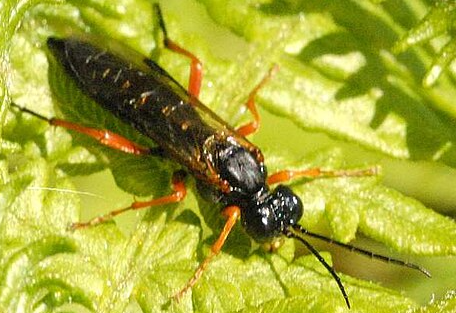
Dock Sawflies (Ametastegia glabrata) are common foliage-feeding pests associated with plants in the genus Rumex, particularly dock and sorrel. These insects are most noticeable during their larval stage, when they resemble small green caterpillars feeding on leaves. They often curl or roll leaf edges to create a protected feeding area, which helps shield them from predators and environmental conditions.
Dock sawflies are frequently found in gardens, pastures, and disturbed areas where dock plants grow abundantly. While they can cause visible damage to foliage, they are generally considered minor pests because they rarely kill host plants and are relatively easy to manage.
Taxonomy and Classification
Dock Sawflies belong to the order Hymenoptera and the family Tenthredinidae, commonly known as sawflies. Unlike true flies (order Diptera), sawflies possess two pairs of wings.
They undergo complete metamorphosis, developing through egg, larva, pupa, and adult stages. The name “sawfly” comes from the female’s ovipositor, which is serrated like a saw and used to cut slits into plant tissue for egg-laying.
The larvae are often mistaken for caterpillars but can be distinguished by having more than five pairs of prolegs on the abdomen, whereas true caterpillars (moths and butterflies) typically have five or fewer.
Physical Description
Adult Dock Sawflies are small, stout, wasp-like insects, typically measuring about 1/4 inch (6–7 mm) in length. They are usually black or dark in color and lack the narrow “waist” seen in true wasps.
Although they resemble stinging insects, sawflies are harmless to humans and do not sting defensively.
The larvae are greenish, soft-bodied, and slightly wrinkled, growing up to about 3/4 inch (18–20 mm) in length. They resemble caterpillars but are distinguishable by their additional prolegs and their feeding behavior.
- Larval Behavior: Often rest with their heads curled toward the body
- Feeding Style: Feed on the underside of leaves
- Leaf Damage: Create holes or skeletonized leaf surfaces
Distribution and Habitat
Dock Sawflies are widely distributed across North America and Europe. They thrive in habitats where dock and sorrel plants are abundant, including:
- Pastures and fields
- Gardens and cultivated areas
- Roadsides and disturbed ground
- Abandoned or unmanaged
Larvae are found directly on host plant leaves, while adults are active flyers that remain near suitable food sources.
Behavior and Life Cycle
Dock Sawflies typically produce multiple generations per year, especially in warm climates. The lifecycle begins when females deposit eggs individually into plant tissue.
After hatching, larvae feed on leaves and may roll or fold leaf edges to create a protective shelter. This behavior helps reduce exposure to predators and environmental stress.
When larvae reach maturity, they drop to the ground and seek out suitable locations for pupation. They often burrow into soil or soft materials such as decaying wood or even wooden structures like decking or window sills.
This tunneling behavior during pupation can occasionally cause minor nuisance issues in residential settings.
Feeding and Damage
Dock Sawfly larvae are foliage feeders that consume leaf tissue from dock and sorrel plants. Their feeding results in:
- Irregular holes in leaves
- Skeletonized foliage
- Ragged or tattered leaf appearance
- Reduced plant vigor in heavy infestations
While dock plants are generally resilient and can tolerate damage, sorrel—often grown as a culinary herb—can suffer more noticeable impacts. In severe cases, leaves may become unsuitable for harvest.
Signs of Infestation
- Visible green larvae on leaf undersides
- Rolled or curled leaf edges
- Chewed or skeletonized foliage
- Presence of larvae resting in curled positions
Because larvae are relatively large and visible, infestations are usually easy to detect.
Management and Prevention (IPM)
Dock Sawflies are generally easy to manage using simple integrated pest management strategies.
- Hand Picking: Remove and destroy larvae manually, especially in small gardens.
- Biological Control: Encourage natural enemies such as parasitic wasps and predatory beetles.
- Cultural Practices: Remove excess dock weeds to reduce breeding sites.
- Organic Treatments: Use insecticidal soap or neem-based products if populations are high.
- Bt Applications: May provide limited control, though less effective than on true caterpillars.
Because infestations are usually localized, manual control is often sufficient.
Ecological Considerations
Dock Sawflies are part of natural ecosystems and serve as prey for a variety of predators. Their populations are often kept in check by natural biological controls.
In unmanaged environments, their feeding rarely causes long-term damage, particularly on hardy weed species like dock.
Conclusion
Dock Sawflies are minor but noticeable pests of dock and sorrel plants. Their caterpillar-like larvae can cause visible leaf damage, but infestations are typically easy to control and rarely threaten plant survival. Through simple monitoring and integrated pest management practices, gardeners and land managers can effectively manage these insects while maintaining ecological balance.