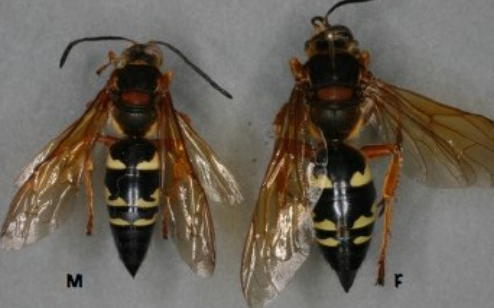
Digging Cicada Killer Wasps (Sphecius speciosus) are large, solitary wasps best known for their impressive hunting behavior and underground nesting habits. Despite their intimidating size and loud buzzing flight, these wasps are non-aggressive toward humans and are considered beneficial predators because they help regulate cicada populations.
These insects are commonly encountered in lawns, gardens, and sandy landscapes during the summer months, where their burrowing activity and territorial flight patterns often draw attention.
Quick Facts
- Common Name: Cicada Killer Wasp
- Scientific Name: Sphecius speciosus
- Family: Crabronidae
- Order: Hymenoptera
- Habitat: Sandy soil, lawns, gardens, open landscapes
- Diet: Adults feed on nectar; larvae feed on cicadas
- Status: Beneficial predator
Taxonomy and Classification
Cicada killer wasps belong to the family Crabronidae, a group commonly referred to as digger wasps. They are part of the order Hymenoptera, which also includes wasps, bees, and ants.
Unlike social wasps such as yellowjackets and hornets, cicada killers are solitary. Each female constructs and provisions her own nest rather than living in a colony.
Identification
Cicada killer wasps are among the largest wasps in North America, making them easy to identify.
- Size: Approximately 1.5 to 2 inches long
- Coloration: Reddish-brown head and thorax
- Abdomen: Black with bold yellow bands
- Wings: Transparent to slightly amber-colored
They are often mistaken for hornets due to their size and coloration, but their behavior is much less aggressive.
Important distinction:
- Females: Possess a stinger but rarely use it defensively
- Males: Cannot sting but may appear aggressive when defending territory
Distribution and Habitat
Cicada killer wasps are widely distributed across the United States, particularly in regions with warm summers and suitable soil conditions.
They prefer environments with:
- Loose, sandy, or well-drained soil
- Open, sunny areas
- Sparse vegetation or thin turf
Common nesting sites include:
- Lawns and garden beds
- Playgrounds and sandboxes
- Golf course edges
- Pathways and bare soil patches
Behavior and Life Cycle
Cicada killer wasps undergo complete metamorphosis with egg, larva, pupa, and adult stages.
The life cycle is closely tied to cicada availability:
- Females dig deep underground burrows with multiple chambers
- They hunt and paralyze cicadas using their sting
- Each chamber is provisioned with one or more cicadas
- An egg is laid on the immobilized prey
The larva hatches and feeds on the cicada, consuming it gradually while remaining protected underground. After feeding, it pupates and remains dormant until emerging as an adult the following summer.
There is typically one generation per year.
Feeding and Ecological Role
Adult cicada killer wasps feed on:
- Nectar
- Plant juices
Their larvae, however, depend entirely on cicadas as a food source.
This makes them important in controlling populations of cicadas, which can become abundant during emergence periods.
They contribute to ecological balance by acting as natural biological control agents.
Pest Status
Cicada killer wasps are not considered harmful pests. However, they may be viewed as nuisance insects due to:
- Large size and intimidating appearance
- Burrowing activity in lawns or gardens
- Presence in high-traffic outdoor areas
Their digging can create small soil mounds, but this rarely causes serious structural or landscape damage.
Management and Control
Control is generally not recommended due to their beneficial role.
| Strategy | Purpose | Benefit |
|---|---|---|
| Cultural Control | Modify soil conditions | Discourages nesting |
| Habitat Management | Maintain dense turf | Reduces suitable nesting sites |
| Observation | Monitor activity | Avoid unnecessary treatment |
In rare cases where control is necessary, efforts should focus on altering habitat rather than direct elimination.
Prevention
- Maintain thick, healthy turf in lawns
- Reduce areas of exposed sandy soil
- Water dry soil to make it less suitable for burrowing
- Avoid disturbing nesting areas unnecessarily
These measures help make environments less attractive for nesting females.
Related Articles
Conclusion
Digging cicada killer wasps are impressive and ecologically valuable insects that play a key role in controlling cicada populations. While their size and nesting behavior may cause concern, they are generally harmless and should be appreciated as beneficial members of the ecosystem.
In most cases, simple habitat management and understanding their behavior is all that is needed to coexist with these fascinating wasps.