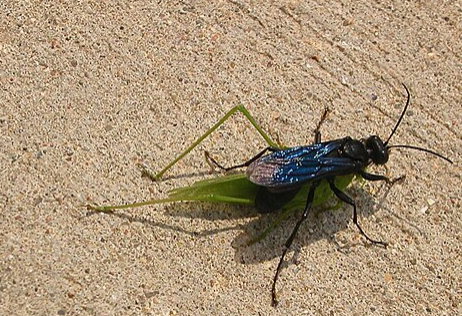
Digger Wasps is a broad common name applied to many species within the superfamily Apoidea (particularly the group Spheciformes) and the family Crabronidae. These wasps are solitary, meaning they do not form colonies like social wasps. Instead, each female independently constructs a burrow in the ground where she provisions her young. Digger wasps are generally considered beneficial insects because they prey on a wide range of pest species, paralyzing them and storing them as food for their larvae. They are rarely aggressive and typically only become a concern when their burrowing activity creates visible mounds in lawns or landscaped areas.
Taxonomy and Classification
Digger wasps represent a diverse grouping of species primarily within the families Crabronidae and Sphecidae. These insects belong to the order Hymenoptera, which also includes bees, ants, and other wasps. Like other members of this order, they undergo complete metamorphosis, progressing through egg, larval, pupal, and adult stages. What unites digger wasps behaviorally is their nesting strategy—each female constructs an individual burrow and provisions it with paralyzed prey for her offspring.
Physical Description
Digger wasps vary significantly in size, color, and form depending on the species. Some are quite small, while others—such as cicada killers—can reach lengths of up to 1.5 inches. Many species are black or feature black-and-yellow or black-and-white coloration, often resembling more aggressive social wasps. However, digger wasps are typically more slender and less robust than yellowjackets.
Their bodies are often adapted for excavation, with stout or spiny legs designed for digging. Many species, particularly those in the Sphecidae family, exhibit a long, narrow waist (petiole) between the thorax and abdomen. The female wasp is responsible for all nesting and hunting activities and is the only one capable of stinging. Larvae are soft, legless, grub-like organisms that remain within underground nest chambers until maturity.
Distribution and Habitat
Digger wasps are found worldwide and are especially common in warm, temperate regions. They prefer environments with dry, loose, sandy, or well-drained soil that is exposed to sunlight. Typical nesting sites include lawns, garden beds, playgrounds, golf course sand traps, dirt paths, and areas with sparse vegetation. Their presence is often seasonal and closely tied to the availability of prey such as caterpillars, flies, spiders, or cicadas.
Behavior and Life Cycle
Digger wasps generally produce one generation per year. The female begins by selecting a suitable nesting site and excavating a burrow in the soil, often creating a small mound of displaced dirt at the entrance. She then hunts for prey, stinging and paralyzing it without killing it, which preserves it as fresh food for her offspring.
Once prey is secured, the female transports it into the burrow and places it in a chamber. She lays a single egg on the paralyzed insect and seals the chamber. When the egg hatches, the larva consumes the prey. After feeding, the larva develops and overwinters in the burrow, pupating the following spring and emerging as an adult in summer.
Male digger wasps are often seen flying low over nesting areas, appearing aggressive as they patrol territories. However, males lack stingers and cannot sting, making them harmless despite their behavior.
Feeding and Conflict
Adult digger wasps feed primarily on nectar, contributing modestly to pollination. Their larvae, however, are carnivorous and depend entirely on the paralyzed prey provided by the female. This predatory behavior makes digger wasps valuable for natural pest control, as they help regulate populations of insects that can damage crops or landscapes.
Conflicts with humans typically arise when large numbers of wasps nest in a concentrated area. While each nest is solitary, multiple females may choose the same favorable location, leading to noticeable soil disturbance. These mounds can affect the appearance of lawns, golf courses, or landscaped areas. Although females are capable of stinging, they are generally non-aggressive and will only sting if handled or threatened.
Management and Prevention
Because digger wasps are beneficial and rarely pose a direct threat, control is usually unnecessary. However, management may be desired in high-traffic or highly maintained areas where burrowing activity is undesirable.
- Habitat Modification: Maintain dense, healthy turf through proper watering and fertilization. Moist, compact soil is less attractive for nesting compared to dry, loose soil.
- Soil Disturbance: Regularly raking, watering, or compacting soil in nesting areas can discourage females from establishing burrows.
- Targeted Treatment: If necessary, individual nests can be treated with insecticidal dust or aerosol applied directly into the burrow entrance after dark, when the female is likely inside. The opening should then be sealed.
Conservation and Research
Digger wasps are considered beneficial insects due to their role in controlling pest populations and contributing to ecological balance. They are also of scientific interest because of their complex hunting behaviors, navigation abilities, and nesting strategies. Conservation efforts emphasize minimizing unnecessary pesticide use and encouraging coexistence, particularly in natural and garden environments where their benefits outweigh their minor nuisances.