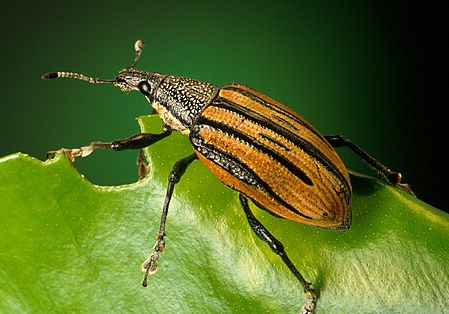
Diaprepes Root Weevils (Diaprepes abbreviatus) are highly destructive plant pests known for causing severe damage to citrus trees, ornamental plants, and a wide range of agricultural crops. Native to the Caribbean, these weevils have become a major invasive pest in parts of the United States, particularly in warm, subtropical regions such as Florida and Texas.
The greatest damage is caused by the larval stage, which feeds underground on plant roots. This hidden feeding can weaken or kill plants and make them more susceptible to soil-borne diseases, making Diaprepes root weevils a serious concern for both commercial agriculture and landscape management.
Quick Facts
- Common Name: Diaprepes Root Weevil
- Scientific Name: Diaprepes abbreviatus
- Family: Curculionidae
- Order: Coleoptera
- Habitat: Citrus groves, nurseries, ornamental landscapes
- Diet: Leaves (adults) and plant roots (larvae)
- Status: Major agricultural pest
Taxonomy and Classification
Diaprepes root weevils belong to the family Curculionidae, commonly known as weevils or snout beetles. This is one of the largest beetle families, containing thousands of plant-feeding species.
The genus Diaprepes includes several species, but D. abbreviatus is the most economically significant. Like other weevils, they possess a characteristic elongated snout (rostrum) used for feeding and egg-laying.
Identification
Adult Diaprepes weevils are relatively large compared to many other weevil species and are easily recognized by their colorful appearance.
- Size: Approximately 10–19 mm long
- Color: Variable; often black with orange, yellow, or gray markings
- Body Shape: Robust with a pronounced snout
The larvae are:
- White to cream-colored
- Legless (grub-like)
- Curved (C-shaped)
- Found in soil feeding on roots
Adults are typically found on foliage, while larvae remain hidden underground, making infestations difficult to detect early.
Distribution and Habitat
Originally native to the Caribbean, Diaprepes root weevils have spread to several regions of the United States, particularly:
- Florida
- Texas
- Other warm, subtropical environments
They are most commonly found in:
- Citrus groves
- Nurseries
- Ornamental landscapes
- Garden plantings
Their ability to infest a wide range of host plants makes them particularly difficult to manage in mixed agricultural and urban environments.
Behavior and Life Cycle
Diaprepes root weevils undergo complete metamorphosis consisting of egg, larva, pupa, and adult stages.
- Egg Stage: Eggs are laid in clusters between leaves, often glued together
- Larval Stage: After hatching, larvae drop to the soil and begin feeding on roots
- Pupal Stage: Pupation occurs in the soil
- Adult Stage: Adults emerge and feed on foliage before reproducing
The larval stage can last several months and is responsible for the most significant damage. Multiple generations may occur depending on environmental conditions.
Feeding and Damage
Damage from Diaprepes root weevils occurs in two distinct ways:
- Adult Feeding: Leaves show characteristic notching along the edges
- Larval Feeding: Larvae consume roots, including major structural roots
Root damage can lead to:
- Reduced water and nutrient uptake
- Plant stress and decline
- Increased susceptibility to fungal pathogens (such as root rot)
- Tree instability or death
In citrus production, infestations can cause significant economic losses due to reduced yields and tree mortality.
Pest Status
Diaprepes root weevils are classified as a major agricultural pest due to their:
- Wide host range
- Destructive root-feeding larvae
- Difficulty of early detection
- Potential to spread rapidly in warm climates
They are particularly problematic in commercial citrus operations and ornamental plant nurseries.
Management and Control
Effective management requires an integrated pest management (IPM) approach targeting both adults and larvae.
| Strategy | Purpose | Benefit |
|---|---|---|
| Monitoring | Detect adult feeding damage | Early identification of infestations |
| Biological Control | Use beneficial nematodes or fungi | Targets soil-dwelling larvae |
| Sanitation | Remove infested plant material | Reduces spread |
| Targeted Treatments | Apply insecticides when necessary | Controls severe infestations |
Biological control using entomopathogenic nematodes has shown effectiveness against larvae in soil environments.
Prevention
- Inspect nursery plants before planting
- Monitor foliage for feeding damage
- Maintain healthy soil and plant conditions
- Avoid introducing infested plant material
Preventative practices are essential, especially in regions where the pest is already established.
Related Articles
Conclusion
Diaprepes root weevils are among the most damaging invasive pests affecting citrus and ornamental plants in warm climates. Their hidden larval feeding on roots makes them particularly dangerous, as damage often goes unnoticed until plants begin to decline.
Through early detection, biological controls, and integrated management strategies, it is possible to reduce their impact and protect valuable crops and landscapes.