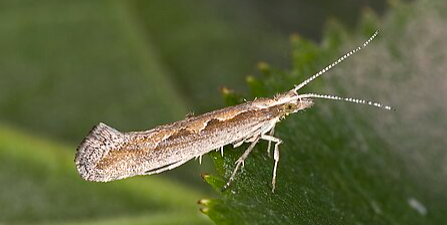
Diamondback Moths (Plutella xylostella) are among the most destructive and economically significant pests of cruciferous crops worldwide. These small moths are named for the distinctive diamond-shaped pattern formed along their backs when their wings are folded at rest. Their larvae are voracious feeders on plants in the cabbage family, including broccoli, kale, cauliflower, and mustard greens.
Due to their rapid reproduction, global distribution, and ability to develop resistance to many insecticides, diamondback moths are considered a major agricultural pest and a key target in integrated pest management (IPM) programs.
Quick Facts
- Common Name: Diamondback Moth
- Scientific Name: Plutella xylostella
- Family: Plutellidae
- Order: Lepidoptera
- Habitat: Gardens, agricultural fields, and vegetable crops
- Diet: Leaves of cabbage-family plants
- Status: Major agricultural pest
Taxonomy and Classification
The diamondback moth belongs to the family Plutellidae within the order Lepidoptera, which includes moths and butterflies. It is one of the most widely studied agricultural pests due to its economic importance and its ability to rapidly develop insecticide resistance.
It is closely related to other plant-feeding moths and shares similar larval feeding habits with many crop-damaging caterpillar species.
Identification
Diamondback moths are small, slender insects with subtle but distinctive markings.
- Adult Size: Approximately 6–8 mm long
- Color: Brown or gray with lighter markings
- Wing Pattern: Pale markings align to form diamond shapes when wings are folded
The larvae (caterpillars) are:
- Small and bright green
- Slender and tapered at both ends
- Highly active, often wriggling or dropping on silk threads when disturbed
Pupae are enclosed in delicate, loosely woven silk cocoons attached to leaves or stems.
Distribution and Habitat
Diamondback moths are cosmopolitan, meaning they are found worldwide wherever cruciferous crops are grown.
They are especially common in:
- Vegetable gardens
- Commercial crop fields
- Greenhouses
- Regions with warm growing seasons
They thrive in environments where host plants are continuously available.
Behavior and Life Cycle
Diamondback moths have a rapid life cycle that allows for multiple generations per year.
- Egg Stage: Eggs are laid singly or in small groups on leaves
- Larval Stage: Caterpillars feed actively on leaf tissue
- Pupal Stage: Pupation occurs in silk cocoons attached to foliage
- Adult Stage: Moths emerge and reproduce quickly
Under favorable conditions, the entire life cycle can be completed in 2–4 weeks, leading to explosive population growth.
Adults are weak fliers but can disperse widely through wind currents.
Feeding and Damage
The larval stage is responsible for all plant damage.
Feeding behavior includes:
- Leaf Mining (early stage): Young larvae feed inside leaf tissue
- Surface Feeding: Older larvae chew holes and skeletonize leaves
Common damage symptoms include:
- Small irregular holes in leaves
- “Windowpane” feeding where leaf tissue is partially eaten
- Skeletonized foliage
- Reduced plant vigor and yield
Severe infestations can result in:
- Complete defoliation of crops
- Contamination of produce
- Significant economic losses
Pest Status
Diamondback moths are classified as a major agricultural pest due to their:
- High reproductive rate
- Multiple generations per season
- Global distribution
- Resistance to many insecticides
They are particularly problematic in commercial agriculture where consistent crop production creates ideal conditions for population buildup.
Management and Control
Effective control requires an integrated pest management (IPM) approach.
| Strategy | Purpose | Benefit |
|---|---|---|
| Monitoring | Track population levels | Enables early intervention |
| Biological Control | Use natural predators and parasitoids | Reduces reliance on chemicals |
| Crop Rotation | Interrupt life cycle | Prevents buildup in fields |
| Targeted Treatments | Apply selective controls | Limits resistance development |
Biological agents such as parasitic wasps are often used to help control populations naturally.
Prevention
- Use row covers to protect crops
- Remove crop debris after harvest
- Rotate crucifer crops each season
- Inspect plants regularly for early signs of infestation
Preventative measures are essential to reduce population buildup before damage becomes severe.
Related Articles
Conclusion
Diamondback moths are one of the most challenging pests in vegetable production due to their adaptability, rapid life cycle, and resistance to control measures. Their larvae can quickly damage cruciferous crops, leading to reduced yield and quality.
By combining monitoring, biological control, and cultural practices, growers can effectively manage populations and protect crops from severe infestations.