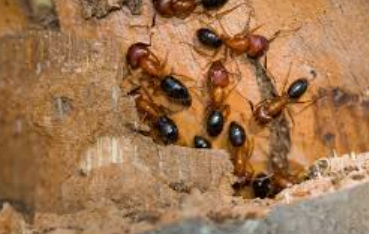
Destructive Wood Ants is a general term commonly used to describe ant species that damage wood structures, most notably Carpenter Ants (Camponotus spp.). Unlike termites, these ants do not consume wood; instead, they excavate tunnels and galleries to create nesting sites. Over time, this activity weakens structural wood in homes, decks, and trees, making them significant structural pests.
Infestations can go unnoticed for extended periods, especially when colonies are hidden inside walls or structural voids. Their presence is often only discovered after visible damage or the appearance of winged ants indoors.
Taxonomy and Classification
- Common Name: Destructive Wood Ants (Carpenter Ants)
- Genus: Camponotus
- Order: Hymenoptera
- Family: Formicidae
- Type: Structural wood-excavating pest
Carpenter ants are social insects that form colonies consisting of queens, workers, and reproductive individuals. They undergo complete metamorphosis (egg, larva, pupa, adult).
Identification
Carpenter ants are among the largest ants found in North America.
- Workers: Typically 1/4 to 5/8 inch long
- Color: Black, red and black, or brown depending on species
- Thorax: Smoothly rounded when viewed from the side
- Petiole: Single node between thorax and abdomen
- Antennae: Elbowed
Winged reproductives (alates) are often seen during swarming:
- Wings: Two pairs, with forewings larger than hindwings
- Size: Larger than worker ants
Larvae are legless, white, and grub-like, remaining inside the nest.
Distribution and Habitat
Destructive wood ants are found worldwide and are especially common in forested and suburban environments.
Preferred nesting sites include:
- Moist or decaying wood
- Tree stumps and logs
- Wall voids near plumbing leaks
- Window frames, decks, and roof structures
Colonies often consist of a parent nest outdoors and satellite nests indoors, making infestations difficult to eliminate completely.
Behavior and Life Cycle
Colonies begin with a single queen and may take several years to mature.
Key behavioral traits include:
- Nocturnal Foraging: Workers are most active at night
- Excavation: Tunnels are carved smoothly along wood grain
- Frass Production: Sawdust-like material mixed with insect parts is expelled from nests
- Swarming: Winged ants emerge in spring or early summer to reproduce
Colonies can persist for years and expand through satellite nesting.
Feeding and Damage
Carpenter ants do not feed on wood but cause damage through excavation.
- Gallery Formation: Hollow tunnels weaken structural wood
- Frass Accumulation: Piles of debris indicate active nesting
- Structural Weakening: Long-term infestations compromise integrity
- Clean Tunnels: Galleries appear smooth and sanded (unlike termite damage)
Damage can become severe if infestations remain untreated over long periods.
Management and Control
Effective control requires locating and eliminating all colonies.
| Strategy | Purpose | Benefit |
|---|---|---|
| Moisture Control | Repair leaks and reduce humidity | Eliminates preferred nesting conditions |
| Wood Management | Remove decaying wood and debris | Reduces nesting sites |
| Baiting | Use slow-acting toxic baits | Targets entire colony, including queen |
| Targeted Treatments | Apply insecticides in wall voids | Provides immediate localized control |
Baiting is often the most effective long-term solution for eliminating entire colonies.
Prevention
- Fix leaks and eliminate excess moisture
- Store firewood away from structures
- Seal cracks and entry points
- Maintain proper drainage around foundations
- Inspect structures regularly for signs of infestation
Preventative maintenance is critical to avoiding costly structural damage.
Related Articles
Conclusion
Destructive wood ants, particularly carpenter ants, are serious structural pests that compromise wood through excavation rather than consumption. Their hidden nesting habits and long colony lifespans make them challenging to control.
By addressing moisture issues, removing nesting sites, and using targeted control methods, infestations can be effectively managed, helping to protect homes and structures from long-term damage.