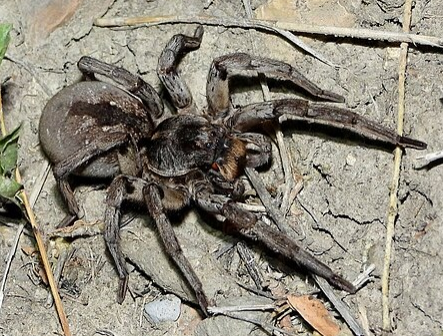
Desert Wolf Spiders (family Lycosidae, commonly including species in the genus Hogna) are fast-moving, ground-dwelling hunting spiders found throughout arid and semi-arid regions of North America. Unlike web-building spiders, they are active predators that chase and capture prey on foot, making them highly effective natural pest controllers in desert ecosystems. :contentReference[oaicite:0]{index=0}
Although their size and speed can make them appear intimidating, desert wolf spiders are generally non-aggressive and play a critical role in controlling insect populations, including crickets, roaches, and other nuisance pests commonly found in desert environments. :contentReference[oaicite:1]{index=1}
Quick Facts
- Common Name: Desert Wolf Spider
- Family: Lycosidae
- Order: Araneae
- Habitat: Deserts, gardens, lawns, and rocky terrain
- Diet: Insects and small arthropods
- Status: Beneficial predator
Taxonomy and Classification
Desert wolf spiders belong to the family Lycosidae, a group of spiders known for their cursorial (running) hunting behavior. They are part of the class Arachnida, which includes other arthropods such as scorpions, mites, and ticks.
They are closely related to other spiders, but differ significantly in that they do not rely on webs for prey capture. Instead, they depend on speed, vision, and ambush tactics.
Many desert species, including the Hogna genus, are considered among the largest wolf spiders in North America. :contentReference[oaicite:2]{index=2}
Identification
Desert wolf spiders are medium to large spiders with a rugged, well-camouflaged appearance.
- Color: Brown, gray, tan, or mottled patterns
- Body: Robust and low to the ground
- Legs: Long, strong, and adapted for running
- Eyes: Distinctive three-row arrangement with large forward-facing eyes
Key identification features include:
- Eye Shine: Their eyes reflect light at night, making them visible with a flashlight
- No Webs: They do not build capture webs
- Fast Movement: Capable of rapid bursts of speed when hunting
Females are often observed carrying egg sacs attached to their abdomen, and later, spiderlings may be seen riding on their backs. :contentReference[oaicite:3]{index=3}
Distribution and Habitat
Desert wolf spiders are widely distributed across the Southwestern United States, including Arizona, Nevada, and New Mexico, as well as other dry regions of North America.
They are commonly found in:
- Desert soils and open terrain
- Gardens and landscaped areas
- Under rocks, logs, and debris
- Burrows or natural crevices
During the day, they typically remain hidden to avoid heat, becoming active at night when temperatures drop. :contentReference[oaicite:4]{index=4}
Behavior and Life Cycle
Desert wolf spiders exhibit unique behaviors compared to other spiders.
- Nocturnal Hunting: Actively hunt prey at night
- Burrowing: Use burrows or sheltered areas to escape extreme heat
- Ambush Strategy: Wait for or chase down prey instead of trapping it
Their life cycle includes:
- Egg Stage: Eggs are carried in a sac by the female
- Spiderlings: Hatch and ride on the mother’s back
- Adult Stage: Mature spiders hunt independently
This maternal care is a defining trait of wolf spiders and increases survival rates of offspring. :contentReference[oaicite:5]{index=5}
Feeding and Ecological Role
Desert wolf spiders are important biological control agents in desert ecosystems.
- Primary Diet: Crickets, beetles, roaches, and other insects
- Secondary Prey: Smaller arthropods, occasionally including young scorpions
They help regulate populations of nuisance and potentially harmful pests, making them a valuable part of natural integrated pest management (IPM). :contentReference[oaicite:6]{index=6}
Pest Status
Desert wolf spiders are considered beneficial predators rather than pests.
They may become a concern when:
- They accidentally enter homes while hunting
- They are seen frequently in yards or garages
However, they:
- Are not aggressive toward humans
- Rarely bite
- Have venom that is generally medically insignificant
Their presence often indicates a healthy ecosystem with available insect prey.
Management and Control
Management focuses on exclusion and environmental control rather than elimination.
| Strategy | Purpose | Benefit |
|---|---|---|
| Exclusion | Seal cracks and entry points | Prevents indoor entry |
| Prey Reduction | Limit insect populations | Reduces attraction |
| Habitat Management | Remove debris and clutter | Eliminates hiding spots |
| Relocation | Safely move spiders outdoors | Preserves beneficial role |
Direct chemical control is generally unnecessary and not recommended.
Prevention
- Seal cracks around doors, windows, and foundations
- Reduce outdoor lighting that attracts insects
- Remove debris, woodpiles, and clutter near structures
- Maintain clean, well-managed landscaping
These measures help minimize encounters while maintaining their ecological benefits.
Related Articles
Conclusion
Desert wolf spiders are essential predators in arid ecosystems, helping control insect populations and maintain ecological balance. Although they may appear intimidating, they are harmless to humans and rarely require intervention.
By understanding their behavior and implementing simple exclusion practices, homeowners can coexist with these beneficial spiders while minimizing unwanted indoor encounters.