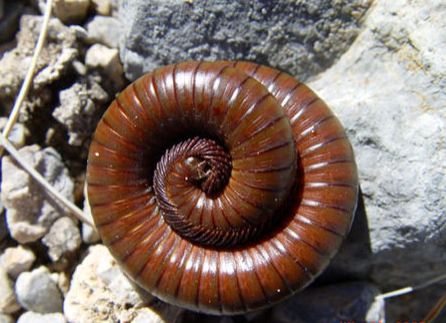
Desert Millipedes (class Diplopoda) are soil-dwelling arthropods that function as important decomposers in arid and semi-arid ecosystems. They feed primarily on decaying organic material, helping break down plant debris and recycle nutrients back into the soil. While they are harmless to humans and beneficial to the environment, they may occasionally become nuisance pests when they gather in large numbers near homes or enter buildings during periods of increased moisture.
Unlike predatory arthropods, desert millipedes are slow-moving scavengers that contribute to soil health and ecosystem balance.
Quick Facts
- Common Name: Desert Millipedes
- Class: Diplopoda
- Phylum: Arthropoda
- Habitat: Soil, mulch, leaf litter, and organic debris
- Diet: Decaying plant material and organic matter
- Status: Beneficial decomposer; occasional nuisance
Taxonomy and Classification
Desert millipedes belong to the class Diplopoda, a group of arthropods characterized by their many body segments and numerous legs. They are distinct from insects and are more closely related to other multi-legged arthropods.
They are often compared to centipedes, but differ significantly in behavior and anatomy. Millipedes are detritivores (feed on dead material), while centipedes are predators.
Millipedes develop through gradual growth, adding body segments and legs with each molt.
Identification
Desert millipedes have a distinctive elongated, segmented body.
- Body Shape: Cylindrical and elongated
- Segments: Each segment typically has two pairs of legs
- Color: Brown, black, reddish, or tan depending on species
- Movement: Slow, steady crawling
Key identifying behaviors include:
- Curling into a tight spiral when disturbed
- Releasing a mild defensive secretion in some species
This defensive posture helps protect them from predators.
Distribution and Habitat
Desert millipedes are found in arid and semi-arid regions where suitable microhabitats provide moisture and organic material.
Common habitats include:
- Soil and sandy substrates
- Mulch beds and landscaping
- Leaf litter and compost piles
- Under rocks, logs, and debris
Although deserts are generally dry, millipedes seek out moist pockets where decomposition occurs.
Behavior and Life Cycle
Desert millipedes are primarily nocturnal and avoid direct sunlight to prevent dehydration.
- Egg Stage: Eggs are laid in protected soil environments
- Juveniles: Hatch with fewer segments and legs
- Adults: Grow through multiple molts, adding segments over time
Their development is gradual, and they may live for several years depending on environmental conditions.
During periods of rainfall or increased humidity, millipedes may become more active and visible.
Feeding and Ecological Role
Desert millipedes are decomposers that feed on organic matter.
- Decaying leaves and plant debris
- Dead roots and vegetation
- Fungi and microorganisms
Their feeding activity contributes to:
- Nutrient recycling in soil
- Improved soil structure
- Decomposition of organic waste
They are an essential part of healthy soil ecosystems and support plant growth indirectly.
Pest Status
Desert millipedes are generally considered beneficial organisms. However, they may become nuisance pests under certain conditions.
They may be noticed when:
- Large numbers gather near buildings
- Moist conditions drive them toward structures
- They accidentally enter homes, garages, or basements
They do not:
- Bite or sting
- Damage structures
- Infest food sources
Any indoor presence is usually temporary and related to environmental conditions.
Management and Control
Control efforts focus on habitat modification and exclusion rather than chemical treatment.
| Strategy | Purpose | Benefit |
|---|---|---|
| Moisture Control | Reduce damp conditions | Discourages millipede activity |
| Debris Removal | Eliminate organic material | Reduces food sources |
| Exclusion | Seal entry points | Prevents indoor access |
| Landscape Management | Adjust mulch and soil conditions | Limits habitat suitability |
Chemical treatments are rarely necessary and typically provide only temporary relief.
Prevention
- Reduce mulch and organic debris near foundations
- Improve drainage and eliminate standing moisture
- Seal cracks, gaps, and entry points around structures
- Keep landscaping well-maintained and dry near the home
Preventative measures are highly effective in minimizing nuisance activity.
Related Articles
Conclusion
Desert millipedes are essential decomposers that play a vital role in maintaining soil health and ecological balance. While they may occasionally become a nuisance near homes, they pose no threat to people or structures.
Through proper moisture management, sanitation, and exclusion practices, their presence can be minimized while still benefiting from their important role in the environment.