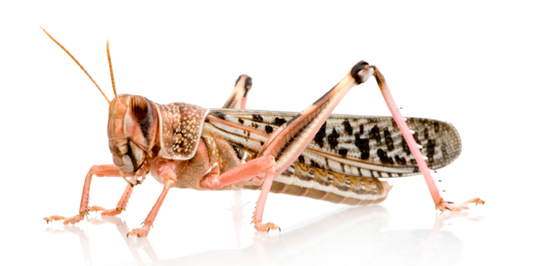
Desert Locusts (Schistocerca gregaria) are among the most destructive migratory insect pests in the world. Native to arid and semi-arid regions of Africa, the Middle East, and parts of Asia, these insects are capable of forming massive swarms that travel hundreds of miles and consume vast amounts of vegetation in a short period of time.
In their normal, solitary phase, desert locusts resemble typical grasshoppers and cause minimal damage. However, when environmental conditions such as rainfall and vegetation growth favor population expansion, they undergo a dramatic transformation into a gregarious (swarming) phase. During this phase, they become highly mobile, aggressive feeders that can devastate crops and natural ecosystems.
Quick Facts
- Common Name: Desert Locust
- Scientific Name: Schistocerca gregaria
- Family: Acrididae
- Order: Orthoptera
- Habitat: Arid and semi-arid regions
- Diet: Leaves, crops, grasses, and vegetation
- Status: Major agricultural pest
Taxonomy and Classification
Desert locusts belong to the family Acrididae, the same group as grasshoppers. What distinguishes locusts from typical grasshoppers is their ability to undergo phase polyphenism—a biological phenomenon where behavior, appearance, and physiology change based on population density.
This adaptability allows desert locusts to shift from harmless individuals into one of the most destructive swarm-forming pests known to agriculture.
Identification
Desert locusts resemble large grasshoppers but exhibit different characteristics depending on their phase:
- Solitary Phase: Brown or green, relatively inactive, avoids other locusts
- Gregarious Phase: Yellow and black (adults), pink or orange (nymphs), highly active and social
General features include:
- Long hind legs for powerful jumping
- Strong wings for sustained flight
- Robust body adapted for migration
Color changes are one of the most visible indicators of their transition into swarm behavior.
Distribution and Habitat
Desert locusts are found across a vast region known as the “locust belt”, which spans:
- North and East Africa
- The Arabian Peninsula
- Southwest Asia (including India and Pakistan)
They thrive in arid and semi-arid environments, where periodic rainfall creates temporary vegetation that supports breeding and population growth.
When swarms form, they can migrate across continents, crossing borders and affecting multiple countries.
Behavior and Life Cycle
Desert locusts undergo incomplete metamorphosis with three main stages:
- Egg: Laid in moist sandy soil in pods
- Nymph (Hopper): Wingless stage that forms bands and marches across land
- Adult: Winged stage capable of long-distance flight
Under favorable conditions, the life cycle can be completed in as little as 2–4 months, allowing rapid population growth.
Key behavioral traits include:
- Swarm Formation: Triggered by crowding and environmental cues
- Migration: Swarms can travel up to 100 miles per day
- Coordinated Feeding: Large groups consume vegetation simultaneously
Feeding and Damage
Desert locusts are voracious herbivores that consume nearly all types of vegetation.
They feed on:
- Cereal crops (wheat, barley, maize)
- Vegetables
- Fruit trees
- Grasses and pastureland
Damage caused by locust swarms includes:
- Complete defoliation of crops
- Destruction of pasture for livestock
- Loss of food security in affected regions
A single swarm can contain billions of locusts and consume as much food in one day as thousands of people.
Pest Status
Desert locusts are classified as one of the most serious agricultural pests globally. Their ability to form massive swarms and travel long distances makes them especially difficult to control.
They pose significant threats to:
- Food production systems
- Rural economies
- Livestock grazing areas
Outbreaks can escalate quickly and require immediate response to prevent widespread damage.
Management and Control
Effective control of desert locusts requires large-scale coordination and early intervention.
| Strategy | Purpose | Benefit |
|---|---|---|
| Monitoring | Track populations and environmental conditions | Early detection of outbreaks |
| Ground Control | Target hopper bands | Prevents swarm formation |
| Aerial Spraying | Treat large swarms | Rapid population reduction |
| International Coordination | Share data and resources | Improves response efficiency |
Controlling locusts at the early nymph (hopper) stage is the most effective method, as swarms are much harder to manage once formed.
Prevention
- Monitor rainfall and vegetation growth patterns
- Identify and track breeding areas
- Coordinate regional surveillance programs
- Respond quickly to early population increases
Preventative strategies rely heavily on early warning systems and international cooperation.
Related Articles
Conclusion
Desert locusts are one of the most formidable insect pests due to their ability to transform from solitary individuals into massive, crop-devouring swarms. Their impact on agriculture and food security is significant, particularly in regions already vulnerable to environmental challenges.
Through early detection, coordinated management, and international collaboration, the risks posed by desert locust outbreaks can be reduced, helping to protect crops and sustain ecosystems in affected regions.