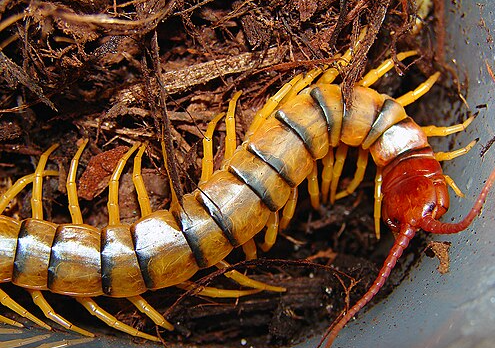
Desert Centipedes are fast-moving, predatory arthropods in the class Chilopoda that are commonly found in arid and semi-arid environments. These elongated, multi-legged hunters are highly effective predators, feeding on insects and other small animals using venom delivered through specialized appendages called forcipules.
Although their appearance can be intimidating, desert centipedes are generally beneficial predators that help control populations of nuisance insects. They are most often encountered outdoors but may occasionally wander indoors in search of prey or moisture.
Quick Facts
- Common Name: Desert Centipedes
- Class: Chilopoda
- Phylum: Arthropoda
- Habitat: Deserts, rocky areas, gardens, and sheltered debris
- Diet: Insects, spiders, and other small arthropods
- Status: Beneficial predator
Taxonomy and Classification
Desert centipedes belong to the class Chilopoda, which includes all centipede species. They are distinct from insects and belong to a separate group of arthropods characterized by their many segmented bodies and numerous legs.
They are closely related to other ground-dwelling arthropods such as millipedes, although centipedes differ significantly in behavior and diet, being active predators rather than decomposers.
Unlike insects, centipedes develop through simple metamorphosis, gradually growing larger through a series of molts.
Identification
Desert centipedes are easily recognized by their elongated bodies and numerous legs.
- Body Shape: Long, flattened, and segmented
- Legs: One pair per body segment
- Color: Tan, reddish-brown, or yellowish depending on species
- Antennae: Long and highly sensitive
Key features include:
- Forcipules: Modified front legs used to inject venom
- Speed: Extremely fast movement when disturbed
- Flexibility: Ability to navigate tight spaces
Some larger desert species, such as giant centipedes, can reach several inches in length and are more noticeable to homeowners.
Distribution and Habitat
Desert centipedes are widely distributed across arid and semi-arid regions, including the southwestern United States.
They are commonly found in:
- Under rocks and logs
- Landscape debris and mulch
- Cracks in soil or foundations
- Gardens and yard edges
They prefer cool, sheltered environments during the day and emerge at night to hunt.
Behavior and Life Cycle
Desert centipedes are solitary and primarily nocturnal hunters.
- Egg Stage: Females lay eggs in protected soil environments
- Juveniles: Hatch resembling miniature adults
- Growth: Develop through successive molts
- Adults: Continue hunting and reproducing
Unlike many insects, young centipedes resemble adults and gradually increase in size with each molt.
They rely heavily on their antennae and body sensitivity to detect vibrations and locate prey.
Feeding and Ecological Role
Desert centipedes are active predators that help regulate insect populations.
- Primary Prey: Insects such as beetles, crickets, and roaches
- Other Prey: Spiders and small arthropods
They capture prey by:
- Grasping with their front appendages
- Injecting venom to immobilize the prey
- Consuming the subdued animal
This predatory behavior makes them valuable in maintaining ecological balance.
Pest Status
Desert centipedes are generally considered beneficial rather than pests.
However, they may be viewed as nuisances when:
- They enter homes or buildings
- Their appearance startles occupants
- They are found in living areas
While most species are not aggressive, they can deliver a painful bite if handled or threatened, though serious medical effects are rare.
Management and Control
Control typically focuses on habitat reduction and exclusion rather than chemical treatment.
| Strategy | Purpose | Benefit |
|---|---|---|
| Clutter Reduction | Remove hiding places | Decreases habitat suitability |
| Exclusion | Seal cracks and entry points | Prevents indoor access |
| Moisture Control | Reduce damp areas | Limits attraction to structures |
| Prey Reduction | Control insect populations | Removes food sources |
Direct control measures are rarely necessary unless centipedes are frequently entering indoor spaces.
Prevention
- Remove debris, rocks, and woodpiles near the home
- Seal foundation cracks and gaps
- Reduce outdoor lighting that attracts insects
- Maintain clean and dry conditions around structures
Preventative steps are effective in reducing both centipedes and their prey.
Related Articles
Conclusion
Desert centipedes are efficient and beneficial predators that play an important role in controlling insect populations in arid environments. While their appearance and speed can be unsettling, they are generally harmless when left undisturbed.
By managing habitat conditions and reducing entry points, homeowners can minimize encounters while still benefiting from these natural pest controllers.