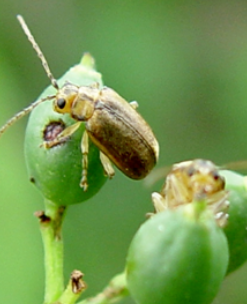
Defoliating Leaf Beetles are a broad group of plant-feeding beetles in the family Chrysomelidae known for their ability to consume foliage and, in some cases, cause severe defoliation of crops, ornamental plants, and trees. While many species exist as minor plant feeders, others can reach outbreak levels and strip entire plants of leaves, significantly impacting plant health and productivity.
Notable pest species include the Elm Leaf Beetle, Viburnum Leaf Beetle, and Cottonwood Leaf Beetle, all of which are capable of causing extensive damage during peak population periods. Their feeding behavior, particularly leaf skeletonization, makes their presence highly visible and often alarming to homeowners and growers.
Quick Facts
- Common Name: Defoliating Leaf Beetles
- Family: Chrysomelidae
- Order: Coleoptera
- Habitat: Gardens, forests, agricultural fields, and ornamental landscapes
- Diet: Plant foliage
- Status: Plant pest (some species highly destructive)
Taxonomy and Classification
Defoliating leaf beetles belong to the family Chrysomelidae, one of the largest beetle families, containing thousands of species worldwide. Members of this family are highly specialized herbivores, often adapted to feed on specific plant hosts.
They are part of the larger group of beetles and are closely associated with garden pests due to their plant-feeding behavior.
Like all beetles, they undergo complete metamorphosis with four life stages: egg, larva, pupa, and adult.
Identification
Defoliating leaf beetles vary widely in appearance depending on the species.
- Adults: Small to medium-sized, oval or rounded
- Coloration: Metallic green, blue, yellow, striped, or mottled
- Body Shape: Compact and smooth
The larvae are often soft-bodied and may appear grub-like or caterpillar-like:
- Appearance: Elongated, sometimes warty or coated in protective secretions
- Behavior: Feed openly on leaf surfaces
Both life stages contribute to plant damage, making infestations particularly impactful.
Distribution and Habitat
Defoliating leaf beetles are found worldwide across nearly all terrestrial ecosystems. They are especially common in:
- Home gardens and landscapes
- Agricultural crop fields
- Forests and tree canopies
- Ornamental plantings
Many species are host-specific, feeding on particular plant families, while others are more generalist feeders.
Behavior and Life Cycle
The life cycle of defoliating leaf beetles typically progresses rapidly under favorable conditions.
- Egg Stage: Eggs are laid on or near host plant leaves
- Larval Stage: Larvae feed intensively on foliage
- Pupal Stage: Pupation occurs in soil or on plant surfaces
- Adult Stage: Adults emerge and continue feeding and reproduction
Some species produce multiple generations per year, leading to repeated feeding cycles and increased damage pressure on plants.
Feeding and Damage
Defoliating leaf beetles are known for their distinctive feeding patterns.
- Skeletonization: Consuming soft tissue between leaf veins
- Hole Feeding: Creating irregular holes in leaves
- Complete Defoliation: Stripping leaves during heavy infestations
Common symptoms include:
- Brown, lace-like leaf remnants
- Curling and premature leaf drop
- Reduced plant vigor and growth
While a single season of damage may not kill a healthy plant, repeated defoliation can:
- Weaken trees and shrubs
- Reduce crop yields
- Increase vulnerability to drought and disease
- Invite secondary pests such as wood-boring insects
Pest Status
Defoliating leaf beetles are considered significant plant pests, especially in agricultural and ornamental settings.
They can impact:
- Shade and ornamental trees
- Vegetable and field crops
- Landscape shrubs and plants
Outbreak populations can cause widespread and highly visible damage.
Management and Control
Effective management combines monitoring and environmentally responsible control methods.
| Strategy | Purpose | Benefit |
|---|---|---|
| Monitoring | Detect early infestations | Prevents severe damage |
| Pruning | Remove infested leaves | Reduces population growth |
| Biological Control | Encourage predators | Natural population suppression |
| Targeted Treatments | Apply neem oil or Bt products | Controls larvae with minimal impact |
In some cases, trap cropping—planting preferred host plants to attract beetles away from valuable crops—can be an effective strategy.
Prevention
- Inspect plants regularly during the growing season
- Maintain plant health through proper watering and fertilization
- Remove plant debris where beetles may overwinter
- Encourage beneficial insects such as lady beetles and predatory wasps
Healthy plants are more resilient and better able to recover from feeding damage.
Related Articles
Conclusion
Defoliating leaf beetles are a diverse and often destructive group of plant-feeding insects capable of causing significant foliage loss. While many species are minor nuisances, others can rapidly escalate into serious pests, particularly when multiple generations occur in a single season.
Through early detection, proper plant care, and integrated pest management strategies, their impact can be minimized while preserving beneficial insects and maintaining healthy landscapes.