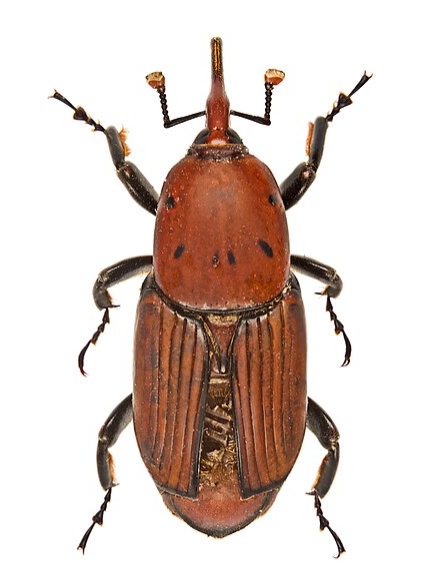
Date Palm Weevils are large, destructive snout beetles in the family Dryophthoridae that attack a wide range of palm species. The most notorious species, including the red palm weevil (Rhynchophorus ferrugineus), are among the most serious pests of palms worldwide. Their larvae tunnel deep inside palm trunks and crowns, feeding on internal tissues and causing severe structural damage.
Because feeding occurs inside the palm, infestations often go unnoticed until significant decline has already occurred. In ornamental landscapes, nurseries, and commercial palm production, date palm weevils are considered high-impact pests capable of killing mature trees.
Quick Facts
- Common Name: Date Palm Weevils
- Family: Dryophthoridae
- Order: Coleoptera
- Habitat: Palm groves, nurseries, landscapes, and irrigated regions
- Diet: Internal palm tissue (trunk, crown, and growing points)
- Status: Serious palm pest
Taxonomy and Classification
Date palm weevils belong to the beetle family Dryophthoridae, a group of weevils known for attacking woody plants and stored products. Within this family, the genus Rhynchophorus contains several destructive palm pests.
They are part of the broader group of weevils, which are characterized by their elongated snouts and plant-feeding behavior.
Like other beetles, they undergo complete metamorphosis, developing through egg, larva, pupa, and adult stages.
Identification
Adult date palm weevils are large and easily recognizable compared to most beetles.
- Size: 2–5 cm long
- Color: Reddish-brown to dark brown
- Body: Robust and elongated
- Snout: Long, curved rostrum used for feeding and egg-laying
The larvae are the most destructive stage:
- Appearance: Cream-colored, legless grubs
- Habitat: Hidden inside palm tissue
- Behavior: Continuous internal feeding
Because larvae remain concealed, infestations are often detected only through indirect symptoms such as:
- Oozing sap or fermented odors
- Frass (chewed plant material) at entry points
- Wilting or collapsing crown leaves
- Structural weakening of the trunk
Distribution and Habitat
Date palm weevils are most common in warm climates where palms are widely cultivated. They are a major concern in regions with ornamental landscaping, date production, or nursery industries.
Typical habitats include:
- Date palm plantations
- Urban and suburban landscapes
- Nursery production facilities
- Irrigated desert and tropical environments
They are especially problematic in areas where palms are stressed, damaged, or improperly maintained.
Behavior and Life Cycle
The life cycle of date palm weevils is closely tied to the availability of suitable palm hosts.
- Egg Stage: Females lay eggs in wounds, cracks, or soft tissue
- Larval Stage: Grubs tunnel through internal tissues
- Pupal Stage: Pupation occurs within fibrous plant material
- Adult Stage: Adults emerge and disperse to new hosts
Females can lay hundreds of eggs, allowing populations to increase rapidly. Adults are capable of flying significant distances, spreading infestations across landscapes.
The hidden larval stage is responsible for most damage, often continuing undetected for extended periods.
Feeding and Damage
Date palm weevil larvae feed on internal palm tissue, causing extensive structural damage.
- Internal Tunneling: Weakens trunk and crown
- Crown Damage: Leads to leaf collapse and death of growing points
- Structural Failure: Trees may become unstable or fall
- Secondary Issues: Attracts pathogens and accelerates decay
Because feeding occurs internally, visible symptoms often appear only after severe damage has already occurred.
Pest Status
Date palm weevils are classified as major palm pests due to their ability to kill trees and cause significant economic losses.
They are particularly damaging in:
- Commercial date production
- High-value ornamental landscapes
- Nursery stock and transplant operations
Infested palms may require removal, which can be costly and labor-intensive.
Management and Control
Effective management depends heavily on early detection and integrated strategies.
| Strategy | Purpose | Benefit |
|---|---|---|
| Regular Inspection | Identify early symptoms | Prevents severe damage |
| Sanitation | Remove infested material | Stops spread to nearby trees |
| Wound Prevention | Avoid unnecessary pruning injuries | Reduces egg-laying sites |
| Professional Treatment | Use targeted pest control methods | Improves success in severe cases |
Because infestations are hidden, professional diagnosis and treatment are often required.
Prevention
- Avoid damaging palm trunks and crowns during maintenance
- Inspect regularly for early warning signs
- Maintain proper irrigation and plant health
- Remove and dispose of heavily infested palms quickly
Healthy palms are less attractive and more resilient to infestation.
Related Articles
Conclusion
Date palm weevils are among the most destructive pests of palm trees, capable of causing severe internal damage that often goes unnoticed until it is too late. Their hidden feeding behavior and ability to spread quickly make them a serious concern in both ornamental and agricultural settings.
Early detection, proper maintenance, and integrated management strategies are essential for protecting palms and preventing widespread damage in affected areas.