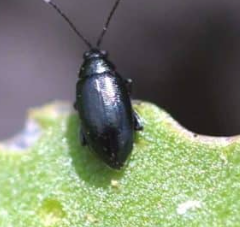
Dandelion Flea Beetles are small, jumping beetles in the family Chrysomelidae that are commonly associated with dandelions and other low-growing broadleaf plants. Like other flea beetles, they are named for their enlarged hind legs, which allow them to leap rapidly when disturbed. These insects are typically considered minor plant pests, but their feeding damage can become noticeable in lawns, gardens, and unmanaged landscape areas where host plants are abundant.
While rarely destructive enough to warrant aggressive control, dandelion flea beetles can cause cosmetic damage to foliage and may become a nuisance when populations are high.
Quick Facts
- Common Name: Dandelion Flea Beetles
- Family: Chrysomelidae
- Order: Coleoptera
- Habitat: Lawns, gardens, field edges, and weedy areas
- Diet: Leaves of dandelions and similar plants
- Status: Minor plant pest
Taxonomy and Classification
Dandelion flea beetles belong to the large leaf beetle family Chrysomelidae, specifically within the group commonly known as flea beetles (tribe Alticini). This group includes many species that feed on a wide range of host plants, including vegetables, ornamentals, and weeds.
They undergo complete metamorphosis, progressing through egg, larval, pupal, and adult stages. Many flea beetle species are host-specific or show strong preferences for certain plant families, including those commonly found in lawns and disturbed soils.
Identification
Dandelion flea beetles are very small, oval-shaped beetles that can be difficult to spot until disturbed.
- Size: Typically 1.5–3 mm long
- Shape: Oval and compact
- Color: Dark brown, black, or slightly metallic
- Movement: Rapid jumping when disturbed
Their most distinctive feature is their enlarged hind legs, which function like springs, allowing them to leap away quickly.
Adults are responsible for visible plant damage, creating small pits or holes in leaves, often described as a “shot-hole” appearance. This feeding pattern is typical of many beetles that chew plant tissue.
Larvae are less commonly observed. They are small, soft-bodied, and usually live in the soil near plant roots.
Distribution and Habitat
Dandelion flea beetles are found throughout North America and other temperate regions wherever suitable host plants are present.
Common habitats include:
- Lawns with dandelion infestations
- Garden beds and ornamental landscapes
- Field edges and open lots
- Disturbed soils and weedy areas
They thrive in areas where weeds are allowed to grow freely, especially during warm weather when plant growth is vigorous.
Behavior and Life Cycle
Dandelion flea beetles typically complete one or more generations per year, depending on climate and environmental conditions.
- Egg Stage: Eggs are laid in soil near host plants.
- Larval Stage: Larvae feed on roots or organic material near the plant base.
- Pupal Stage: Pupation occurs in the soil.
- Adult Stage: Adults emerge and feed on leaves.
Adults are most active during warm, sunny conditions and are often seen hopping across foliage when disturbed. Their jumping behavior makes them difficult to capture and contributes to their survival against predators.
Feeding and Damage
Dandelion flea beetles primarily feed on leaf surfaces, creating small pits and holes that can give plants a ragged appearance.
- Damage Type: Shot-hole feeding on leaves
- Target Plants: Dandelions and similar broadleaf weeds
- Severity: Usually cosmetic
In most cases, the damage does not significantly harm plant health. However, high populations may make lawns or ornamental plantings appear unsightly.
Because they focus mainly on weeds, their impact on desirable plants is typically limited unless populations spread to nearby ornamentals or vegetable crops.
Pest Status
Dandelion flea beetles are considered minor pests. They do not damage structures or stored goods and rarely cause serious economic harm.
Their presence is often more of an indicator of underlying weed issues than a primary pest concern.
Management and Control
Control strategies focus on cultural management rather than chemical intervention.
| Strategy | Purpose | Benefit |
|---|---|---|
| Weed Control | Remove dandelions and host plants | Reduces beetle populations |
| Turf Maintenance | Promote dense, healthy grass | Discourages weed growth |
| Monitoring | Check plants during warm weather | Early detection of activity |
| Limited Chemical Use | Use insecticides only if necessary | Minimizes environmental impact |
In most cases, improving lawn and garden health is sufficient to manage populations without the need for insecticides.
Prevention
- Maintain dense turf to outcompete weeds
- Regularly remove dandelions and other host plants
- Avoid overwatering or nutrient imbalances that favor weed growth
- Inspect plants during peak growing seasons
Preventative measures aimed at reducing weed populations are the most effective long-term solution.
Related Articles
Conclusion
Dandelion flea beetles are small, jumping leaf beetles that primarily feed on weeds such as dandelions. While their feeding damage can be noticeable, it is usually limited to cosmetic effects and rarely threatens plant health.
Effective management focuses on controlling weed hosts and maintaining healthy lawns and gardens. With proper landscape care, these minor pests can be kept at low, manageable levels without the need for intensive treatment.