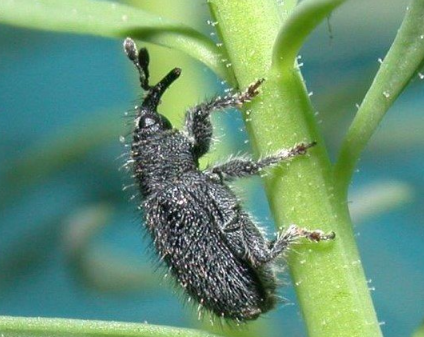
Dalmatian Toadflax Weevils are a group of small beetles used as biological control agents against Dalmatian Toadflax (Linaria dalmatica), an invasive noxious weed in North America. Important species include the Defoliating Stem-Mining Weevil (Mecinus janthinus) and the Stem-Boring Weevil (Mecinus janthiniformis).
Unlike many insects covered on Pestipedia, these weevils are not considered pests. They are beneficial insects intentionally released to reduce the spread, vigor, and seed production of invasive toadflax in rangelands, roadsides, pastures, and disturbed habitats.
Taxonomy and Classification
- Common Name: Dalmatian Toadflax Weevils
- Notable Species: Mecinus janthinus, Mecinus janthiniformis
- Order: Coleoptera
- Family: Curculionidae
- Type: Beneficial biological control weevil
- Primary Host: Dalmatian Toadflax (Linaria dalmatica)
These insects are members of the weevil family, also known as snout beetles. They undergo complete metamorphosis, developing through egg, larva, pupa, and adult stages.
Identification and Physical Description
Adult Dalmatian toadflax weevils are small, slender beetles, typically measuring 3 to 4 millimeters long. They are usually dull black, dark gray, or slightly blue-gray.
Key identifying features include:
- Small, elongated body
- Dark coloration
- Distinct weevil snout or rostrum
- Association with Dalmatian toadflax plants
The larvae are small, legless, cream-colored grubs that feed hidden inside the stems or root crown of the host plant. Because the larvae develop internally, infestations are usually detected by plant symptoms rather than direct observation.
Distribution and Habitat
Dalmatian toadflax weevils are native to Eurasia, where their host plants also occur naturally. They have been introduced into parts of the western United States and Canada as part of classical biological control programs.
Their habitat is closely tied to infestations of Dalmatian toadflax, especially in:
- Rangelands
- Roadsides
- Pastures
- Dry disturbed areas
- Open slopes and grasslands
They are most successful where dense toadflax stands provide enough host material for feeding, reproduction, and overwintering.
Behavior and Life Cycle
Dalmatian toadflax weevils usually produce one generation per year. Adults emerge in spring and begin feeding on toadflax foliage before mating.
The life cycle includes:
- Egg Stage: Females chew small openings in stems and deposit eggs.
- Larval Stage: Larvae feed internally within stems or root crowns.
- Pupal Stage: Pupation occurs inside the plant tissue.
- Adult Stage: New adults emerge in late summer and overwinter near the host plant.
Larval feeding is the most damaging stage to the plant. As larvae tunnel through stems, they interfere with the movement of water and nutrients, weaken stem structure, and reduce the plant’s ability to flower and set seed.
Ecological Role and Benefits
The primary role of Dalmatian toadflax weevils is invasive weed suppression. They help reduce the competitive advantage of Dalmatian toadflax, allowing native plants and forage species to recover.
- Stem Mining: Larvae tunnel through stems, weakening plant growth.
- Reduced Flowering: Damaged plants often produce fewer flowers.
- Lower Seed Production: Reduced seed set slows weed spread.
- Root Stress: Feeding can reduce energy storage and long-term plant vigor.
Their high level of host specificity makes them valuable in integrated weed management. They are not used to control insect pests, but to reduce an invasive plant that displaces native vegetation and lowers rangeland value.
Impact on Dalmatian Toadflax
Dalmatian toadflax is a deep-rooted perennial weed that spreads by seed and creeping roots. Because it is difficult to manage with mowing or hand removal alone, biological control can provide long-term suppression.
Weevil feeding does not always eliminate toadflax quickly. Instead, it gradually weakens plants over multiple seasons. In successful biological control programs, weevil populations build over time and contribute to:
- Reduced stand density
- Lower plant height
- Fewer flowering stems
- Reduced seed dispersal
- Improved competition from grasses and native plants
Management and Conservation
Because these weevils are beneficial, management focuses on protecting and encouraging their populations.
| Strategy | Purpose | Benefit |
|---|---|---|
| Avoid Broad-Spectrum Insecticides | Protect established weevil populations | Maintains biological control activity |
| Redistribute Colonies | Move weevils from established sites to new infestations | Expands weed control coverage |
| Preserve Host Patches | Maintain enough toadflax for weevil survival during establishment | Supports long-term population growth |
| Combine with Weed Management | Use grazing, mowing, or herbicides carefully | Improves control without eliminating beneficial insects |
Land managers often integrate biological control with other methods, but timing is important. Herbicide or mowing programs should avoid destroying host plants before weevil populations have established.
Prevention and Best Practices
- Monitor toadflax stands for weevil establishment.
- Avoid unnecessary insecticide use near release sites.
- Coordinate with local weed management districts before moving insects.
- Use biological control as part of a long-term management plan.
- Encourage native vegetation recovery where toadflax declines.
Conservation and Research
Research on Dalmatian toadflax weevils focuses on establishment success, host specificity, climate tolerance, and long-term weed suppression. Scientists and land managers study which environmental conditions—such as elevation, temperature, moisture, and plant density—support the strongest weevil populations.
These studies help improve biological control programs and reduce reliance on repeated herbicide applications in sensitive rangeland and roadside habitats.
Related Articles
Conclusion
Dalmatian toadflax weevils are beneficial beetles used to suppress the invasive weed Dalmatian toadflax. Their stem-mining and stem-boring larvae weaken the plant, reduce flowering, and limit seed production over time.
Rather than controlling these insects, land managers work to conserve and redistribute them. When integrated with broader weed management practices, Dalmatian toadflax weevils can help restore healthier rangelands and reduce the spread of this difficult invasive plant.