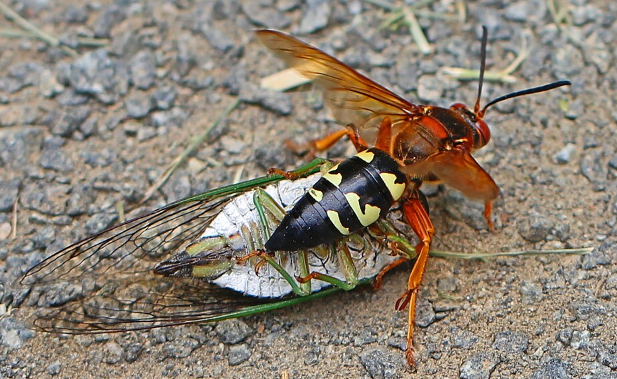
Eastern Cicada Killer (Sphecius speciosus) is the largest wasp species in North America and is often noticed due to its impressive size and loud buzzing flight. Despite their intimidating appearance, these insects are solitary wasps and are not aggressive toward humans or pets.
Eastern Cicada Killers are considered beneficial insects because they help control cicada populations. They are only considered pests when their burrowing activity disrupts turf, landscaping, or soil structures.
Taxonomy and Classification
The Eastern Cicada Killer belongs to the family Crabronidae, commonly known as digger wasps, within the order Hymenoptera, which also includes bees, ants, and other wasps. They undergo complete metamorphosis, developing through egg, larva, pupa, and adult stages.
- Common Name: Eastern Cicada Killer
- Scientific Name: Sphecius speciosus
- Order: Hymenoptera
- Family: Crabronidae
- Type: Solitary digger wasp
Unlike social wasps such as yellowjackets and hornets, Cicada Killers do not form colonies or defend a communal nest.
Identification and Physical Description
Adult Eastern Cicada Killers are large, robust wasps, typically measuring 1 to 1.5 inches in length. Their size often leads to confusion with hornets or large yellowjackets.
Key identifying features include:
- Black body with bold yellow banding on the abdomen
- Three distinct yellow bands across the abdomen
- Dusky brown to reddish-orange wings
- Stout, yellowish-red legs
Females are larger and possess a stinger used primarily for hunting. Males are smaller, lack a stinger, and are often seen flying aggressively near nesting areas, although they are harmless.
Distribution and Habitat
The Eastern Cicada Killer is widely distributed across the eastern and central United States. It prefers warm, sunny areas with loose, well-drained soil.
Common nesting sites include:
- Lawns and turf areas
- Garden beds
- Golf course sand traps
- Edges of sidewalks and driveways
- Areas with sparse vegetation
They are most active during the summer months when cicadas are abundant.
Behavior and Life Cycle
The Eastern Cicada Killer has one generation per year. Adults emerge in early to mid-summer, coinciding with peak cicada activity.
The female excavates a deep underground burrow, creating a noticeable U-shaped mound of soil at the entrance. Inside the burrow, she constructs chambers for her offspring.
She hunts cicadas, paralyzing them with her sting. The immobilized cicada is then transported back to the burrow, where the female lays an egg on it. Each chamber may contain one or more cicadas.
The larva hatches and feeds on the still-living cicada, eventually pupating in the soil. The developing wasp overwinters and emerges as an adult the following summer.
Feeding and Conflict
Adult Cicada Killers feed on nectar and plant juices, making them occasional pollinators. The larvae feed exclusively on cicadas provided by the mother.
Conflict with humans typically arises from their nesting activity rather than aggression. Burrowing can lead to:
- Unsightly soil mounds in lawns
- Localized turf damage
- Soil instability in heavily infested areas
Note on Stinging: Only females can sting, and they use their sting primarily to paralyze prey. Defensive stings are rare and typically occur only if the insect is handled or stepped on. Males cannot sting.
Management and Prevention
Control is usually unnecessary and often discouraged due to the beneficial role of Cicada Killers. However, management may be considered in high-traffic areas or where structural concerns exist.
- Cultural Control: Water soil regularly and compact loose areas to discourage nesting.
- Soil Disturbance: Raking or flattening soil mounds can deter females from establishing burrows.
- Individual Treatment: Apply insecticidal dust directly into burrows at night when the female is inside, then seal the entrance.
- Exclusion: Maintain dense, healthy turf to reduce suitable nesting areas.
Large-scale pesticide use is rarely necessary.
Prevention
Preventative strategies focus on making the environment less attractive for nesting:
- Maintain thick, healthy grass coverage
- Avoid leaving bare or sandy soil exposed
- Water dry areas regularly
- Reduce loose soil near structures
These steps can significantly reduce nesting activity.
Conservation and Research
Eastern Cicada Killers are important natural predators of cicadas and contribute to ecological balance. Research continues to explore their nesting behavior, hunting strategies, and role in urban ecosystems.
Because they are non-aggressive and beneficial, conservation efforts generally support their presence rather than elimination.
Related Articles
Conclusion
The Eastern Cicada Killer is a large but harmless solitary wasp that plays a valuable role in controlling cicada populations. Although their nesting activity can be disruptive in certain areas, they are generally not dangerous and should be tolerated whenever possible.
With proper lawn care and minor environmental adjustments, conflicts can be minimized while preserving the ecological benefits these insects provide.