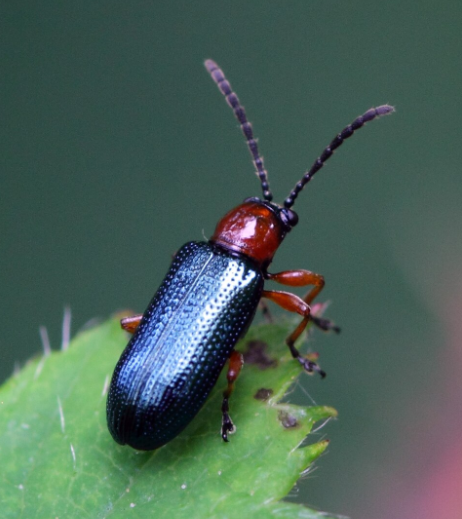
The Cereal Leaf Beetle (Oulema melanopus) is an invasive agricultural pest that attacks small grain crops, especially wheat, oats, barley, and rye. Native to Europe and parts of Asia, the beetle became established in North America during the twentieth century and spread through many grain-producing regions. Both adults and larvae feed on cereal leaves, but the larval stage causes most of the economic damage.
Heavy infestations can remove large amounts of green leaf tissue, reducing photosynthesis and causing fields to develop a pale, frosted, or silvery appearance. Fortunately, the Cereal Leaf Beetle is also one of the best-known examples of successful classical biological control in agriculture, with introduced parasitoid wasps helping suppress populations across much of its North American range.
Taxonomy and Classification
The Cereal Leaf Beetle belongs to the order Coleoptera and family Chrysomelidae, commonly known as leaf beetles. Its scientific name is Oulema melanopus. Like other beetles, it undergoes complete metamorphosis, developing through egg, larval, pupal, and adult stages.
This species is strongly associated with grasses in the family Poaceae. Cultivated cereal grains are the most important economic hosts, but adults and larvae may also feed on certain wild grasses.
Physical Description
Adult Cereal Leaf Beetles are small, slender beetles measuring approximately 5 millimeters long. Their contrasting colors make them relatively distinctive when viewed closely.
- Head: Metallic bluish-black to black.
- Wing Covers: Dark metallic blue or blue-black.
- Thorax: Bright reddish-orange.
- Legs: Usually reddish-orange with darker portions.
- Body Shape: Narrow, elongated, and somewhat cylindrical.
The larva looks very different from the adult. It is soft-bodied, yellowish, and somewhat slug-like. A particularly unusual feature is the dark coating of fecal material and mucus that commonly covers its body. This layer gives the larva a shiny black or dark brown appearance and can make it resemble a small bird dropping.
Distribution and Habitat
The Cereal Leaf Beetle is now established in many grain-producing areas of Europe, Asia, and North America. In agricultural regions, it is most commonly encountered in wheat, oats, barley, rye, and related cereal crops.
Adults spend winter in sheltered locations such as leaf litter, crop residue, grassy field margins, bark crevices, and other protected sites. As temperatures rise in spring, they become active and move into cereal fields to feed and reproduce.
Life Cycle
The Cereal Leaf Beetle typically produces one generation per year. Adults that survived the winter emerge during early spring and begin feeding on young grain leaves.
Females lay elongated yellow eggs on the upper surfaces of leaves, often placing them singly or in short rows near the midrib. The eggs gradually darken as they develop.
After hatching, larvae begin feeding immediately and pass through several developmental stages. Once mature, they leave the plant and move to the soil, where they create a small earthen chamber and pupate.
New adults emerge during summer and feed for a period before moving to protected overwintering sites. These adults remain dormant until the following spring, when the cycle begins again.
Feeding Damage
Both adult beetles and larvae feed on leaves, but larvae generally cause the greatest yield loss. Their feeding pattern produces a highly characteristic form of injury often described as window-paning.
The insects scrape away much of the soft green leaf tissue while leaving part of the outer leaf surface intact. Damaged areas appear as long, pale, translucent strips running lengthwise along the leaf.
- Window-Pane Damage: Long whitish or translucent feeding scars appear on leaves.
- Reduced Photosynthesis: Loss of green tissue reduces the plant’s ability to manufacture energy.
- Frosted Appearance: Heavily damaged fields may appear pale or silver when viewed from a distance.
- Reduced Yield: Severe feeding can reduce grain development, especially when upper leaves are heavily damaged.
- Flag Leaf Injury: Feeding on the flag leaf can be particularly important because this leaf contributes substantially to grain filling.
Economic Importance
Crop losses vary according to beetle density, weather, crop stage, and the amount of damage to important upper leaves. Young cereal plants can tolerate some feeding, but large larval populations can significantly reduce leaf area during critical stages of crop development.
Because adults and larvae concentrate on exposed leaf surfaces, infestations can sometimes develop rapidly across a field. Regular scouting is therefore important in regions where the pest occurs.
Monitoring and Detection
Growers should begin monitoring cereal crops in spring as overwintered adults become active. Look for adult beetles, rows of yellow eggs, dark-coated larvae, and fresh window-pane feeding damage.
Scouting should pay particular attention to upper leaves as the crop develops. Economic thresholds vary by crop, growth stage, location, and management system, so local agricultural recommendations should be used before deciding whether chemical control is justified.
Biological Control
The management history of the Cereal Leaf Beetle is an important example of successful biological control. After the beetle became established in North America, several parasitoid species were introduced to attack its eggs and larvae.
One of the most important is Tetrastichus julis, a small parasitic wasp that attacks Cereal Leaf Beetle larvae. Female wasps lay eggs in the beetle larva, and the developing parasitoids ultimately kill the host.
Where these parasitoids are well established, they can provide substantial natural suppression and greatly reduce the need for routine insecticide treatments.
Management and Prevention
Cereal Leaf Beetle management is most effective when based on Integrated Pest Management (IPM), combining scouting, biological control, crop management, and targeted insecticide use only when necessary.
- Scout Regularly: Monitor fields for adults, eggs, larvae, and window-pane feeding.
- Protect Parasitoids: Avoid unnecessary broad-spectrum insecticides that can kill beneficial wasps along with the pest.
- Use Economic Thresholds: Treat only when beetle populations and crop damage reach levels likely to cause economic loss.
- Manage Field Borders: Monitor grassy areas and crop residue where adults may overwinter.
- Use Appropriate Crop Timing: Planting date and crop development can influence how much feeding occurs during vulnerable growth stages.
Chemical Control
Insecticides may be appropriate when larval populations exceed established action thresholds and biological control is insufficient. Treatments are generally most effective when directed at actively feeding larvae before severe upper-leaf damage develops.
Product selection should follow current label directions and local extension recommendations. Unnecessary insecticide applications can disrupt parasitoid populations and may increase long-term dependence on chemical control.
Conservation and Research
Research on the Cereal Leaf Beetle continues to focus on biological control, parasitoid establishment, economic thresholds, crop resistance, and regional population monitoring. The long-term success of parasitoid programs demonstrates how beneficial insects can provide durable pest suppression when carefully integrated into crop management.
For grain producers, the most important strategy is to distinguish between low populations that can be tolerated and damaging outbreaks that require intervention. Preserving natural enemies while monitoring vulnerable crop stages provides an effective and environmentally responsible approach to managing this invasive cereal pest.