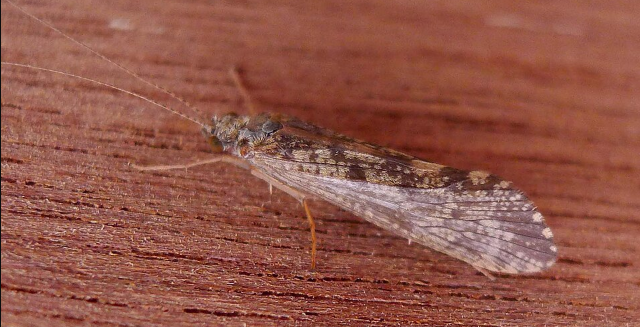
Caddisflies (order Trichoptera) are a diverse group of aquatic insects closely related to moths. They are best known for their larval stage, during which they construct intricate protective cases from materials such as sand, pebbles, plant fragments, and silk. While adult caddisflies are short-lived and harmless, their larvae play a critical role in freshwater ecosystems and are an important food source for fish, especially trout.
Caddisflies are considered beneficial insects and are widely used as indicators of clean, healthy water systems.
Taxonomy and Classification
Caddisflies belong to the order Trichoptera, which translates to “hair-wings,” referring to the fine hairs covering their wings. They undergo complete metamorphosis, developing through egg, larva, pupa, and adult stages.
- Common Name: Caddisflies
- Order: Trichoptera
- Related Group: Moths (Lepidoptera)
- Type: Aquatic insect (beneficial)
There are over 14,000 described species worldwide. They are commonly divided into two ecological groups:
- Case-making Caddisflies (Integripalpia): Build portable protective cases
- Net-spinning Caddisflies (Annulipalpia): Construct fixed retreats and silk nets
Identification and Physical Description
Adult caddisflies resemble small moths and are typically dull brown or gray in color. They range in size from a few millimeters to several centimeters in length.
Key identifying features include:
- Hair-covered wings (instead of scales like moths)
- Tent-like wing posture when at rest
- Long, thread-like antennae
The larval stage is more distinctive and ecologically important. Larvae are:
- Soft-bodied and grub-like
- Equipped with three pairs of legs
- Possessing abdominal prolegs with hooks
The most defining characteristic is the protective case they build. These cases vary by species and may resemble tiny sticks, stones, or tubes made from surrounding materials.
Distribution and Habitat
Caddisflies are found worldwide but are strongly associated with clean freshwater habitats.
Typical habitats include:
- Streams and rivers
- Lakes and ponds
- Wetlands and springs
Larvae live underwater, often attached to rocks or submerged vegetation. Adults are terrestrial but remain close to water sources.
Because many species are sensitive to pollution and oxygen levels, caddisflies are widely used as bioindicators of water quality.
Behavior and Life Cycle
Caddisflies typically complete their life cycle in about one year, though this can vary depending on species and environmental conditions.
Females lay eggs in gelatinous masses on or near water surfaces. After hatching, larvae begin constructing their protective cases or retreats.
Case-making larvae carry their portable shelters as they move and feed, while net-spinning species build stationary silk structures to capture food particles.
When fully developed, larvae seal themselves inside their case and pupate underwater. Adults emerge and briefly live on land, focusing on reproduction before dying.
Feeding and Ecological Role
Caddisfly larvae are essential to aquatic ecosystems and serve a variety of ecological roles. They are classified into several feeding groups:
- Shredders: Break down leaf litter and organic debris
- Grazers: Feed on algae growing on rocks
- Collectors: Filter fine organic particles from water
- Predators: Hunt smaller aquatic organisms
This diversity of feeding behavior makes them key contributors to nutrient cycling and energy flow in freshwater systems.
They are also a major food source for fish, birds, and other wildlife.
Interaction with Humans
Adult caddisflies are harmless to humans. They do not bite or sting and are generally not considered pests.
Occasionally, large numbers of adults may be attracted to lights near water, creating a temporary nuisance.
However, their presence is typically a sign of a healthy aquatic environment.
Management and Prevention
Caddisflies do not require control and should not be managed as pests. Their presence is beneficial and desirable in natural ecosystems.
In rare cases where large numbers gather near structures, simple measures such as reducing outdoor lighting may help minimize nuisance activity.
Conservation and Research
Caddisflies are important subjects of ecological research due to their sensitivity to environmental changes. They are widely used to assess stream and water quality.
Conservation efforts focus on:
- Protecting freshwater habitats
- Reducing pollution and runoff
- Maintaining natural stream ecosystems
Their unique silk production and case-building behavior are also studied for applications in biomaterials and engineering.
Related Articles
Conclusion
Caddisflies are essential components of freshwater ecosystems, contributing to nutrient cycling, water quality, and aquatic food webs. Their remarkable larval behavior and ecological importance make them valuable indicators of environmental health.
Rather than being pests, caddisflies should be recognized as beneficial organisms that support biodiversity and ecosystem stability.