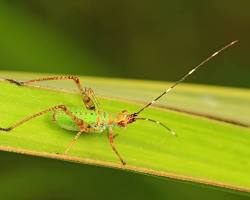
Scudder’s Bush Katydid (Scudderia furcata), also known as the Fork-tailed Bush Katydid, is a slender green insect commonly found in shrubs, trees, gardens, and woodland edges throughout North America. Like other katydids, this species produces rhythmic chirping and buzzing sounds during warm summer evenings, especially from midsummer into early autumn.
These insects are well known for their remarkable camouflage. Their narrow green wings and leaf-like bodies help them blend perfectly into foliage, making them difficult for predators and humans to spot. Although they may occasionally feed on leaves, flowers, and tender plant material, Scudder’s bush katydids are generally considered harmless members of natural ecosystems.
Quick Facts
- Scientific Name: Scudderia furcata
- Common Name: Scudder’s Bush Katydid
- Order: Orthoptera
- Family: Tettigoniidae
- Habitat: Trees, shrubs, gardens, woodlands
- Diet: Leaves, flowers, and plant material
- Active Season: Summer through early fall
- Status: Minor plant feeder
Taxonomy and Classification
Scudder’s bush katydid belongs to the order Orthoptera, a group that includes grasshoppers, crickets, and katydids. Within this order, it is part of the family Tettigoniidae, commonly known as katydids or bush crickets. These insects are recognized for their extremely long antennae, leaf-like appearance, and nighttime songs. :contentReference[oaicite:1]{index=1}
The genus Scudderia contains several closely related bush katydid species distributed across North America. Members of this genus are commonly associated with deciduous forests, shrublands, and suburban landscapes where they feed on foliage and flowers. :contentReference[oaicite:2]{index=2}
Identification
Scudder’s bush katydids are bright green insects with long antennae and narrow wings. Their slim bodies strongly resemble leaves, providing excellent camouflage among branches and foliage.
Adults generally measure between 1.2 and 1.8 inches long including the wings. Their wings are delicate and translucent with visible leaf-like veins. Some individuals may display shades of yellow, brown, or reddish coloration, although bright green is most common. :contentReference[oaicite:3]{index=3}
The antennae are extremely long and threadlike, often extending several times the length of the body. These antennae help the insect navigate vegetation and locate mates during nighttime activity.
Females possess a curved, blade-like ovipositor used to insert eggs into plant tissue. Males create chirping sounds by rubbing specialized structures on their front wings together, a process known as stridulation. :contentReference[oaicite:4]{index=4}
Distribution and Habitat
This species is found across much of North America and is particularly common in wooded areas, suburban gardens, parks, and shrubby habitats. Its range extends throughout much of the United States and southern Canada. :contentReference[oaicite:5]{index=5}
Scudder’s bush katydids prefer habitats with dense vegetation where they can hide during the day and feed at night. Common habitats include:
- Deciduous forests
- Shrublands
- Woodland edges
- Urban gardens
- Hedgerows
- Flowering meadows
- Tree canopies
These katydids are most active during warm summer nights when males call continuously from shrubs and trees in search of mates.
Life Cycle
The life cycle of Scudder’s bush katydid includes egg, nymph, and adult stages. Like most katydids, this species undergoes incomplete metamorphosis, meaning there is no pupal stage.
Females lay thin, flattened eggs inside leaves or along leaf edges during late summer and early fall. The eggs remain protected within plant tissue throughout the winter months. :contentReference[oaicite:6]{index=6}
In spring, tiny nymphs hatch and begin feeding on flowers, leaves, and soft plant tissue. Young nymphs resemble miniature wingless adults and often display black-and-white banded antennae. As they grow, they molt several times before reaching adulthood in midsummer. :contentReference[oaicite:7]{index=7}
Adults are most abundant from July through October, depending on regional climate conditions. Most individuals live for only one season, with the species surviving winter in the egg stage. :contentReference[oaicite:8]{index=8}
Behavior and Feeding Habits
Scudder’s bush katydids are primarily nocturnal insects. During the day they remain motionless among leaves and branches, relying on camouflage to avoid predators. At night they become active feeders and singers.
These katydids feed on a variety of plant materials including:
- Leaves
- Flower petals
- Tree foliage
- Shrub growth
- Garden plants
- Soft fruit tissue
Nymphs are often observed feeding on flowers, while adults tend to prefer woody deciduous foliage. :contentReference[oaicite:9]{index=9}
Male katydids produce repetitive chirping sounds to attract females. Their songs are often heard during humid summer evenings and may continue well into the night.
Pest Status
Katydids occasionally feed on leaves and flowers but rarely cause serious plant damage. Most populations remain low and are balanced naturally by predators and environmental conditions.
In some agricultural regions, heavy feeding may damage soft fruit or ornamental plants. The fork-tailed bush katydid has occasionally been reported feeding on citrus fruit and tender vegetation. However, serious infestations are uncommon. :contentReference[oaicite:10]{index=10}
For most homeowners and gardeners, these insects are considered harmless and even beneficial as part of healthy backyard ecosystems.
Natural Predators
Scudder’s bush katydids are preyed upon by many animals and insects, including:
- Birds
- Spiders
- Praying mantises
- Bats
- Small mammals
- Parasitic flies and wasps
Their camouflage helps protect them from predators, while their nighttime habits reduce exposure during daylight hours.
Control and Prevention
Control is rarely necessary because populations are usually small and temporary. When management is desired, non-chemical methods are generally sufficient.
- Inspect garden plants regularly
- Encourage birds and natural predators
- Reduce dense overgrowth around sensitive plants
- Hand-remove insects if necessary
- Avoid unnecessary pesticide applications
Because katydids contribute to biodiversity and serve as food for wildlife, preserving balanced ecosystems is usually the best management strategy.
Interesting Facts About Scudder’s Bush Katydid
- Their leaf-like wings provide excellent camouflage.
- Katydids are more closely related to crickets than grasshoppers.
- Males create songs by rubbing their wings together.
- The species is also known as the Fork-tailed Bush Katydid.
- Eggs are hidden inside leaves to protect them from predators.