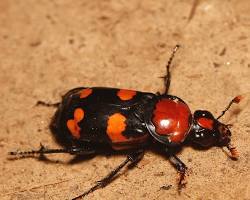
The American Burying Beetle (Nicrophorus americanus) is a large carrion beetle known for burying small animal carcasses to feed its young. This unusual behavior helps recycle nutrients in ecosystems and makes the species an important decomposer.
The “Nature’s Undertaker”: Burying Beetle
Burying Beetles (genus Nicrophorus), also known as Sexton Beetles, are high-priority beneficial scavengers found across the United States. These insects are essential for nutrient cycling. They are famous for their complex parental care and their role in removing small animal carcasses from the landscape. While their association with decay may seem “noxious” to some, they are beneficial ecosystem engineers.
Technical Identification: Diagnostic Markers
- Phenotype: Characterized by a robust, shiny black body typically decorated with four bright orange or red patches on the wing covers (elytra). A primary diagnostic key for is the club-shaped antennae tipped with orange.
- Phoretic Mites: Often seen carrying tiny mites on their bodies. This is a symbiotic relationship; the mites eat fly eggs on carcasses, reducing competition for the beetle’s larvae.
- Sexton Behavior: They possess a powerful sense of smell, capable of detecting carrion from over a mile away in the night.
Ecological Impact: Carrion Recycling and Soil Enrichment
The primary impact of Burying Beetles is the underground sequestration of organic matter, which prevents the spread of “noxious” vertebrate pathogens.
- Carcass Burial: A mated pair will excavate the soil beneath a small animal (bird or mouse) until it is completely interred. This recycles nitrogen directly into the soil.
- Antimicrobial Coating: The beetles strip fur/feathers and apply oral and anal secretions that inhibit bacterial decay, preserving the meat for their larvae.
- Advanced Parental Care: Unlike most beetles, Nicrophorus parents stay to feed and protect their young, ensuring high offspring survival in forests and fields.
Management & Conservation Strategies
Management of Burying Beetles in the United States focuses on tolerance and habitat preservation.
| Strategy | Technical Specification | Operational Benefit |
|---|---|---|
| Soil Integrity Maintenance | Avoiding heavy compaction | allows beetles to bury carrion; supports soil aeration and fertility. |
| Light Mitigation | Using motion-activated outdoor lighting | reduces nocturnal disorientation; helps endangered national species find breeding sites. |
| Chemical Safety | Eliminating broad-spectrum soil drenches | prevents the “noxious” poisoning of beneficial soil fauna that provide free waste management. |
- Monitoring: Watch for large orange-spotted beetles flying at dusk or attracted to porch lights. Their presence confirms a healthy decomposer community.
- Federal Protection: The American Burying Beetle (N. americanus) is federally listed. Pestipedia.com reminds users that harming this specific species is prohibited under U.S. law.
Quick Facts
- Family: Silphidae
- Habitat: Grasslands, forests
- Diet: Carrion
- Status: Endangered species
Identification
The American burying beetle is a large black beetle with distinctive orange-red markings on the wing covers.
Distribution
This species once occurred across much of eastern North America but is now limited to smaller populations due to habitat loss.
Life Cycle
Adult beetles locate small animal carcasses, bury them underground, and lay eggs nearby. The carcass serves as food for developing larvae.
Pest Status
This beetle is not a pest and is considered beneficial because it helps break down dead animals.
Control
No control is necessary. The American burying beetle is a protected species in many areas.