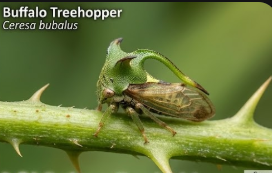
The Buffalo Treehopper (Stictocephala bisonia) is a distinctive sap-feeding insect known for its unusual body shape that resembles a tiny buffalo or thorn. This species belongs to the family Membracidae, a fascinating group of insects commonly called treehoppers. Their enlarged pronotum, which extends upward and backward over the body, gives them one of the most recognizable appearances among North American plant-feeding insects.
Buffalo treehoppers are commonly found on shrubs, orchard trees, grapevines, weeds, and ornamental plants. Although they are usually considered minor pests, large populations can sometimes damage stems and young plant tissue through feeding and egg-laying activity. Their unusual appearance and camouflage strategies make them especially interesting members of the insect world.
Quick Facts
- Family: Membracidae
- Common Habitat: Gardens, orchards, shrubs, vineyards, woodland edges
- Diet: Plant sap
- Status: Minor plant pest
- Distinctive Feature: Buffalo-shaped triangular body
Identification
Buffalo treehoppers are small bright green insects measuring approximately 1/4 inch long. Their most recognizable feature is the enlarged triangular pronotum that arches over the body like a shield.
This unique structure gives the insect a buffalo-like silhouette, which inspired its common name.
Key identifying characteristics include:
- Bright green coloration
- Triangular hump-backed appearance
- Small wedge-shaped body
- Short antennae
- Strong jumping legs
The pointed pronotum often helps camouflage the insect among thorns, stems, and leaves.
Nymphs resemble smaller wingless versions of adults and are often pale green.
Like other true bugs, buffalo treehoppers possess piercing-sucking mouthparts used for feeding on plant sap.
Distribution and Habitat
Buffalo treehoppers occur throughout much of North America and are especially common in eastern and central regions of the United States and southern Canada.
They thrive in habitats containing woody vegetation and abundant host plants.
Common habitats include:
- Orchards
- Gardens
- Vineyards
- Shrublands
- Forest edges
- Weedy fields
- Residential landscapes
The species is frequently associated with:
- Apple trees
- Grapevines
- Rose bushes
- Maples
- Willows
- Herbaceous weeds
Buffalo treehoppers are most active during warm spring and summer months.
Life Cycle
The buffalo treehopper undergoes incomplete metamorphosis consisting of three primary stages:
- Egg
- Nymph
- Adult
Females lay eggs inside small slits cut into plant stems or twigs.
This egg-laying activity may leave scars or wounds on plants.
After hatching, nymphs feed on plant sap while developing through several molts.
Nymphs gradually mature into winged adults capable of short flights and jumping.
Most populations produce one generation per year, although climate conditions can influence development timing.
Behavior
Buffalo treehoppers are relatively secretive insects that spend much of their time resting along stems and branches where their shape provides excellent camouflage.
When disturbed, they often:
- Jump rapidly away from predators
- Fly short distances
- Move behind stems for concealment
Their feeding behavior involves inserting needle-like mouthparts into plant tissues to extract sap.
Heavy feeding may weaken tender stems or reduce plant vigor.
Some treehopper species are also known for producing honeydew, a sugary waste product that can encourage the development of sooty mold fungi.
Buffalo treehoppers may also interact with ants, which sometimes protect sap-feeding insects in exchange for honeydew.
Plant Damage
Although buffalo treehoppers are usually considered minor pests, they can occasionally damage ornamental and agricultural plants.
Common forms of damage include:
- Stem scarring from egg-laying
- Wilting of young shoots
- Reduced plant vigor
- Small feeding wounds
- Occasional twig dieback
Young fruit trees and grapevines may be more vulnerable to injury.
Damage is generally cosmetic unless populations become unusually high.
Natural Predators
Buffalo treehoppers are preyed upon by many beneficial predators and parasites.
Natural enemies include:
- Spiders
- Lady beetles
- Predatory wasps
- Birds
- Assassin bugs
- Parasitic flies
Healthy ecosystems with abundant predator populations often keep treehopper numbers naturally controlled.
Pest Status
Buffalo treehoppers are considered minor plant pests in most situations.
Unlike many serious agricultural insects, they rarely cause widespread economic losses.
However, occasional infestations in orchards or vineyards may require monitoring if stem injury becomes noticeable.
The species is more often viewed as an unusual curiosity because of its bizarre shape and camouflage abilities.
Prevention
Preventive management focuses on maintaining healthy plants and encouraging beneficial predators.
Recommended prevention methods include:
- Maintain proper plant health through watering and fertilization
- Inspect young stems for egg-laying scars
- Reduce excessive weed growth near crops
- Encourage natural predators
- Avoid unnecessary pesticide applications
Balanced ecosystems typically prevent serious population outbreaks.
Control
Control measures are rarely necessary for buffalo treehoppers.
When management is needed, common approaches include:
- Pruning heavily damaged stems
- Manual removal
- Biological control through predator conservation
- Targeted insecticidal soaps for severe infestations
Broad-spectrum insecticides are usually discouraged because they may harm beneficial insects that naturally suppress treehopper populations.
Interesting Facts
- The buffalo treehopper’s body shape helps mimic plant thorns.
- Treehoppers are among the most oddly shaped insects in the world.
- Some treehopper species communicate through plant vibrations.
- The enlarged pronotum acts as camouflage against predators.
- Buffalo treehoppers are strong jumpers despite their unusual shape.
- Females damage stems primarily during egg-laying rather than feeding.