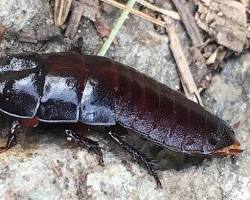
The Brown-hooded Cockroach (Cryptocercus punctulatus) is a wood-dwelling cockroach species commonly found in decaying logs and forest environments throughout eastern North America. Unlike indoor pest roaches that invade kitchens and buildings, this species spends nearly its entire life hidden inside rotting wood where it helps recycle dead plant material back into the ecosystem.
Unlike common cockroaches associated with homes and restaurants, brown-hooded cockroaches are beneficial decomposers that rarely interact with humans.
The brown-hooded cockroach is considered one of the most primitive and scientifically important cockroach species in North America. Researchers often study it because of its unusual social behavior and evolutionary connection to termites. In fact, many scientists believe termites evolved from ancient wood-feeding cockroach ancestors closely related to species in the genus Cryptocercus.
Quick Facts
- Family: Cryptocercidae
- Scientific Name: Cryptocercus punctulatus
- Habitat: Decaying logs and forest debris
- Diet: Rotting wood and decomposing plant material
- Status: Beneficial decomposer
- Primary Activity: Wood recycling in forests
Identification
Brown-hooded cockroaches are medium-sized, dark brown insects with flattened oval bodies adapted for life inside wood.
Adults usually measure between 3/4 inch and 1.25 inches long.
Important identifying characteristics include:
- Dark brown to reddish-brown coloration
- Broad flattened body
- Strong legs adapted for crawling through wood tunnels
- Shield-like pronotum covering the head
- Absence of fully developed wings
Unlike many modern cockroach species, brown-hooded cockroaches are wingless or possess only reduced wing structures. This adaptation helps them move through narrow tunnels inside decaying logs.
Their appearance resembles ancient cockroach ancestors that existed millions of years ago.
Nymphs resemble smaller versions of adults and remain with the family group throughout development.
Distribution and Habitat
The brown-hooded cockroach occurs primarily in forested regions of eastern North America.
They are especially common in:
- The Appalachian Mountains
- Eastern hardwood forests
- Moist woodland habitats
- Old-growth forest systems
- Mountain forests
The species prefers environments containing abundant dead wood and moisture.
Typical habitats include:
- Rotting logs
- Fallen tree trunks
- Decaying stumps
- Forest litter
- Wood debris piles
Because they depend on rotting wood for food and shelter, brown-hooded cockroaches are strongly tied to mature forest ecosystems.
They are rarely encountered in homes or urban environments.
Life Cycle
The life cycle of the brown-hooded cockroach differs significantly from that of common pest roaches.
Development includes:
- Egg
- Nymph
- Adult
However, their behavior is highly unusual because they live in organized family groups.
After eggs hatch, young nymphs remain with adults inside the log.
Adults actively care for the young by:
- Protecting them inside galleries
- Sharing food
- Helping transfer digestive microorganisms
- Maintaining communal tunnels
This social behavior is rare among insects outside of ants, bees, wasps, and termites.
Young cockroaches depend on specialized gut microorganisms to digest cellulose from wood.
Without these microbes, they cannot survive on their woody diet.
Nymphs gradually molt through several stages before becoming adults.
The full life cycle may take several years depending on environmental conditions and food availability.
Behavior
Brown-hooded cockroaches are slow-moving, secretive insects that spend nearly all their lives hidden inside wood.
They excavate galleries and tunnels through decaying logs where they:
- Feed
- Breed
- Raise offspring
- Avoid predators
Their primary food source is decomposing wood rich in fungi and microorganisms.
By feeding on dead wood, they help:
- Recycle nutrients
- Break down fallen timber
- Improve soil quality
- Support forest ecosystems
Unlike pest cockroaches, brown-hooded cockroaches:
- Do not infest kitchens
- Do not contaminate food
- Do not spread household bacteria
- Do not reproduce inside buildings
The species is almost entirely dependent on forest habitats.
Evolutionary Importance
The brown-hooded cockroach is scientifically important because it shares many characteristics with termites.
Researchers have discovered similarities involving:
- Wood digestion
- Gut microorganisms
- Social family behavior
- Nest sharing
- Parental care
These similarities support the theory that termites evolved from ancient cockroach ancestors related to Cryptocercus.
For this reason, brown-hooded cockroaches are often studied in evolutionary biology and entomology research.
Pest Status
Brown-hooded cockroaches are not considered pests.
Instead, they are beneficial decomposers that contribute positively to forest health.
Unlike indoor roaches such as:
Brown-hooded cockroaches do not invade buildings or contaminate food.
They help forests by accelerating decomposition and nutrient cycling.
Signs of Activity
Because the species lives hidden inside wood, signs are subtle.
Possible indicators include:
- Tunnels inside rotting logs
- Small wood particles or frass
- Cockroaches visible inside split logs
- Family groups within decaying wood
Most people encounter them accidentally while moving firewood or fallen logs.
Prevention
No prevention measures are typically necessary because these insects rarely enter structures.
In rare cases where they are found near homes:
- Remove heavily decayed wood near foundations
- Store firewood away from structures
- Reduce excess moisture around buildings
However, brown-hooded cockroaches generally pose no risk to buildings.
Control
Control is not recommended because these insects are ecologically beneficial and rarely interact with humans.
If individuals are accidentally brought indoors with firewood, they can simply be removed and returned outside.
Pesticide treatment is unnecessary in nearly all situations.
Interesting Facts
- Brown-hooded cockroaches are closely related to termite ancestors.
- They live in organized family groups.
- Adults help care for their young.
- The species feeds primarily on decaying wood.
- They rely on gut microbes to digest cellulose.
- Unlike household cockroaches, they rarely enter buildings.
- They are considered important forest decomposers.