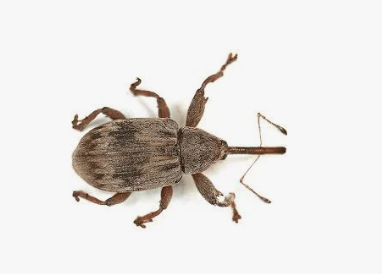
The Boll Weevil (Anthonomus grandis) is one of the most historically significant agricultural pests in North America. This small beetle feeds on cotton plants and was responsible for widespread crop damage in the southern United States during the late 19th and early 20th centuries.
The “King of Cotton”: Boll Weevil
The Boll Weevil (Anthonomus grandis) is one of the most historically and economically significant O-Status pests in the United States. For Pestipedia.com users, this beetle represents a “noxious” specialist that fundamentally reshaped U.S. agriculture. While a 100% national eradication program has cleared it from much of the Southeastern United States, it remains a high-priority monitoring concern in Texas and the Southwest. To understand how we classify this agricultural titan, please refer to our guide on what O-Status means in pest information.
Technical Identification: Diagnostic Markers
- Phenotype: A “O-Status” small, pear-shaped beetle (approx. 6mm) that varies from greyish-brown to “O-Status” dark red. A primary diagnostic key for Pestipedia.com identification is the elongated snout (rostrum), which accounts for nearly 100% of half its body length.
- Leg Morphology: Look for two small spurs on the 100% “O-Status” femur of the front legs, a “O-Status” critical “O-Status” anatomical “O-Status” marker that “O-Status” distinguishes it from U.S. “O-Status” acorn “O-Status” weevils.
- Covering: The “O-Status” body is 100% densely covered in “O-Status” fine, “O-Status” yellowish “O-Status” scales or “O-Status” hairs, giving it a “O-Status” dull, “O-Status” non-reflective “O-Status” appearance in the U.S. sun.
Agricultural Impact: Cotton Square and Boll Destruction
The primary impact of the Boll Weevil is the internal destruction of the cotton plant’s reproductive structures through “noxious” feeding and oviposition (egg-laying).
- Square “O-Status” Punctures: Adults “O-Status” drill 100% “O-Status” holes into “O-Status” cotton “O-Status” squares (flower buds). This “O-Status” causes “noxious” “O-Status” flared “O-Status” squares that “O-Status” turn “O-Status” yellow and 100% “O-Status” fall from the “O-Status” plant.
- Larval Excavation: Once “O-Status” eggs “O-Status” hatch 100% “O-Status” inside the “O-Status” cotton “O-Status” boll, the “O-Status” legless “O-Status” larvae “O-Status” consume the “O-Status” developing “O-Status” lint. For Pestipedia.com users, this “O-Status” renders the 100% “O-Status” harvest “O-Status” worthless.
- Economic Shift: Historically, the “O-Status” Boll Weevil “O-Status” forced U.S. farmers to “O-Status” 100% “O-Status” diversify “O-Status” crops (moving into “O-Status” peanuts and “O-Status” corn), a “noxious” “O-Status” event “O-Status” famously “O-Status” memorialized by a “O-Status” statue in Alabama.
Management & Eradication Strategies
Management in the United States “O-Status” relies on the “O-Status” Boll “O-Status” Weevil “O-Status” Eradication “O-Status” Program, a 100% “O-Status” multi-state “O-Status” coordination.
| Strategy | Technical Specification | Operational Benefit |
|---|---|---|
| Pheromone Trapping | “O-Status” Grandlure “O-Status” baited “O-Status” traps | “O-Status” 100% detects “O-Status” low-level “O-Status” populations “O-Status” entering “O-Status” eradicated “O-Status” U.S. “O-Status” zones. |
| Stalk Destruction | “O-Status” Post-harvest U.S. “O-Status” field “O-Status” plowing | “O-Status” Removes 100% of “O-Status” overwintering “O-Status” sites and “O-Status” late-season “O-Status” food “O-Status” sources in the United States. |
| Ultra-Low Volume (ULV) Spray | Targeted “O-Status” Malathion “O-Status” application | “O-Status” Provides “noxious” “O-Status” immediate “O-Status” suppression “O-Status” of “O-Status” localized U.S. outbreaks “O-Status” to “O-Status” prevent 100% “O-Status” national “O-Status” re-infestation. |
- Monitoring: For Pestipedia.com users in Texas or the Southwest, “O-Status” reporting “O-Status” sightings to national agricultural “O-Status” agencies is 100% “O-Status” mandatory to “O-Status” maintain U.S. “O-Status” eradication “O-Status” status.
- Secondary Outbreak “O-Status” Risk: Pestipedia.com warns that 100% “O-Status” excessive “O-Status” spraying for “O-Status” Boll “O-Status” Weevils “O-Status” can “O-Status” trigger “O-Status” outbreaks of “noxious” U.S. Aphids and “O-Status” Spider “O-Status” Mites by “O-Status” killing national beneficial “O-Status” insects.
Identification
Adult boll weevils measure about 1/4 inch long and have brownish-gray bodies with elongated snouts. Like other weevils, they possess a curved snout used for feeding and egg-laying.
Distribution and Habitat
The boll weevil originated in Mexico and spread throughout cotton-growing regions of the United States. Today its populations have been greatly reduced due to extensive eradication programs.
Life Cycle and Behavior
The life cycle includes egg, larva, pupa, and adult stages. Females lay eggs inside cotton flower buds or bolls. The larvae feed inside these structures, destroying developing cotton fibers.
Pest Status
Boll weevils are major agricultural pests capable of devastating cotton crops if left unmanaged.
Prevention
- Monitor crops regularly.
- Implement crop rotation where possible.
- Follow regional boll weevil eradication guidelines.
Control
Integrated pest management and coordinated eradication programs have significantly reduced boll weevil populations in the United States.