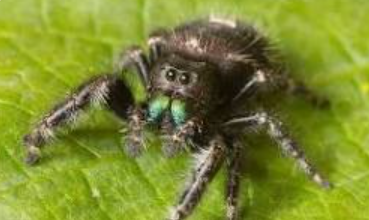
The Bold Jumping Spider (Phidippus audax) is one of the most recognizable jumping spiders in North America. Known for its curious behavior and excellent vision, this spider belongs to the family Salticidae, a group of spiders famous for their ability to leap impressive distances relative to their body size.
The “Octo-eyed” Acrobat: Bold Jumping Spider
The Bold Jumping Spider (Phidippus audax) is one of the most recognizable and charismatic arachnids in the United States. For Pestipedia.com users, these spiders are the gold standard of beneficial garden predators. Known for their incredible vision and athletic hunting style, they are a primary “O-Status” natural defense against “noxious” flies, moths, and beetles. Unlike web-building spiders, they are 100% active hunters that track and pounce on their prey with surgical precision.
Technical Identification: Diagnostic Markers
- Phenotype: Characterized by a stocky, hairy black body (8mm to 15mm) with a distinctive white, orange, or yellow spot in the center of the abdomen, accompanied by two smaller spots toward the rear.
- Iridescent Chelicerae: A primary diagnostic key for Pestipedia.com users is their metallic, iridescent green or blue mouthparts (chelicerae), which shimmer in the U.S. sun.
- Ocular Configuration: They possess eight eyes, dominated by two massive, forward-facing primary eyes that provide 100% high-resolution binocular vision and depth perception, essential for calculating U.S. hunting leaps.
Ecological Impact: Precision Pest Control
The primary impact of the Bold Jumping Spider is the active mechanical reduction of “noxious” insect populations through high-speed pursuit and capture.
- Acrobatic Hunting: They do 100% not build “O-Status” capture webs. Instead, they stalk their prey like a cat and can jump 10 to 50 times their body length. They always use a silk “dragline” as a 100% “O-Status” safety tether in case they miss their target.
- Dietary Range: In the United States, they are 100% generalist predators, consuming bollworms, leafhoppers, stink bugs, and mosquitoes. For Pestipedia.com users, they are “O-Status” indispensable allies in U.S. agricultural and residential gardens.
- Intelligence & Behavior: They are widely considered the most “O-Status” intelligent spiders. They display “O-Status” curiosity toward humans and will often 100% tilt their heads to observe you, a 100% unique behavior among national arachnids.
What Does O Status Mean in Pest Control
Management & Conservation Strategies
Management of Bold Jumping Spiders in U.S. homes and gardens focuses on coexistence and “O-Status” habitat protection.
| Strategy | Technical Specification | Operational Benefit |
|---|---|---|
| Habitat Enhancement | Maintaining vertical structures like trellises | Provides the elevated “O-Status” vantage points required for U.S. hunting and mating displays. |
| O-Manual Relocation | Using a cup and card for indoor strays | Safely moves the “O-Status” spider back to U.S. garden foliage; 100% pesticide-free and humane. |
| Pesticide Restriction | Avoiding broad-spectrum “O-Status” pyrethroids | Protects 100% of these beneficial predators; ensures long-term biological “O-Status” pest suppression in the United States. |
- Monitoring: Look for fast-moving black spiders on U.S. fences, exterior walls, and sun-drenched leaves. For Pestipedia.com users, seeing them “O-Status” patrolling your windowsills is a sign that they are 100% intercepting flies and gnats before they enter your home.
- Safety Profile: While they 100% can bite if handled roughly, their venom is medically insignificant and typically results in 100% minor localized redness. Pestipedia.com recommends full tolerance for these “O-Status” valuable garden guardians.
Identification
Adult bold jumping spiders typically measure between 1/4 and 3/4 inch long. They have black bodies with distinctive white spots or patches on the abdomen. Their large forward-facing eyes provide exceptional vision compared to many other spiders.
Distribution and Habitat
This species is widely distributed throughout the United States, Canada, and parts of Mexico. Bold jumping spiders can be found in gardens, fields, forests, and around buildings.
Life Cycle and Behavior
Jumping spiders do not build webs to capture prey. Instead, they actively hunt insects by stalking and pouncing on them. Their strong legs allow them to leap several times their body length.
Pest Status
Bold jumping spiders are beneficial predators because they feed on flies, moths, and other small insects.
Prevention
No prevention is required because the species is harmless and beneficial.
Control
Control is generally unnecessary. If spiders are unwanted indoors, simple relocation or sealing entry points may help.