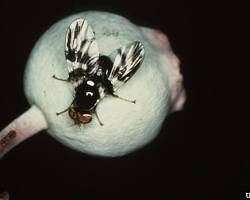
The Blueberry Maggot Fly (Rhagoletis mendax) is one of the most important insect pests affecting blueberry production in North America. This small fruit fly belongs to the family Tephritidae, a group of insects commonly referred to as true fruit flies. The species is notorious for its larval stage, which develops inside ripening blueberries and feeds on the fruit pulp. Infested berries often become soft, discolored, and unmarketable, leading to significant economic losses for commercial blueberry growers.
Blueberry maggot flies are particularly problematic in regions where blueberries are cultivated commercially, especially in the northeastern United States and parts of Canada. Because the larvae remain hidden inside fruit, infestations may go unnoticed until berries are harvested or sold.
Quick Facts
- Order: Diptera
- Family: Tephritidae
- Scientific Name: Rhagoletis mendax
- Habitat: Blueberry fields and wild blueberry patches
- Diet: Developing blueberry fruit
- Status: Major agricultural pest
Identification
Adult blueberry maggot flies are small insects measuring approximately:
- 1/4 inch long
Adults possess several distinctive features including:
- Black bodies
- White markings on the thorax
- Clear wings with dark banding patterns
- Large compound eyes
The patterned wings are one of the easiest ways to identify this species and distinguish it from other flies.
Larvae are:
- Small white maggots
- Legless
- Cylindrical in shape
- Found inside blueberries
Because larvae develop internally, infestations are often difficult to detect without cutting open fruit.
Distribution and Habitat
The blueberry maggot fly occurs primarily throughout:
- The northeastern United States
- Eastern Canada
- Regions with commercial blueberry production
It is especially common in states known for blueberry cultivation, including:
- Maine
- Michigan
- New Jersey
- Massachusetts
- New York
The insect thrives in:
- Commercial blueberry farms
- Wild blueberry fields
- Home gardens with blueberry bushes
- Areas with moist soils suitable for pupation
Wild blueberries can serve as reservoirs for infestations that later spread into cultivated crops.
Life Cycle
The blueberry maggot fly undergoes complete metamorphosis consisting of four stages:
- Egg
- Larva
- Pupa
- Adult
Adult flies typically emerge during early to mid-summer as blueberries begin ripening.
Females use a specialized egg-laying structure called an ovipositor to insert eggs directly into fruit.
After hatching, larvae feed internally on blueberry pulp.
Infested berries may:
- Become soft
- Collapse prematurely
- Drop from plants
- Develop internal decay
When fully developed, larvae exit the fruit and drop to the soil where they pupate.
Pupae overwinter underground and emerge as adults the following growing season.
Behavior
Adult blueberry maggot flies are most active during warm sunny weather.
Females carefully select ripening berries for egg laying because larvae require soft fruit tissue to develop successfully.
The species relies heavily on:
- Fruit availability
- Temperature conditions
- Moist soils
- Host plant abundance
Adults are relatively short-lived but can lay numerous eggs during their lifespan.
Damage and Economic Importance
Blueberry maggot flies are considered major agricultural pests due to the damage caused by larval feeding.
Common signs of infestation include:
- Soft berries
- Premature fruit drop
- Shriveled blueberries
- Internal maggots within fruit
Infested berries become unsuitable for:
- Fresh markets
- Commercial processing
- Export sales
Economic impacts may include:
- Reduced crop yields
- Market rejection of fruit
- Increased pest management costs
- Quarantine restrictions
Even low infestation levels can create serious problems for commercial growers because consumers will reject fruit containing larvae.
Monitoring and Detection
Monitoring programs are critical for controlling blueberry maggot flies.
Growers commonly use:
- Yellow sticky traps
- Red sphere traps
- Ammonium acetate bait traps
These traps help detect adult activity before significant egg laying occurs.
Monitoring is especially important during:
- Fruit ripening periods
- Warm summer months
- Peak adult emergence times
Prevention
Preventing infestations often requires integrated pest management techniques.
Recommended prevention methods include:
- Harvest blueberries promptly
- Monitor fields regularly with traps
- Remove fallen berries from the ground
- Destroy infested fruit
- Maintain clean field sanitation
- Control wild host plants nearby
Prompt harvesting reduces the amount of time berries remain vulnerable to egg laying.
Control
Management strategies for blueberry maggot flies may include:
- Sticky monitoring traps
- Biological control methods
- Targeted insecticide applications
- Cultural control practices
- Field sanitation
In commercial agriculture, insecticides are often timed according to adult trap captures to maximize effectiveness.
Biological control agents such as parasitoid wasps may also help suppress populations naturally.
Ecological Importance
Although blueberry maggot flies are damaging agricultural pests, they are also part of natural food webs.
Their larvae and adults serve as food for:
- Birds
- Predatory insects
- Spiders
- Parasitic wasps
Natural predators can help reduce populations in unmanaged habitats.
Interesting Facts
- Blueberry maggot larvae develop entirely inside berries.
- The species belongs to the true fruit fly family Tephritidae.
- Adult flies have highly distinctive patterned wings.
- Infested fruit may appear normal externally at first.
- Pupae overwinter underground in soil.
- Commercial blueberry growers rely heavily on monitoring traps.