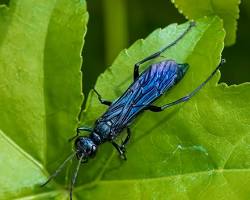
The Blue Mud Dauber (Chalybion californicum) is a solitary wasp species well known for its metallic blue coloration and mud nest-building behavior. Unlike aggressive social wasps such as yellowjackets and hornets, blue mud daubers are generally calm insects that rarely sting humans. These wasps are considered beneficial predators because they hunt and paralyze spiders, which they use as food for their developing larvae.
The Blue Mud Dauber belongs to the wasp family Sphecidae, a group of solitary hunting wasps known for constructing nests from mud or soil. This species is especially recognizable because of its smooth metallic blue body and slender appearance.
Blue mud daubers are frequently encountered around:
- Homes
- Barns
- Garages
- Sheds
- Gardens
- Porches
- Bridges
- Outdoor structures
Although their nests may occasionally become a nuisance when attached to buildings, these insects provide valuable natural pest control by reducing spider populations.
Quick Facts
- Order: Hymenoptera
- Family: Sphecidae
- Scientific Name: Chalybion californicum
- Habitat: Gardens, buildings, barns, wooded areas
- Diet: Nectar and spiders
- Status: Beneficial predatory wasp
Identification
Adult Blue Mud Daubers typically measure:
- 3/4 inch to 1 inch long
Their bodies are:
- Metallic blue
- Dark blue-black
- Smooth and shiny
Unlike fuzzy bees or heavily marked yellowjackets, Blue Mud Daubers have a sleek appearance with:
- Long narrow waists
- Slender legs
- Elongated abdomens
- Transparent wings
Key identifying features include:
- Iridescent blue coloration
- Thin thread-like waist
- Long dangling legs during flight
- Smooth body lacking dense hairs
- Graceful slow flight patterns
Their appearance is often intimidating to homeowners, but these wasps are generally non-aggressive and prefer to avoid conflict.
Distribution and Habitat
Blue Mud Daubers occur throughout much of North America and are especially common in:
- The United States
- Southern Canada
- Northern Mexico
They thrive in warm environments where mud and spider prey are readily available.
Common habitats include:
- Residential neighborhoods
- Woodlands
- Farms
- Wetlands
- Gardens
- Rural buildings
- Parks
Blue Mud Daubers prefer sheltered nesting locations such as:
- Under roof eaves
- Inside sheds
- Beneath bridges
- Inside garages
- Along walls
- Within barns
They are especially active during:
- Spring
- Summer
- Early fall
Life Cycle
Like other wasps, Blue Mud Daubers undergo complete metamorphosis consisting of four stages:
- Egg
- Larva
- Pupa
- Adult
Female wasps begin by searching for suitable nesting sites. Unlike some mud dauber species that build entirely new nests, Blue Mud Daubers often:
- Reuse abandoned mud nests
- Repair older nests
- Expand existing chambers
After preparing a nest chamber, the female hunts spiders.
Using her venomous sting, she:
- Paralyzes spiders
- Transports them to the nest
- Stores them inside mud chambers
Once enough spiders are collected, the female lays an egg inside the chamber and seals it with mud.
After hatching, the larva feeds on the immobilized spiders until fully developed.
The larva then pupates within the chamber before emerging as an adult wasp.
Behavior
Blue Mud Daubers are solitary wasps, meaning they do not form large colonies like social wasps.
Each female independently:
- Builds nests
- Hunts prey
- Raises offspring
These wasps are highly beneficial because they prey heavily on:
- House spiders
- Orb-weaving spiders
- Wolf spiders
- Other small spiders
Interestingly, Blue Mud Daubers may even invade nests built by other mud dauber species to steal stored spiders.
Adult wasps feed primarily on:
- Nectar
- Honeydew
- Plant sugars
They are commonly seen visiting flowers in gardens and natural landscapes.
Pest Status
Blue Mud Daubers are generally considered beneficial insects.
Unlike aggressive stinging wasps, they:
- Rarely sting humans
- Do not defend large colonies
- Avoid confrontation
- Help control spider populations
The primary nuisance associated with the species is the appearance of mud nests on buildings and structures.
These nests may create:
- Cosmetic staining
- Small mud accumulations
- Unsightly wall deposits
However, structural damage is extremely rare.
Signs of Activity
Common indicators of Blue Mud Dauber activity include:
- Mud tube nests on walls
- Metallic blue wasps flying near structures
- Spider remains near nests
- Increased wasp activity around eaves
Nests are usually composed of:
- Dried mud chambers
- Tubular compartments
- Clustered mud cells
Prevention
If nest placement becomes undesirable, several preventive measures may help reduce nesting activity.
Helpful prevention methods include:
- Seal cracks and crevices around buildings
- Reduce spider populations near structures
- Remove inactive nests
- Limit exposed damp mud sources
- Inspect sheltered outdoor surfaces regularly
Removing old nests may discourage future nesting in the same area.
Control
Control is rarely necessary because Blue Mud Daubers are harmless and beneficial.
If nests occur in inconvenient locations, they can usually be:
- Scraped away
- Washed off surfaces
- Removed after wasps emerge
Because these wasps are solitary and non-aggressive, chemical treatment is seldom required.
Professional pest control may occasionally be used when large numbers of nests accumulate on structures.
Ecological Importance
Blue Mud Daubers provide valuable ecological services by naturally reducing spider populations.
They also contribute to pollination when feeding on flowers.
The species is considered an important part of healthy garden ecosystems and outdoor habitats.