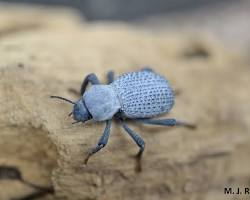
The Blue Death-feigning Beetle (Asbolus verrucosus) is one of the most recognizable desert beetles in North America. This unusual insect is famous for its striking powdery blue coloration and dramatic defensive behavior in which it pretends to be dead when threatened. Because of its calm nature, unique appearance, and hardiness, the species has become popular among insect enthusiasts and educational displays.
The beetle belongs to the darkling beetle family Tenebrionidae, a large group of insects adapted to dry environments. Blue Death-feigning Beetles are native to the deserts of the southwestern United States and northern Mexico, particularly within the Sonoran and Mojave desert regions.
These beetles are commonly found in:
- Desert scrub habitats
- Sandy washes
- Rocky desert terrain
- Arid grasslands
- Cactus environments
- Dry desert valleys
Despite their unusual appearance, Blue Death-feigning Beetles are harmless scavengers that help recycle decaying organic material in desert ecosystems.
Quick Facts
- Order: Coleoptera
- Family: Tenebrionidae
- Scientific Name: Asbolus verrucosus
- Habitat: Southwestern deserts
- Diet: Decaying organic matter
- Status: Beneficial desert decomposer
Identification
Adult Blue Death-feigning Beetles measure approximately:
- 3/4 inch to 1 inch long
Their most distinctive feature is their:
- Matte powdery blue coloration
This coloration comes from a waxy protective coating covering the beetle’s dark exoskeleton. If the coating is removed by moisture or handling, the underlying body appears:
- Dark brown
- Black
Key identifying features include:
- Oval-shaped body
- Rough textured wing covers
- Short sturdy legs
- Hard exoskeleton
- Velvety blue appearance
Unlike many beetles, these insects do not fly because their wing covers are fused shut.
The waxy blue coating helps protect the beetle from:
- Desert heat
- Water loss
- Harsh environmental conditions
Distribution and Habitat
Blue Death-feigning Beetles are native to:
- Arizona
- Southern California
- Nevada
- New Mexico
- Northern Mexico
They are especially common in:
- The Sonoran Desert
- The Mojave Desert
Preferred habitats include:
- Sandy desert soils
- Dry rocky landscapes
- Cactus-filled environments
- Desert washes
- Sparse shrub habitats
During the hottest parts of the day, these beetles often hide beneath:
- Rocks
- Logs
- Desert debris
- Leaf litter
They become more active during cooler temperatures, especially:
- Early morning
- Evening hours
- After rainfall
Life Cycle
Like other beetles, the Blue Death-feigning Beetle undergoes complete metamorphosis consisting of four stages:
- Egg
- Larva
- Pupa
- Adult
Females lay eggs in protected desert soil or beneath organic debris.
After hatching, larvae develop underground where they feed on:
- Decaying plant material
- Organic debris
- Dried vegetation
Larvae resemble mealworms and gradually molt as they grow.
After pupation, adults emerge fully adapted for desert survival.
These beetles are known for their long lifespan compared to many insects and may survive for:
- Several years under favorable conditions
Behavior
The species is best known for its remarkable defensive behavior known as thanatosis, or death-feigning.
When threatened, the beetle may:
- Roll onto its back
- Remain completely motionless
- Pull in its legs
- Pretend to be dead
This behavior helps discourage predators that prefer live prey.
Other defensive strategies include:
- Hard armored exoskeleton
- Camouflage against desert surfaces
- Protective wax coating
Blue Death-feigning Beetles are primarily scavengers and feed on:
- Dead plant matter
- Organic debris
- Dried vegetation
- Decaying desert material
They help recycle nutrients within fragile desert ecosystems.
Pest Status
Blue Death-feigning Beetles are not considered pests.
They do not:
- Damage homes
- Infest structures
- Attack crops
- Bite humans
- Spread disease
Instead, they are considered beneficial decomposers that contribute positively to desert environments.
Because of their harmless nature and fascinating appearance, they are often appreciated by:
- Naturalists
- Educators
- Insect hobbyists
- Wildlife enthusiasts
Adaptations for Desert Survival
Blue Death-feigning Beetles possess several important desert adaptations.
These include:
- Protective wax coating to reduce dehydration
- Nocturnal or crepuscular activity patterns
- Efficient moisture retention
- Ability to tolerate high desert temperatures
- Strong armored exoskeleton
The powdery blue coating is especially important because it helps reflect sunlight and reduce water loss.
Prevention
No prevention measures are necessary because Blue Death-feigning Beetles are harmless.
In natural environments, they should generally be left undisturbed due to their ecological importance.
Control
Control is not recommended.
These beetles are beneficial members of desert ecosystems and rarely interact negatively with humans.
If found near homes or outdoor areas, they can simply be relocated without harm.
Interesting Facts
- The beetle’s blue color comes from a wax coating rather than body pigment.
- It can survive in extremely dry desert conditions.
- The species cannot fly because its wing covers are fused shut.
- Death-feigning behavior helps deter predators.
- These beetles are popular in educational insect exhibits.
- The species may live for several years in captivity.