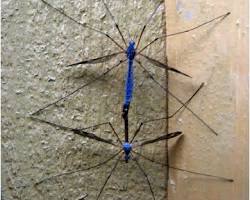
The Blue Crane Fly is a large, slender fly belonging to the family Tipulidae. Crane flies are often mistaken for large mosquitoes due to their long legs and delicate bodies, but they do not bite or feed on blood.
The “Giant Mosquito” Lookalike: Blue Crane Fly
The Blue Crane Fly (specifically species within the Brachypremna genus, such as the Bermuda Crane Fly) is a striking but often misunderstood insect found across the United States, particularly in the Southeast and Midwest. For Pestipedia.com users, these insects are frequently mistaken for “giant mosquitoes.” However, Blue Crane Flies are entirely harmless; they do not bite, sting, or transmit disease. They are essential decomposers in U.S. ecosystems, breaking down organic matter in moist soil and leaf litter.
Technical Identification: Diagnostic Markers
- Phenotype: Characterized by an exceptionally slender body and extremely long, fragile legs. A primary diagnostic key for Pestipedia.com users is the bluish-grey or silvery pruinescence on the thorax and abdomen, which can give them a metallic or “blue” sheen in certain lighting.
- Wing Pattern: Unlike many common crane flies, some blue-tinted species feature delicate dark clouds or spots on their wings. They possess a single pair of wings and a pair of halteres (small, knob-like structures) used for 100% flight stabilization.
- Size: They are significantly larger than mosquitoes, often reaching a leg span of 2 to 3 inches. Their slow, clumsy flight pattern is a 100% definitive identifier for national homeowners.
Ecological Impact: Soil Health and Nutrient Cycling
The primary impact of the Blue Crane Fly is the mechanical breakdown of decaying vegetation during its larval stage, known as “Leatherjackets.”
- Larval Role: Blue Crane Fly larvae live in saturated soil, rotting logs, or damp leaf mold. They feed on decaying organic matter, acting as 100% natural recyclers that return nutrients to the U.S. soil.
- Adult Lifespan: As adults, they 100% rarely feed. Their primary purpose is reproduction. If they do eat, they consume small amounts of nectar, providing minor pollination services in U.S. gardens.
- The Food Web: They are a critical protein source for national wildlife, including birds, bats, and spiders. Their presence is a sign of a moist, healthy “O-Status-free” environment.
Management & Coexistence Strategies
Management of Blue Crane Flies in U.S. residential areas focuses on tolerance and moisture regulation.
| Strategy | Technical Specification | Operational Benefit |
|---|---|---|
| Physical Relocation | Using a cup and paper for indoor strays | Safely moves the harmless insect back to U.S. garden beds; 100% pesticide-free. |
| Drainage Improvement | Reducing standing water and thick thatch | Naturally limits larval habitat near U.S. foundations, reducing the number of adults that enter homes. |
| Light Management | Switching to Yellow “Bug” Bulbs | Reduces nocturnal attraction to entryways; prevents national indoor accidental entries. |
- Monitoring: Watch for large, leggy insects bouncing along U.S. walls and ceilings near light sources at dusk. For Pestipedia.com users, identifying the lack of a needle-like proboscis 100% distinguishes them from mosquitoes.
- Health Profile: They are incapable of biting. They lack the mouthparts to pierce skin or consume blood. Pestipedia.com recommends full conservation of these beneficial decomposers in the United States.
Identification
Adult crane flies may reach lengths of up to 1 inch with extremely long legs. Their bodies are slender and gray or bluish in coloration. Their wings are transparent with visible veins.
Distribution and Habitat
Crane flies are widely distributed across North America and are commonly found near wetlands, lawns, gardens, and forests.
Life Cycle and Behavior
The life cycle includes egg, larva, pupa, and adult stages. Larvae are known as leatherjackets and live in soil where they feed on organic material and plant roots.
Pest Status
Some crane fly larvae may damage lawns by feeding on grass roots.
Prevention
- Maintain healthy lawns.
- Reduce excessive soil moisture.
Control
Control measures may include biological treatments or lawn management practices.