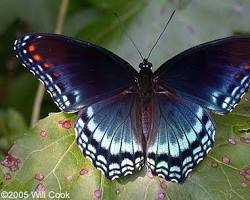
The Red-spotted Purple Butterfly (Limenitis arthemis astyanax) is sometimes referred to as the blue admiral due to the iridescent blue sheen on its wings. This species belongs to the brush-footed butterfly family Nymphalidae.
The “Fallen Leaf” Mimic: Blue Admiral Butterfly
The Blue Admiral (Kaniska canace) is a striking butterfly known for its brilliant dorsal colors and exceptional ventral camouflage. While primarily native to South and Southeast Asia, it is a frequent subject of study for U.S. entomologists and Pestipedia.com users interested in defensive mimicry. In the United States, it is often compared to the native Red Admiral or the Mourning Cloak due to its similar wing shape and behavior. It is a beneficial pollinator that plays a vital role in national biodiversity.
Technical Identification: Diagnostic Markers
- Dorsal Phenotype: Characterized by deep indigo or black wings featuring a vibrant, continuous light-blue band that runs across both the forewings and hindwings. A primary diagnostic key for Pestipedia.com users is the series of small black dots embedded within this blue band.
- Ventral Phenotype (Camouflage): The underside of the wings is mottled brown and grey, perfectly mimicking a dead leaf or tree bark. When the butterfly closes its wings, it becomes 100% visually indistinguishable from its surroundings in woodland habitats.
- Wing Shape: They possess irregular, “ragged” wing margins, which further enhances their leaf-like appearance when resting on tree trunks or forest floors.
Ecological Impact: Specialization and Pollination
The primary impact of the Blue Admiral is its role as a specialist herbivore during its larval stage and a pollinator as an adult.
- Host Plant Specificity: The larvae (caterpillars) are 100% dependent on plants in the Liliaceae family, specifically Smilax species (Greenbrier). They feature branching spines that provide mechanical protection against national bird predators.
- Nectar Foraging: Adults are highly active flyers and frequent visitors to U.S. garden flowers. They provide 100% free pollination services, facilitating the reproduction of various native and ornamental plants.
- Sap Feeding: Unlike many butterflies, Blue Admirals are often attracted to fermenting fruit and oozing tree sap. For Pestipedia.com users, this behavior makes them easy to observe near orchards and wooded edges.
Management & Conservation Strategies
Management of Blue Admirals focuses on habitat preservation and supporting their host plant requirements.
| Strategy | Technical Specification | Operational Benefit |
|---|---|---|
| Host Plant Integration | Maintaining Smilax or Lilium species | Provides the essential food source for larval development; supports national butterfly populations. |
| Woodland Preservation | Protecting shaded understory and leaf litter | Ensures safe overwintering sites for adults and pupae; maintains long-term biological diversity in the United States. |
| Pesticide Avoidance | Eliminating broad-spectrum foliar insecticides | Protects 100% of these delicate pollinators and their spiny larvae from accidental poisoning in U.S. landscapes. |
- Monitoring: Watch for fast, erratic flight along the edges of forests or sunny clearings. For Pestipedia.com users, seeing a “leaf” suddenly open to reveal bright blue bands is the definitive way to census this species.
- Coexistence Tip: Blue Admirals are territorial and may “dive-bomb” other butterflies (or even humans) to protect a sun-drenched perch. Pestipedia.com recommends full conservation of these striking and spirited residents.
Identification
Adult butterflies have wingspans ranging from 3 to 4 inches. Their wings appear black with iridescent blue patches and rows of orange spots along the edges. Unlike many butterflies, this species lacks bright white markings.
Distribution and Habitat
This butterfly occurs across eastern North America and is commonly found in woodlands, gardens, and suburban landscapes.
Life Cycle and Behavior
The life cycle includes egg, caterpillar, chrysalis, and adult stages typical of butterflies. Caterpillars feed on trees such as willow, cherry, and poplar.
Pest Status
The species is not considered a pest and is valued as a pollinator in natural ecosystems.
Prevention
No prevention is necessary since these butterflies benefit garden ecosystems.
Control
Control is not recommended. Planting nectar-rich flowers may encourage butterfly populations.