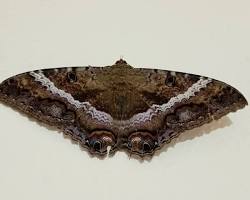
The Black Witch Moth (Ascalapha odorata) is one of the largest and most mysterious moth species found in North America. Famous for its enormous wingspan, dark coloration, and striking appearance, this moth has inspired folklore, myths, and superstition across many cultures throughout the Americas. Despite its intimidating size and shadowy appearance, the Black Witch Moth is completely harmless to humans and is generally considered an interesting migratory insect rather than a pest.
The Black Witch Moth belongs to the family Erebidae, a large family of moths that includes many nocturnal species. These moths are primarily active at night and are often attracted to lights during migration events. Their dark wings provide excellent camouflage against tree bark, walls, and shaded surfaces, helping them avoid predators during daylight hours.
Although most commonly associated with tropical and subtropical regions, Black Witch Moths occasionally migrate far north into the United States and even southern Canada during warm seasons. Their unexpected appearances often attract attention because of their impressive size and unusual appearance.
Quick Facts
- Scientific Name: Ascalapha odorata
- Family: Erebidae
- Common Habitat: Forests, gardens, woodlands, tropical regions
- Wingspan: Up to 6–7 inches
- Diet: Tree and vine foliage (larvae), fruit and nectar (adults)
- Status: Harmless migratory moth
Identification
The Black Witch Moth is one of the largest moths in North America.
Key identifying characteristics include:
- Very large wingspan
- Dark brown to black wings
- Mottled bark-like wing patterns
- Subtle eyespots and pale markings
- Broad triangular wings
- Strong rapid flight
Adult moths may reach:
- Over 6 inches in wingspan
Females are generally:
- Larger
- Lighter brown in coloration
- More heavily patterned
Males often appear:
- Darker
- More uniformly black or chocolate brown
- Marked with pale bands or spots
The wing patterns resemble:
- Dead leaves
- Tree bark
- Shadowed wood surfaces
This camouflage helps protect the moth during daytime resting periods.
Like many other moths, the Black Witch possesses scaled wings and feathery sensory structures used for navigation and detecting mates.
Distribution and Habitat
The Black Witch Moth is native to tropical and subtropical regions of the Americas.
It is commonly found in:
- Mexico
- Central America
- South America
- Southern United States
- Caribbean regions
Seasonal migrations sometimes carry these moths far north into:
- Texas
- Arizona
- Florida
- California
- Midwestern states
- Southern Canada
Preferred habitats include:
- Tropical forests
- Woodlands
- Gardens
- Parks
- Dense vegetation
- Tree-lined urban areas
Adults are commonly attracted to:
- Outdoor lights
- Porches
- Walls
- Fruit sources
Life Cycle
The Black Witch Moth undergoes complete metamorphosis.
The life stages include:
- Egg
- Caterpillar
- Pupa
- Adult moth
Females deposit eggs on suitable host plants.
Caterpillars feed primarily on:
- Leguminous plants
- Acacia species
- Cassia plants
- Mesquite relatives
- Tropical shrubs and vines
The caterpillars are typically:
- Brownish
- Well camouflaged
- Elongated in appearance
After completing development, larvae pupate in protected locations among leaves or debris.
Adults emerge as powerful nocturnal fliers capable of traveling long distances.
Behavior
Black Witch Moths are primarily nocturnal.
Adults are active during:
- Nighttime hours
- Warm evenings
- Migration periods
During the day they typically rest on:
- Tree trunks
- Walls
- Wooden surfaces
- Dark shaded structures
Their camouflage makes them surprisingly difficult to spot despite their large size.
Adults feed on:
- Overripe fruit
- Tree sap
- Nectar
- Fermenting plant material
Unlike some pest moth species, Black Witch Moths rarely occur in large enough numbers to cause significant plant damage.
Folklore and Cultural Significance
The Black Witch Moth has long been associated with myths and folklore throughout the Americas.
In some cultures, sightings are believed to represent:
- Good luck
- Death omens
- Spiritual messages
- Visiting souls
- Weather changes
In parts of Mexico and Central America, the moth is sometimes called:
- “Mariposa de la Muerte”
Meaning:
- “Butterfly of Death”
Despite these legends, the moth is completely harmless and poses no danger to humans.
Pest Status
The Black Witch Moth is not considered a pest species.
Reasons include:
- Low population densities
- Minimal larval feeding damage
- Limited agricultural impact
- Non-destructive adult behavior
Caterpillar feeding rarely causes noticeable damage to host plants.
Most encounters with Black Witch Moths are brief and harmless.
Prevention
No prevention measures are generally necessary.
Because these moths are harmless, they are usually appreciated as interesting wildlife visitors.
Outdoor lighting may attract adult moths during migration periods.
Control
Control measures are almost never required.
If a moth enters a structure accidentally, it can simply be:
- Captured gently
- Released outdoors
- Allowed to exit naturally
The species does not infest homes, stored food, or structural materials.
Interesting Facts
- The Black Witch Moth is among the largest moths in North America.
- Its wingspan may exceed 6 inches.
- The species can migrate surprisingly long distances.
- Its wing patterns provide exceptional camouflage.
- Many cultures associate the moth with folklore and superstition.
- Despite its dramatic appearance, the moth is harmless.