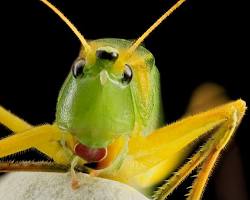
The Black-tipped Conehead Katydid (Neoconocephalus triops) is a large, grasshopper-like insect belonging to the family Tettigoniidae. This species is recognized for its long green body, cone-shaped head, and loud buzzing calls heard during warm summer evenings. Like other katydids, it is closely related to crickets and grasshoppers and is commonly found in grassy habitats throughout North America.
The Black-tipped Conehead Katydid is most often encountered in:
- Tall grass prairies
- Wetlands
- Roadside vegetation
- Fields
- Pastures
- Agricultural landscapes
- Overgrown gardens
Its name comes from the pointed cone-like projection on the head, a feature shared by conehead katydids. These insects are especially active during late summer and are commonly heard at night producing continuous buzzing songs.
Although they occasionally feed on vegetation, Black-tipped Conehead Katydids are usually not considered serious pests because populations are generally low and feeding damage remains minor.
Quick Facts
- Order: Orthoptera
- Family: Tettigoniidae
- Scientific Name: Neoconocephalus triops
- Habitat: Grasslands, wetlands, fields, roadside vegetation
- Diet: Plant material and small insects
- Status: Minor plant feeder
Identification
Adult Black-tipped Conehead Katydids are relatively large insects, typically measuring between 1 and 1.5 inches long.
Key identifying features include:
- Bright green body coloration
- Long narrow wings
- Distinct cone-shaped head
- Dark or black-tipped cone projection
- Extremely long antennae
- Strong hind legs for jumping
The antennae may exceed the entire body length and are used for:
- Navigation
- Detecting vibrations
- Finding mates
- Sensing predators
Their long wings allow strong flight capabilities, especially during warm nighttime conditions.
Nymphs resemble smaller wingless adults and gradually develop through several molts before reaching maturity.
Distribution and Habitat
The Black-tipped Conehead Katydid occurs throughout large portions of North America, especially in warm and humid regions.
Preferred habitats include:
- Prairies
- Wet meadows
- Marsh edges
- Agricultural fields
- Dense grassy vegetation
- Roadside grasses
These insects prefer areas with:
- Tall grasses
- Dense vegetation
- Warm temperatures
- Moist environments
During the daytime, they often remain hidden among grass stems where their green coloration provides effective camouflage.
Adults become especially active during evening and nighttime hours.
Life Cycle
Like other katydids and crickets, the Black-tipped Conehead Katydid undergoes incomplete metamorphosis.
The life cycle includes:
- Egg
- Nymph
- Adult
Females deposit eggs into:
- Grass stems
- Plant tissues
- Soil near vegetation
Eggs overwinter and hatch during warm weather.
Nymphs resemble miniature adults but lack fully developed wings. As they mature, they pass through several molts before becoming winged adults.
Adults are usually most abundant during:
- Mid-summer
- Late summer
- Early fall
Behavior
One of the most recognizable characteristics of conehead katydids is their loud calling behavior.
Males produce buzzing or rattling songs to:
- Attract females
- Establish territory
- Communicate with other katydids
The sounds are created through a process called stridulation, where specialized wing structures are rubbed together.
Black-tipped Conehead Katydids are:
- Strong jumpers
- Capable fliers
- Mostly nocturnal
- Well camouflaged among vegetation
They feed on:
- Grass blades
- Plant leaves
- Seeds
- Small insects
- Soft plant tissues
Although primarily herbivorous, some conehead katydids occasionally consume small insects or dead organic material.
Pest Status
The Black-tipped Conehead Katydid is generally considered a minor plant feeder rather than a serious pest.
In most environments:
- Population levels remain low
- Plant damage is minimal
- Feeding rarely threatens crops
Occasionally, large populations may feed on:
- Garden plants
- Field crops
- Ornamental grasses
However, damage is typically insignificant compared to major agricultural pests such as grasshoppers or armyworms.
Ecological Importance
Black-tipped Conehead Katydids contribute to local ecosystems by serving as:
- Food for birds
- Prey for reptiles
- Food sources for spiders
- Participants in grassland food webs
Their nighttime songs also contribute to the characteristic sounds of summer grasslands and wetlands.
Prevention
Prevention measures are rarely necessary because this species seldom causes significant plant damage.
Maintaining balanced ecosystems helps naturally regulate populations.
- Encourage birds and beneficial predators.
- Maintain healthy vegetation.
- Monitor gardens for excessive feeding.
- Avoid unnecessary pesticide applications.
Control
Control is rarely required.
If populations become unusually large in gardens or agricultural settings, management options may include:
- Manual removal
- Habitat modification
- Targeted insect control methods
Because these insects are important parts of natural ecosystems, widespread insecticide use is generally discouraged.
Interesting Facts
- Conehead katydids can produce very loud nighttime calls.
- Their long antennae may exceed the body length.
- They are closely related to crickets and grasshoppers.
- The cone-shaped head helps distinguish them from other katydids.
- Their green coloration provides excellent camouflage in grasses.
- Some conehead species are capable of long-distance flight.