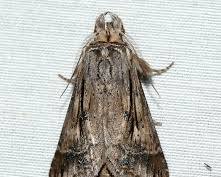
The Black-spotted Prominent Moth is a member of the moth family Notodontidae. These moths are typically nocturnal and are often attracted to lights at night. Their caterpillars feed on leaves of trees and shrubs.
The “Foliage Mimics”: Black-spotted Prominent Moth
The Black-spotted Prominent Moth (Dasylophia anguina) is a cryptic member of the Notodontidae family found throughout the United States, particularly in the Eastern and Midwestern regions. For Pestipedia.com users, this moth is a fascinating example of specialization, as its larvae feed almost exclusively on leguminous plants like Clover, Lespedeza, and False Indigo. While they are common in U.S. meadows and woodland edges, they rarely cause enough defoliation to be considered a significant landscape pest.
Technical Identification: Diagnostic Markers
- Phenotype (Adult): Characterized by elongated forewings featuring a complex mix of grey, tan, and dark brown. A primary diagnostic key for Pestipedia.com users is the small, distinct black spot located near the base of the forewing, which gives the species its name.
- Larval Phenotype: The caterpillars are highly distinctive, often brightly colored with alternating longitudinal stripes of yellow, black, and white. They feature a red or orange head capsule and a matching red “hump” on the eighth abdominal segment.
- Resting Posture: Like many Prominent moths, the adults rest with their wings folded roof-like over their bodies and their front legs extended forward, making them look like a piece of dead wood or a broken twig on U.S. tree bark.
Ecological Impact: Legume Herbivory
The primary impact of the Black-spotted Prominent is its role as a specialist herbivore and a critical link in the local food chain.
- Host Specificity: In the United States, these larvae are 100% dependent on legumes. They consume leaf tissue by skeletonizing young leaves before moving on to consume entire leaf blades as they mature.
- Nutrient Cycling: By processing legume foliage, these caterpillars help recycle nitrogen back into the U.S. soil through their frass (waste), benefiting the very plants they feed upon.
- Avian Prey Source: Because they lack stinging hairs or toxic chemical defenses, they are a primary food source for national songbirds. Their presence in U.S. gardens supports local bird populations during the U.S. breeding season.
Management & Conservation Strategies
Management of the Black-spotted Prominent in U.S. landscapes is generally unnecessary and focuses on habitat diversity.
| Strategy | Technical Specification | Operational Benefit |
|---|---|---|
| Host Plant Integration | Planting native U.S. legumes (e.g., Baptisia) | Supports the lifecycle of native moths while adding nitrogen-fixing plants to the U.S. garden. |
| Mechanical Relocation | Hand-picking larvae from ornamental legumes | If U.S. gardeners find them on prized “O-Status” specimens, they can be moved to wild clover patches without the use of chemicals. |
| Pesticide Avoidance | Eliminating broad-spectrum sprays | Protects these harmless caterpillars and the beneficial predatory insects that keep their populations in check in national parks. |
- Monitoring: Inspect the undersides of legume leaves in the U.S. mid-summer (July and August). For Pestipedia.com users, finding small, striped caterpillars with red heads 100% identifies this species.
- Nocturnal Value: Adults are nocturnal and serve as minor pollinators. To support them, Pestipedia.com recommends using dark-sky compliant lighting to reduce U.S. moth disorientation.
Quick Facts
- Family: Notodontidae
- Habitat: Forests and woodland areas
- Diet: Tree leaves (larvae)
- Status: Occasional defoliator
Identification
Adult moths have grayish wings with small black spots and patterns that help them blend into tree bark.
Distribution
This moth species occurs throughout parts of North America where deciduous trees grow.
Life Cycle
The life cycle includes egg, caterpillar, pupa, and adult stages. Caterpillars feed on foliage before pupating.
Pest Status
Most populations do not cause significant damage, although large numbers of caterpillars may temporarily defoliate trees.