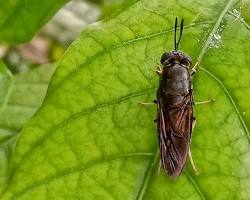
The Black Soldier Fly (Hermetia illucens) is one of the most beneficial decomposer insects found in North America and many other warm regions of the world. Although the adult fly resembles a slender black wasp, it is completely harmless to humans and animals. Black soldier flies do not bite, sting, or spread disease like some other fly species. Instead, they play an important ecological role by rapidly breaking down decaying organic material through their highly efficient larval stage.
The larvae of black soldier flies are widely recognized for their ability to consume food waste, manure, compost, and decaying organic material. Because of this remarkable feeding behavior, the species has become increasingly important in composting systems, sustainable agriculture, animal feed production, and commercial waste management operations.
Unlike nuisance house flies, adult black soldier flies rarely enter homes and are not attracted to human food. In fact, their presence can actually help suppress populations of pest flies by competing for breeding material. For this reason, black soldier flies are widely considered highly beneficial insects.
Quick Facts
- Scientific Name: Hermetia illucens
- Family: Stratiomyidae
- Common Habitat: Compost piles, manure, decaying organic matter
- Adult Size: Approximately 5/8 to 3/4 inch long
- Diet: Decomposing organic waste
- Status: Beneficial decomposer insect
Identification
Adult black soldier flies are easily recognized by their dark wasp-like appearance.
Key identifying features include:
- Black elongated body
- Long slender legs
- Dark smoky wings folded flat over the back
- Narrow waist-like body shape
- White translucent patches near the abdomen
- Large compound eyes
Adults are often mistaken for:
- Wasps
- Mud daubers
- Large gnats
- Other black flies
However, unlike stinging insects, black soldier flies:
- Cannot sting
- Do not bite
- Rarely land on people
- Do not invade kitchens
The larvae are very different in appearance from the adults.
Larval characteristics include:
- Flattened segmented bodies
- Dark gray or brown coloration
- Tough leathery skin
- Maggot-like appearance
- Length up to 1 inch
The larvae are commonly found in:
- Compost bins
- Manure piles
- Organic waste containers
- Decaying vegetation
Distribution and Habitat
Black soldier flies occur throughout much of the world, especially in warm and humid climates.
In North America, they are especially common in:
- Southern states
- Agricultural areas
- Composting facilities
- Urban gardens
- Livestock operations
Preferred habitats include:
- Compost piles
- Decaying plant matter
- Animal manure
- Organic waste
- Moist decomposing materials
Adults are usually seen resting on:
- Vegetation
- Walls
- Fences
- Compost bins
- Garden structures
Unlike many pest fly species, adult black soldier flies are not strongly attracted to indoor environments.
Life Cycle
Black soldier flies undergo complete metamorphosis.
The life stages include:
- Egg
- Larva
- Pupa
- Adult
Adult females deposit eggs near decomposing organic matter rather than directly inside it.
After hatching, larvae immediately begin feeding on nearby waste materials.
The larval stage is the longest and most important stage in terms of decomposition.
Larvae consume:
- Food scraps
- Fruit waste
- Vegetable waste
- Animal manure
- Decaying organic matter
As larvae mature, they become darker and eventually stop feeding before entering the pupal stage.
Adults emerge from pupae and live relatively short lives focused primarily on reproduction.
Interestingly, adult black soldier flies consume very little food compared to many other flies.
Behavior
Black soldier fly larvae are highly efficient decomposers.
Their feeding behavior provides several environmental benefits:
- Rapid breakdown of organic waste
- Reduction of odors
- Reduction of pest fly breeding
- Nutrient recycling
- Compost production
Larvae can consume large amounts of organic material quickly, making them valuable in:
- Commercial composting
- Sustainable farming
- Waste reduction programs
- Livestock feed production
Adult flies are calm and slow-moving compared to house flies.
They are commonly seen:
- Resting in sunny areas
- Hovering near compost
- Mating near breeding sites
- Exploring organic waste locations
Unlike pest flies, they do not spread filth between garbage and food preparation areas.
Pest Status
Black soldier flies are considered highly beneficial insects.
Benefits include:
- Waste decomposition
- Natural compost production
- Reduction of nuisance fly populations
- Organic nutrient recycling
- Sustainable animal feed potential
The larvae outcompete many nuisance fly species for breeding resources.
Because adults do not feed heavily on human foods, they are far less problematic than:
- House flies
- Blow flies
- Fruit flies
In many compost systems, black soldier fly larvae are intentionally encouraged.
Prevention
Prevention is usually unnecessary because black soldier flies are beneficial.
However, to discourage breeding near structures:
- Keep compost bins covered.
- Reduce exposed organic waste.
- Maintain dry waste containers.
- Remove excessive manure accumulation.
In most cases, their presence is considered environmentally positive.
Control
Control is rarely required.
If populations become excessive:
- Reduce moisture in compost.
- Cover exposed food waste.
- Improve sanitation around organic debris.
- Remove breeding materials.
Chemical treatment is generally unnecessary and discouraged because these insects provide major ecological benefits.
Interesting Facts
- Black soldier fly larvae are widely used in commercial composting systems.
- The larvae can dramatically reduce food waste volume.
- Adults do not bite or sting.
- The species helps suppress populations of nuisance flies.
- Larvae are increasingly used as sustainable animal feed.
- Adults resemble wasps but are completely harmless.