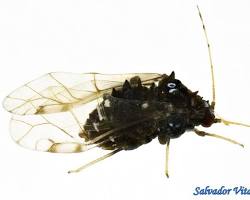
The Black Pecan Aphid (Melanocallis caryaefoliae) is a destructive sap-feeding insect that commonly infests pecan trees throughout the southern United States and other pecan-growing regions. Unlike many aphid species that primarily cause cosmetic plant damage, the Black Pecan Aphid is considered one of the most economically important aphid pests affecting pecan production because its feeding causes distinctive leaf injury that can significantly reduce tree vigor and nut yield.
These aphids feed primarily on the undersides of pecan leaves where they use specialized piercing-sucking mouthparts to extract plant sap. Their feeding introduces toxins into leaf tissue that cause characteristic yellow angular spots between leaf veins. Severe infestations may lead to premature leaf drop, weakened trees, reduced nut production, and increased stress during hot summer conditions.
Black pecan aphids are especially problematic in commercial orchards where favorable weather conditions allow populations to increase rapidly. Warm temperatures, dense foliage, and prolonged dry periods often contribute to large outbreaks. Because multiple generations may occur during a single growing season, populations can escalate quickly if left unmanaged.
Quick Facts
- Family: Aphididae
- Scientific Name: Melanocallis caryaefoliae
- Primary Host: Pecan trees
- Size: Approximately 1/16 inch long
- Color: Dark brown to black
- Status: Major pecan orchard pest
Identification
Black pecan aphids are small soft-bodied insects commonly found clustered on the undersides of pecan leaves.
Key identifying features include:
- Dark brown or black coloration
- Tiny pear-shaped bodies
- Long legs and antennae
- Soft-bodied appearance
- Colonies concentrated beneath leaves
- Yellow leaf spotting caused by feeding
Adults typically measure:
- Around 1/16 inch long
Both winged and wingless forms may occur depending on population density and environmental conditions.
The most recognizable sign of infestation is often the leaf damage rather than the insects themselves.
Typical feeding injury includes:
- Bright yellow angular spots
- Leaf discoloration between veins
- Premature browning
- Leaf drop during severe infestations
Heavy infestations may also produce sticky honeydew deposits similar to other aphids.
Distribution and Habitat
Black pecan aphids are widely distributed throughout the southern United States where pecan cultivation is common.
They are especially abundant in:
- Texas
- Georgia
- Oklahoma
- New Mexico
- Louisiana
- Mississippi
- Arizona pecan-growing areas
The insects thrive in:
- Commercial pecan orchards
- Residential landscapes
- Urban pecan plantings
- Warm humid climates
Preferred habitats include mature pecan trees with dense canopies where humidity and shade help support aphid development.
Life Cycle
Black pecan aphids reproduce rapidly and may complete numerous generations during a single growing season.
The life cycle includes:
- Egg
- Nymph
- Adult
Like many aphid species, females are capable of reproducing without mating during favorable conditions.
This rapid reproductive ability allows populations to increase quickly during:
- Warm weather
- Late summer conditions
- Periods of low rainfall
- Stable orchard environments
Nymphs resemble smaller wingless adults and begin feeding immediately after birth.
Winged adults may develop when:
- Colonies become overcrowded
- Plant quality declines
- Environmental conditions change
These winged forms help spread infestations to nearby trees.
Behavior and Feeding Damage
The Black Pecan Aphid feeds by inserting needle-like mouthparts into leaf tissue and extracting plant sap.
Unlike many aphids that mainly remove nutrients, this species injects toxins into the leaf during feeding.
Damage symptoms include:
- Bright yellow chlorotic spots
- Leaf tissue death
- Premature defoliation
- Reduced photosynthesis
- Weakened tree vigor
- Lower nut production
Severe infestations may cause:
- Significant leaf drop
- Reduced nut size
- Poor kernel filling
- Tree stress during drought
Honeydew production may also lead to:
- Sooty mold development
- Sticky leaves
- Attraction of ants
Trees repeatedly stressed by aphid infestations become more vulnerable to:
- Drought stress
- Secondary pests
- Reduced orchard productivity
Pest Status
The Black Pecan Aphid is considered one of the most important aphid pests affecting pecan production.
Economic impacts include:
- Reduced nut yields
- Poor nut quality
- Premature defoliation
- Long-term tree stress
- Increased orchard management costs
Unlike some minor aphid species, Black Pecan Aphids can cause serious commercial damage when populations become high.
Young trees and stressed orchards are especially vulnerable.
Prevention
Preventive management focuses on maintaining healthy trees and monitoring populations closely.
- Inspect pecan leaves regularly during warm months.
- Encourage beneficial insects such as lady beetles.
- Maintain proper irrigation during drought.
- Avoid excessive nitrogen fertilization.
- Prune trees to improve airflow.
- Monitor orchards for early yellow spotting symptoms.
Balanced orchard management helps reduce severe outbreaks.
Control
Integrated pest management is commonly used to control Black Pecan Aphids.
Management options include:
- Biological control predators
- Insecticidal soaps
- Horticultural oils
- Selective insecticides
- Population monitoring programs
Natural predators include:
- Lady beetles
- Lacewings
- Parasitic wasps
- Predatory bugs
In commercial orchards, treatment decisions are often based on:
- Leaf damage thresholds
- Aphid population density
- Tree stress conditions
- Weather patterns
Proper timing is critical because aphid populations can increase rapidly during hot weather.
Interesting Facts
- Black Pecan Aphids inject toxins into leaves while feeding.
- This species can cause more serious leaf damage than many other aphids.
- Several generations may develop during one growing season.
- Pecan orchards often rely heavily on biological control predators.
- Leaf yellowing caused by this aphid is highly distinctive.
- Hot dry weather often increases infestation severity.