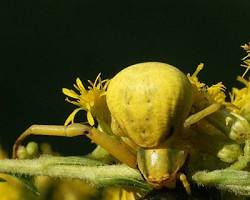
The Goldenrod Crab Spider (Misumena vatia) is a small but highly specialized ambush spider known for its remarkable ability to change color between white and yellow. This adaptation allows the spider to blend into flowers where it waits motionless for prey such as bees, flies, butterflies, and other pollinating insects. Although small in size, the goldenrod crab spider is an effective predator that plays an important role in garden and meadow ecosystems.
Unlike many other spiders, the goldenrod crab spider does not build a web to capture prey. Instead, it relies on camouflage and patience, remaining hidden among flower petals until an unsuspecting insect lands nearby. The spider then rapidly grabs its prey using powerful front legs and injects venom to immobilize it.
This species is commonly found on flowering plants such as:
- Goldenrod
- Daisies
- Sunflowers
- Milkweed
- Queen Anne’s lace
- Garden ornamentals
Because goldenrod crab spiders feed on many flying insects, they are generally considered beneficial predators in natural habitats and gardens.
The species belongs to the larger group of crab spiders, which are named for their crab-like appearance and sideways walking behavior.
Quick Facts
- Order: Araneae
- Family: Thomisidae
- Habitat: Flowering plants, gardens, meadows, fields
- Diet: Bees, flies, butterflies, and other insects
- Hunting Style: Ambush predator
- Status: Beneficial predator
Identification
The Goldenrod Crab Spider is easily recognized by its rounded body and sideways-oriented front legs.
Adult females generally measure:
- About 1/4 inch long
Males are much smaller and less colorful than females.
Common identifying features include:
- Bright yellow or white coloration
- Large front legs held outward
- Rounded abdomen
- Crab-like posture
- Ability to walk sideways
One of the species’ most fascinating characteristics is its ability to slowly change color between:
- White
- Yellow
This color adaptation helps the spider match the flower on which it is hunting.
The color change process may take:
- Several days
This camouflage allows the spider to remain nearly invisible to both predators and prey.
Distribution and Habitat
Goldenrod crab spiders occur widely throughout North America and parts of Europe.
They are most commonly found in:
- Gardens
- Meadows
- Prairies
- Roadside vegetation
- Wildflower fields
- Wetland edges
- Flower beds
The species strongly prefers habitats with:
- Abundant flowering plants
- Pollinator activity
- Warm sunlight
- Dense vegetation
Goldenrod and daisy flowers are among the most common hunting sites for this spider.
The spider typically remains hidden directly on:
- Flower petals
- Flower centers
- Stem junctions
- Leaf surfaces near blossoms
Life Cycle
Like other spiders, the Goldenrod Crab Spider develops through several immature stages before reaching adulthood.
The life stages include:
- Egg
- Spiderling
- Juvenile molts
- Adult
Females produce silk egg sacs that are attached to:
- Leaves
- Flower stems
- Protected vegetation
The female often guards the egg sac until the spiderlings emerge.
Young spiderlings resemble miniature adults and molt several times while growing.
As they mature, they gradually develop:
- Adult coloration
- Larger front legs
- Improved camouflage abilities
Adults are most commonly observed during:
- Late spring
- Summer
- Early fall
Behavior
Goldenrod crab spiders are ambush predators rather than web-builders.
Instead of spinning capture webs, they:
- Remain motionless on flowers
- Wait for pollinators to approach
- Strike suddenly with front legs
- Inject venom into prey
Prey commonly includes:
- Bees
- Flies
- Butterflies
- Moths
- Small beetles
- Wasps
The spider’s camouflage allows it to remain nearly invisible while hunting.
Unlike aggressive hunting spiders, goldenrod crab spiders rely on:
- Patience
- Camouflage
- Stealth
Natural predators include:
- Birds
- Larger spiders
- Parasitic wasps
- Predatory insects
Pest Status
The Goldenrod Crab Spider is considered a beneficial predator.
It does not:
- Damage plants
- Infest structures
- Feed on crops
- Create nuisance infestations
Although the spider may capture some pollinators such as bees, it also helps reduce populations of:
- Flies
- Plant-feeding insects
- Small nuisance pests
The species is harmless to humans and rarely bites.
Bites are extremely uncommon and usually occur only if the spider is directly handled.
Prevention
No prevention measures are necessary because the species is harmless and beneficial.
Many gardeners intentionally encourage crab spiders by planting:
- Native flowers
- Pollinator gardens
- Wildflower habitats
- Nectar-producing plants
Healthy ecosystems naturally support balanced spider populations.
Control
Control is not recommended.
Goldenrod crab spiders provide natural pest control and contribute to biodiversity in outdoor environments.
If relocation is necessary, the spider can simply be moved gently to another flowering plant.
Chemical treatments are discouraged because they may harm:
- Pollinators
- Beneficial predators
- Native spiders
- Garden ecosystems
Interesting Facts
- Goldenrod crab spiders can slowly change color to match flowers.
- They do not spin webs to catch prey.
- Their front legs resemble crab claws.
- Females are much larger than males.
- They often capture insects larger than themselves.
- The species is one of the best-known flower ambush spiders in North America.