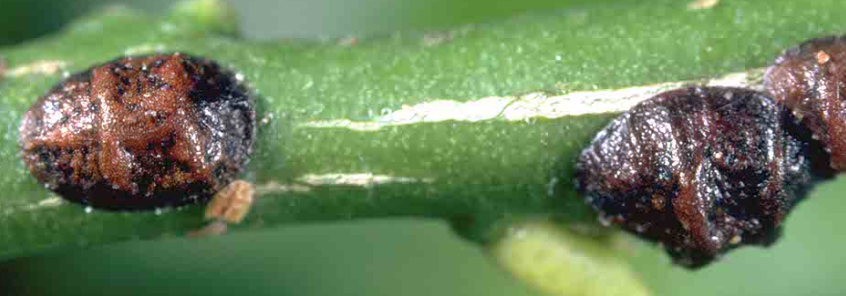
The Black Olive Scale (Saissetia oleae) is a destructive sap-feeding insect belonging to the soft scale family Coccidae. This species is one of the most important scale insect pests affecting olive trees worldwide, although it also infests many ornamental shrubs, citrus trees, and landscape plants. Black olive scales attach themselves to stems, twigs, leaves, and small branches where they feed continuously on plant sap using specialized piercing-sucking mouthparts.
Because these insects remain motionless after settling onto a plant, they are commonly mistaken for dark bumps, fungal growths, or natural plant structures rather than living insects. Heavy infestations can weaken trees, reduce fruit production, and create sticky honeydew deposits that encourage the growth of black sooty mold fungi.
Black olive scale is especially problematic in warm Mediterranean and subtropical climates where olive production is common. However, the insect may also infest ornamental landscapes, greenhouses, and indoor plants in favorable conditions. Severe infestations can reduce plant vigor and create unsightly black fungal coatings on leaves and fruit.
Quick Facts
- Family: Coccidae
- Scientific Name: Saissetia oleae
- Common Hosts: Olive trees, citrus, ornamental shrubs
- Size: Approximately 1/8 inch long
- Color: Dark brown to black
- Status: Agricultural and ornamental plant pest
Identification
Black olive scales are small dome-shaped insects that resemble dark raised bumps attached to plant surfaces.
Key identifying features include:
- Dark brown or black coloration
- Rounded or oval dome-shaped bodies
- Hard waxy exterior
- Stationary feeding behavior
- Clusters along stems and leaves
- Sticky honeydew deposits nearby
Adult females typically measure:
- About 1/8 inch long
- Oval to hemispherical in shape
- Smooth or slightly ridged in appearance
One of the most recognizable characteristics is the “H-shaped” ridge pattern often visible on mature scales.
Immature stages, called crawlers, are:
- Small
- Yellow to orange
- Mobile
- Difficult to detect
After locating a suitable feeding site, crawlers settle and begin producing their protective scale covering.
Distribution and Habitat
Black olive scale insects occur worldwide in warm climates.
They are especially common in:
- Mediterranean regions
- Subtropical environments
- Olive orchards
- Citrus groves
- Residential landscapes
- Greenhouses
Primary host plants include:
- Olive trees
- Citrus trees
- Oleander
- Holly
- Privet
- Various ornamental shrubs
The insects favor:
- Warm temperatures
- Dense foliage
- Protected branches
- Plants with poor airflow
Infestations are commonly concentrated on:
- Twigs
- Young branches
- Leaf undersides
- Stem junctions
Life Cycle
The Black Olive Scale undergoes gradual development through several stages.
The life cycle includes:
- Egg
- Crawler (mobile immature stage)
- Nymph
- Adult
Adult females lay eggs beneath their protective bodies where the eggs remain sheltered until hatching.
The crawler stage is the primary dispersal phase.
Crawlers move to new feeding sites by:
- Crawling along stems and leaves
- Being transported by wind
- Hitchhiking on birds or insects
- Moving between touching plants
Once settled, the insects insert their mouthparts into plant tissue and remain largely immobile for the remainder of their lives.
Several generations may occur annually in warm climates.
Behavior and Feeding Damage
Black olive scales feed continuously on plant sap.
Their feeding behavior can result in:
- Reduced plant vigor
- Leaf yellowing
- Premature leaf drop
- Twig dieback
- Reduced fruit production
- Stunted plant growth
One of the most significant secondary problems associated with scale infestations is honeydew production.
Honeydew is a sticky sugary waste material that:
- Coats leaves and branches
- Attracts ants
- Encourages fungal growth
- Promotes black sooty mold development
Sooty mold fungi can block sunlight from leaves and interfere with photosynthesis.
Heavy infestations may cause:
- Weakened trees
- Poor fruit quality
- Increased stress susceptibility
- Decline of ornamental appearance
Pest Status
The Black Olive Scale is considered a serious agricultural and ornamental pest.
It is especially problematic in:
- Olive orchards
- Citrus production
- Nurseries
- Landscape plantings
Unlike beneficial insects, scale insects drain plant nutrients directly from host tissues.
Severe infestations can:
- Reduce crop yields
- Lower fruit quality
- Increase tree stress
- Encourage fungal disease growth
Young or weakened plants are particularly vulnerable.
Prevention
Preventing black olive scale infestations focuses on maintaining plant health and early detection.
- Inspect plants regularly for scale buildup.
- Prune dense branches to improve airflow.
- Avoid excessive nitrogen fertilization.
- Encourage beneficial insects such as lady beetles.
- Remove heavily infested plant material.
- Monitor for sticky honeydew deposits.
Healthy plants are generally more resistant to severe infestations.
Control
Management of black olive scale often requires an integrated pest management approach.
Common control methods include:
- Horticultural oils
- Insecticidal soaps
- Biological control agents
- Pruning infested branches
- Systemic insecticides in severe cases
Horticultural oils are particularly effective against crawler stages because they smother exposed insects.
Natural predators that help suppress populations include:
- Lady beetles
- Parasitic wasps
- Lacewings
Proper timing is critical because crawler stages are much easier to control than mature adults protected beneath their waxy coverings.
Interesting Facts
- Black olive scale is one of the world’s most important olive tree pests.
- The insect’s waxy body protects it from many pesticides.
- Honeydew production often causes black sooty mold outbreaks.
- Ants frequently protect scale insects in exchange for honeydew.
- Scale insects may appear more like plant growths than insects.
- Biological control has successfully reduced outbreaks in many regions.