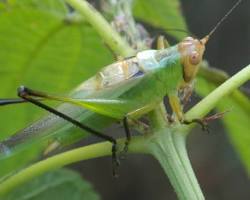
The Black-legged Meadow Katydid is a small grasshopper-like insect belonging to the family Tettigoniidae. Katydids are closely related to grasshoppers and crickets, and are well known for the chirping sounds produced by males during warm evenings. This species is especially recognized for its slender green body and contrasting dark or black legs, which help distinguish it from other meadow katydids.
Black-legged meadow katydids are common inhabitants of grassy fields, meadows, wetlands, roadsides, and natural landscapes throughout North America. Their green coloration provides excellent camouflage among grasses and vegetation, making them difficult to spot despite being fairly common in suitable habitats.
Although katydids feed on plant material, the black-legged meadow katydid rarely causes significant damage to crops or ornamental plants. Most populations remain low and are considered a natural part of healthy outdoor ecosystems.
Like many members of the insect order Orthoptera, these katydids communicate through sound production, especially during late summer evenings. Their calls contribute to the familiar nighttime sounds heard in fields and wetland habitats.
The species belongs to the larger group of katydids, which includes numerous nocturnal plant-feeding insects found throughout North America.
Quick Facts
- Order: Orthoptera
- Family: Tettigoniidae
- Habitat: Meadows, grasslands, wetlands, gardens
- Diet: Plant material and soft vegetation
- Activity Period: Primarily active during warm months
- Status: Minor or non-pest insect
Identification
The Black-legged Meadow Katydid is a small, delicate katydid species with slender proportions and long antennae.
Key identifying characteristics include:
- Bright green body coloration
- Distinctive dark or black legs
- Very long thread-like antennae
- Narrow wings folded along the body
- Slender body structure
Adults generally measure:
- Approximately 1/2 to 3/4 inch long
The antennae are especially noticeable and may:
- Exceed the length of the body
- Assist with navigation and sensing vibrations
Like other katydids, the hind legs are adapted for:
- Jumping
- Climbing vegetation
- Rapid escape from predators
The green body coloration helps camouflage the insect among:
- Grass stems
- Wetland vegetation
- Garden foliage
- Native meadow plants
Distribution and Habitat
Black-legged meadow katydids occur widely throughout North America.
They are commonly found in:
- Grasslands
- Wet meadows
- Roadside vegetation
- Native prairies
- Gardens
- Marsh edges
- Overgrown fields
The species prefers environments containing:
- Tall grasses
- Dense vegetation
- Moist habitats
- Flowering plants
- Undisturbed meadow growth
Wetlands and meadow habitats are especially important because they provide:
- Shelter from predators
- Food resources
- Egg-laying sites
- Protective vegetation cover
These katydids are most active during:
- Late spring
- Summer
- Early fall
Life Cycle
Like other orthopteran insects, the Black-legged Meadow Katydid undergoes incomplete metamorphosis.
The life stages include:
- Egg
- Nymph
- Adult
Females deposit eggs on:
- Grass stems
- Plant tissue
- Moist vegetation
- Protected field areas
After hatching, young nymphs resemble:
- Small wingless adults
Nymphs molt multiple times while gradually developing:
- Wings
- Adult coloration
- Reproductive structures
Both nymphs and adults feed on soft vegetation and remain hidden within grasses during the daytime.
Behavior
Black-legged meadow katydids are generally shy insects that rely heavily on camouflage.
Common behaviors include:
- Climbing grasses and stems
- Jumping to escape predators
- Remaining motionless when disturbed
- Producing chirping sounds at night
Male katydids create sounds through a process called stridulation, which involves rubbing specialized wing structures together.
Their nighttime calls help:
- Attract mates
- Establish territory
- Communicate with other katydids
Natural predators include:
- Birds
- Spiders
- Praying mantises
- Small mammals
- Predatory insects
Their green coloration and black-legged patterning help them remain concealed within dense vegetation.
Pest Status
Black-legged meadow katydids are generally considered harmless insects.
Although they feed on plants, they rarely:
- Damage crops significantly
- Cause economic loss
- Infest structures
- Threaten ornamental plants
In most environments, they are viewed as:
- Natural meadow insects
- Part of local biodiversity
- Minor herbivores
Because populations are usually small and dispersed, noticeable feeding damage is uncommon.
Prevention
Prevention measures are rarely necessary.
If populations become noticeable around gardens:
- Maintain healthy vegetation.
- Encourage birds and natural predators.
- Reduce excessive overgrowth if desired.
- Monitor ornamental plants for feeding.
Healthy ecosystems naturally regulate katydid populations through predation and environmental pressures.
Control
Control is usually unnecessary because these insects rarely become problematic.
If management is desired, options may include:
- Manual removal
- Reducing dense vegetation near sensitive plants
- Encouraging natural predators
- Maintaining balanced landscapes
Chemical treatment is rarely recommended because katydids:
- Cause little damage
- Support local food webs
- Provide ecological value
Interesting Facts
- Katydids are more closely related to crickets than grasshoppers.
- Their long antennae help them navigate dense vegetation.
- Males produce nighttime songs to attract females.
- Their green coloration provides excellent camouflage.
- Many katydids are active mainly at night.
- Some species resemble leaves to avoid predators.