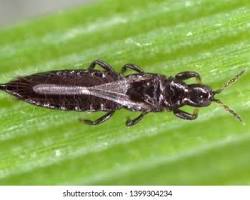
The Black Hunter Thrips (Leptothrips mali) is a small predatory insect belonging to the order Thysanoptera. Unlike many other thrips species that damage plants by feeding on leaves and flowers, black hunter thrips are considered highly beneficial insects because they prey on harmful plant pests. These tiny predators help suppress populations of aphids, mites, scale crawlers, whiteflies, and even other pest thrips in gardens, orchards, greenhouses, and agricultural crops.
Although their name includes the word “thrips,” black hunter thrips behave very differently from destructive species that scar leaves or damage flowers. Instead of feeding on plant tissue, these insects actively hunt soft-bodied prey on stems, foliage, buds, and fruit surfaces. Their predatory nature makes them important biological control agents in integrated pest management programs.
Because of their extremely small size, black hunter thrips often go unnoticed by gardeners and homeowners. However, they are commonly present anywhere populations of pest insects are abundant. In many agricultural systems, conserving beneficial predators such as black hunter thrips can reduce the need for chemical insecticides.
Quick Facts
- Scientific Name: Leptothrips mali
- Order: Thysanoptera
- Family: Phlaeothripidae
- Size: Approximately 1/16 inch long
- Habitat: Gardens, orchards, greenhouses, crops
- Diet: Predatory on aphids, mites, and small insects
- Status: Beneficial insect
Identification
Black hunter thrips are extremely small insects with slender dark-colored bodies.
Key identifying features include:
- Dark brown to black coloration
- Very narrow elongated body
- Thin fringed wings
- Rapid movement across leaf surfaces
- Tiny piercing-sucking mouthparts
Adults typically measure:
- About 1/16 inch in length
Their wings are lined with fine hair-like fringes typical of most thrips species.
Because of their small size, identification often requires:
- Magnification
- Close visual inspection
- Monitoring cards in greenhouses
Unlike pest thrips that feed directly on plants, black hunter thrips are usually seen moving quickly while searching for prey.
Distribution and Habitat
Black hunter thrips occur widely throughout North America and other temperate regions.
Common habitats include:
- Fruit orchards
- Vegetable gardens
- Crop fields
- Greenhouses
- Flower beds
- Landscape shrubs
- Tree canopies
They are especially common in environments where prey insects are abundant.
Black hunter thrips frequently occur on plants infested with:
- Aphids
- Spider Mites
- Whiteflies
- Scale crawlers
- Other thrips species
Because they depend on prey availability, populations often increase naturally during pest outbreaks.
Life Cycle
Black hunter thrips undergo incomplete metamorphosis.
Their developmental stages include:
- Egg
- Nymph
- Adult
Females deposit eggs directly on plant surfaces or near prey populations.
After hatching:
- Nymphs begin hunting immediately
- Young thrips resemble tiny wingless adults
Both immature and adult stages are active predators.
Development speed depends heavily on:
- Temperature
- Humidity
- Prey availability
Warm conditions with abundant prey can allow populations to grow rapidly.
Behavior
Black hunter thrips are aggressive predators despite their tiny size.
They actively search plant surfaces for:
- Aphids
- Mite eggs
- Small larvae
- Soft-bodied insects
Using their piercing mouthparts, they puncture prey and consume internal fluids.
Unlike destructive thrips species, they rarely feed on plant tissue itself.
These beneficial insects are especially valuable because they can reach small hidden areas where larger predators may struggle to hunt.
In greenhouse systems, they are often considered important natural enemies of pest thrips populations.
Benefits in Agriculture and Gardens
Black hunter thrips provide several ecological and agricultural benefits.
They help:
- Reduce aphid populations
- Suppress spider mites
- Control whiteflies
- Reduce damaging thrips species
- Limit pesticide dependence
Because they contribute natural biological control, growers often attempt to conserve these insects rather than eliminate them.
Healthy predator populations may improve long-term plant health in:
- Vegetable crops
- Fruit orchards
- Flower production systems
- Greenhouse environments
Pest Status
Black hunter thrips are not considered pests.
Unlike plant-feeding thrips species, they:
- Do not scar leaves
- Do not damage flowers
- Do not reduce crop quality
Instead, they are classified as beneficial predatory insects.
Their presence usually indicates:
- Active prey populations nearby
- A balanced garden ecosystem
- Natural biological pest control activity
Conservation and Prevention
No prevention measures are necessary because black hunter thrips are beneficial insects.
To encourage their presence:
- Reduce broad-spectrum insecticide use
- Maintain plant diversity
- Encourage beneficial insect habitats
- Provide flowering plants nearby
- Use integrated pest management strategies
Heavy pesticide applications may accidentally kill these predators and worsen pest outbreaks by removing natural enemies.
Control
Control is not recommended.
Black hunter thrips are highly valuable biological control insects that help regulate pest populations naturally.
In commercial agriculture, conservation of beneficial predators like black hunter thrips is often preferred over repeated chemical spraying.
Interesting Facts
- Black hunter thrips are predators rather than plant feeders.
- Both nymphs and adults hunt prey insects.
- They help suppress destructive thrips species.
- Their tiny size allows them to access hidden prey.
- They are commonly found in orchards and greenhouses.
- Many gardeners never notice them despite their beneficial role.