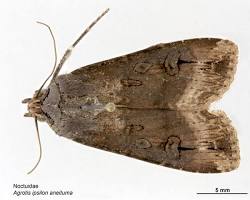
Black Cutworm Moths (Agrotis ipsilon) are highly destructive agricultural pests best known for their damaging larval stage, commonly called black cutworms. These nocturnal caterpillars attack young seedlings and newly emerged crops by feeding at or below the soil surface, often severing plants completely at the stem. Black cutworms are major pests of corn, vegetables, turfgrass, and many garden plants throughout North America and other agricultural regions worldwide.
The adult moth itself causes little direct damage, but female moths lay eggs in weedy fields, grassy areas, and crop residue where larvae can easily access emerging plants after hatching. Because young larvae feed at night and hide beneath soil or debris during the day, infestations are often not noticed until seedlings begin collapsing or disappearing entirely.
Black cutworms are among the most economically important early-season crop pests because they can rapidly reduce plant stands in both commercial agriculture and home gardens.
Quick Facts
- Scientific Name: Agrotis ipsilon
- Family: Noctuidae
- Common Name: Black Cutworm Moth
- Size: Caterpillars up to 2 inches long
- Color: Dark gray to black larvae
- Habitat: Agricultural fields, gardens, turfgrass
- Diet: Seedlings and young plants
- Status: Major agricultural pest
Identification
Adult black cutworm moths are medium-sized nocturnal moths with muted coloration that helps camouflage them during daylight hours.
Adult moth characteristics include:
- Grayish-brown wings
- Wingspan around 1.5 inches
- Dark dagger-like wing markings
- Smooth narrow body
- Nocturnal activity
The larvae are more recognizable and responsible for crop damage.
Larval features include:
- Dark gray or black coloration
- Smooth greasy-looking skin
- Cylindrical body
- Pale underside
- Curling into a C-shape when disturbed
Older larvae may grow to:
- Nearly 2 inches long
Distribution and Habitat
Black cutworm moths occur throughout:
- North America
- Central America
- Europe
- Asia
- Other temperate agricultural regions
They are especially common in:
- Corn fields
- Vegetable gardens
- Soybean fields
- Turfgrass
- Pastures
- Greenhouses
Adult moths prefer laying eggs in:
- Weedy fields
- Dense vegetation
- Crop residue
- Moist low-growing plants
Fields with heavy weed growth prior to planting are particularly attractive to egg-laying females.
Life Cycle
Black cutworm moths undergo complete metamorphosis consisting of:
- Egg
- Larva
- Pupa
- Adult
Adult moths migrate into northern agricultural areas during spring.
Females deposit eggs on:
- Weeds
- Plant debris
- Young crops
After hatching:
- Young larvae feed on leaves initially
- Older larvae begin cutting seedlings at the base
Larvae typically feed:
- At night
During daytime they hide:
- In soil cracks
- Beneath crop residue
- Under clumps of dirt
After completing development, larvae pupate in the soil before emerging as adult moths.
Several generations may occur annually in warm climates.
Behavior and Damage
Black cutworm larvae are most destructive during early crop development.
Damage commonly includes:
- Seedlings cut at soil level
- Wilted plants
- Missing plants in rows
- Partially chewed stems
- Defoliated young leaves
Young larvae may feed on:
- Leaf surfaces
Larger larvae become more destructive by:
- Severing stems completely
Plants commonly attacked include:
- Corn
- Tomatoes
- Lettuce
- Peppers
- Cabbage
- Beans
- Turfgrass
Larvae may drag cut plant material into their burrows to continue feeding underground.
Signs of Infestation
- Seedlings cut near soil level
- Wilting young plants
- Missing sections of crop rows
- C-shaped caterpillars in soil
- Night feeding damage
- Irregular stand development
- Chewed stems and foliage
Damage is usually most severe:
- During early spring planting periods
Pest Status
Black cutworms are considered major:
- Agricultural pests
- Garden pests
- Turfgrass pests
Economic impacts include:
- Reduced crop stands
- Lower yields
- Replanting costs
- Delayed crop development
Even low populations may cause significant losses in:
- Seedling crops
- High-value vegetables
- Commercial agriculture
Natural Predators
Many beneficial organisms help suppress black cutworm populations naturally.
Important predators and parasites include:
- Ground beetles
- Parasitic wasps
- Birds
- Predatory bugs
- Nematodes
- Fungal pathogens
Healthy ecosystems often reduce severe outbreaks naturally.
Prevention
Preventive management is extremely important in agricultural systems.
- Remove weeds before planting
- Monitor moth activity with traps
- Inspect fields regularly
- Reduce crop residue buildup
- Encourage beneficial predators
- Use healthy transplants
- Avoid planting into heavy weed growth
Weed removal several weeks before planting is especially effective because it discourages egg-laying moths.
Control
Integrated pest management is commonly used to control black cutworms.
Control methods may include:
- Pheromone trap monitoring
- Biological control agents
- Bacillus thuringiensis treatments
- Beneficial nematodes
- Targeted insecticides
- Field scouting programs
Treatment timing is critical because younger larvae are easier to control than mature cutworms.
Interesting Facts
- Black cutworms feed primarily at night.
- Larvae curl into a tight C-shape when disturbed.
- Adult moths are capable of long-distance migration.
- Large larvae may destroy multiple seedlings in a single night.
- Infestations are often associated with weedy fields.
- The species is one of the most important early-season corn pests in North America.