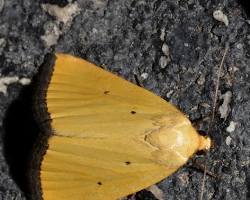
The Black-bordered Lemon Moth is a brightly colored moth species recognized for its vivid yellow wings accented by dark borders and markings. This attractive moth belongs to the order Lepidoptera, the same insect group that includes butterflies and thousands of other moth species. Although its appearance is striking, the black-bordered lemon moth is generally harmless and is rarely considered an important pest in gardens or agricultural environments.
Like many nocturnal moths, adult black-bordered lemon moths are most active during evening and nighttime hours. They are commonly attracted to porch lights, garden lighting, and illuminated windows after dark. During daylight hours, these moths often rest quietly among leaves and vegetation where their coloration provides partial camouflage against flowers and foliage.
The species is commonly associated with woodland edges, meadows, flower gardens, and other natural habitats rich in host plants and nectar-producing flowers. While caterpillars may occasionally feed on ornamental plants, feeding damage is usually minimal and does not justify control in most situations.
Black-bordered lemon moths are part of the larger moth group discussed in moths, which contains many beneficial pollinators and ecologically important nocturnal insects.
Quick Facts
- Order: Lepidoptera
- Common Habitat: Gardens, woodland edges, grassy fields
- Wingspan: Approximately 1–1.5 inches
- Diet: Nectar (adults), foliage (larvae)
- Status: Minor or non-pest moth species
- Activity Period: Primarily nocturnal
Identification
The Black-bordered Lemon Moth is easily recognized by its bright coloration and contrasting wing margins.
Key identifying features include:
- Bright lemon-yellow wings
- Dark brown or black wing borders
- Delicate scaled wings
- Slender body structure
- Fine antennae
- Soft fuzzy thorax
Adult moths generally have:
- A wingspan between 1 and 1.5 inches
The dark wing margins often create:
- A sharp contrasting outline
- A camouflage effect among flowers and leaves
- A warning-like appearance to predators
When resting, the moth typically folds its wings flat or tent-like over the body.
Like most moth species, the body is covered in:
- Fine scales
- Hair-like structures
These scales help regulate temperature and improve flight performance.
Distribution and Habitat
The Black-bordered Lemon Moth occurs across portions of North America where suitable vegetation and host plants are available.
Common habitats include:
- Woodland edges
- Native grasslands
- Gardens
- Flower beds
- Meadows
- Roadside vegetation
- Open forests
Adults are especially attracted to areas containing:
- Nectar-producing flowers
- Dense vegetation
- Sheltered foliage
- Outdoor lighting
Because many moth species are nocturnal, they are often more commonly observed around:
- Porch lights
- Street lights
- Landscape lighting
- Campground lights
Life Cycle
The Black-bordered Lemon Moth undergoes complete metamorphosis.
The life stages include:
- Egg
- Caterpillar
- Pupa
- Adult moth
Female moths lay eggs on or near suitable host plants.
After hatching, caterpillars begin feeding on plant foliage.
Larvae are usually:
- Green or brownish
- Well camouflaged
- Leaf-feeding caterpillars
Caterpillars molt multiple times before reaching maturity.
Once fully developed, the larvae pupate within:
- Leaf litter
- Silken cocoons
- Protected vegetation
- Soil debris
Adults emerge from the pupal stage ready to mate and continue the cycle.
Behavior
Black-bordered lemon moths are primarily nocturnal insects.
Adults become active during:
- Evening hours
- Warm nights
- Humid conditions
Adult moths feed mainly on:
- Flower nectar
- Plant fluids
- Sweet organic materials
While feeding, adults may assist with:
- Pollination
- Nectar transfer between flowers
Natural predators include:
- Bats
- Birds
- Spiders
- Predatory insects
The moth’s coloration and nighttime activity help reduce predation risk.
Pest Status
The Black-bordered Lemon Moth is generally not considered an economically important pest.
Reasons include:
- Low population densities
- Limited feeding damage
- Preference for wild vegetation
- Minimal impact on crops
Occasionally, caterpillars may feed on:
- Ornamental plants
- Garden foliage
- Native vegetation
However, damage is usually:
- Minor
- Temporary
- Cosmetic only
In most landscapes, the species is viewed as a harmless part of the local insect ecosystem.
Prevention
Prevention is rarely necessary because infestations are uncommon.
If caterpillar feeding becomes noticeable:
- Inspect plants regularly.
- Encourage natural predators.
- Maintain healthy plant growth.
- Reduce excessive nighttime lighting if desired.
Healthy garden ecosystems naturally regulate moth populations.
Control
Control measures are rarely required.
If management becomes necessary, options include:
- Manual caterpillar removal
- Pruning affected foliage
- Biological insecticides such as Bacillus thuringiensis
- Encouraging birds and beneficial insects
Chemical insecticides are generally discouraged because they may harm:
- Pollinators
- Butterflies
- Beneficial predators
- Native moth populations
Interesting Facts
- The moth’s bright yellow coloration resembles citrus or lemon tones.
- Dark wing borders help break up the moth’s outline against vegetation.
- Adults are strongly attracted to lights at night.
- Most feeding damage from caterpillars is minor.
- The species contributes to nighttime pollination.
- Moths are among the most diverse insect groups on Earth.