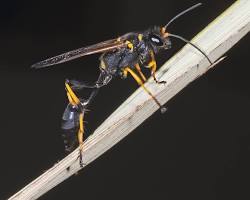
Black and Yellow Mud Daubers (Sceliphron caementarium) are solitary hunting wasps commonly found throughout North America. These insects are best known for their unique mud nests and their habit of hunting spiders to provision their developing larvae. Unlike highly social wasps such as yellowjackets or paper wasps, mud daubers are generally calm, non-aggressive insects that rarely sting humans unless directly handled or trapped.
Black and yellow mud daubers are considered highly beneficial because they naturally help control populations of spiders around homes, barns, garages, and outdoor structures. Their nests are often discovered attached to walls, ceilings, sheds, attics, bridges, porches, and under roof eaves where sheltered surfaces protect the developing larvae from weather and predators.
Quick Facts
- Scientific Name: Sceliphron caementarium
- Family: Sphecidae
- Common Names: Black and Yellow Mud Dauber, Mud Wasp
- Habitat: Buildings, barns, bridges, sheltered structures
- Diet: Spiders (larvae), nectar (adults)
- Status: Beneficial predator
- Nest Type: Mud tube nests
Identification
Black and yellow mud daubers are slender wasps with distinctive coloration and extremely narrow waists.
Key identification features include:
- Black body with bright yellow markings
- Long thread-like waist (petiole)
- Long dangling legs during flight
- Narrow elongated abdomen
- Smooth body with minimal hair
- Dark smoky wings
Adults typically measure:
- Approximately 3/4 to 1 inch long
Their flight is often slow and graceful compared to:
The most recognizable sign of their presence is the appearance of mud nests attached to sheltered surfaces.
Distribution and Habitat
This species occurs widely throughout:
- The United States
- Southern Canada
- Mexico
- Parts of Central America
Black and yellow mud daubers prefer warm areas where suitable nesting surfaces and spider prey are available.
Common habitats include:
- Barns
- Sheds
- Garages
- Porches
- Attics
- Bridges
- Rock overhangs
- Abandoned structures
- Outdoor equipment
They frequently choose locations protected from:
- Rain
- Direct sunlight
- Strong wind
Nest Construction
The nests of black and yellow mud daubers are among the most distinctive structures created by insects.
Females gather:
- Mud
- Water
- Fine soil particles
Using these materials, they build:
- Tubular mud chambers
- Parallel mud cells
- Clustered mud nests
Each chamber serves as an individual nursery for a developing larva.
Nests are commonly attached to:
- Walls
- Wood beams
- Concrete
- Metal structures
- Ceilings
- Window frames
Completed nests harden into durable mud structures that may persist long after the wasps emerge.
Life Cycle
Black and yellow mud daubers undergo complete metamorphosis consisting of:
- Egg
- Larva
- Pupa
- Adult
After constructing a mud chamber, the female hunts spiders to provision the nest.
She:
- Paralyzes spiders with venom
- Places them inside the mud cell
- Lays a single egg
- Seals the chamber with mud
The larva later feeds on the immobilized spiders while safely protected within the nest.
After completing development:
- The larva pupates
- An adult emerges by chewing through the mud wall
Several generations may occur yearly in warm climates.
Behavior
Unlike social wasps, black and yellow mud daubers live solitary lives.
Each female independently:
- Builds nests
- Hunts prey
- Raises offspring
Adults feed primarily on:
- Nectar
- Honeydew
- Plant sugars
Larvae feed exclusively on:
- Paralyzed spiders
Common spider prey includes:
- Orb weavers
- Jumping spiders
- Wolf spiders
- House spiders
Their hunting behavior provides natural biological control around structures.
Pest Status
Black and yellow mud daubers are generally considered beneficial insects.
Benefits include:
- Spider population reduction
- Natural pest control
- Minimal aggression toward humans
Unlike aggressive social wasps:
- They rarely defend nests aggressively
- They seldom sting humans
- They usually avoid confrontation
Most issues involve:
- Mud nest appearance on structures
- Accumulation of old nests
- Surprise encounters indoors
The wasps themselves are not considered dangerous.
Signs of Activity
- Tubular mud nests on walls or ceilings
- Large slender black and yellow wasps flying slowly
- Spider remains near nest areas
- Wasps collecting mud from wet soil
Prevention
If mud nests become undesirable, prevention measures may include:
- Removing inactive nests
- Sealing cracks and openings
- Reducing spider populations near buildings
- Limiting sheltered nesting surfaces
- Inspecting garages and sheds regularly
Pressure washing and regular cleaning can discourage repeated nesting.
Control
Control is rarely necessary because these wasps are beneficial predators.
If nests appear in inconvenient locations:
- Wait until nests are inactive
- Scrape nests away carefully
- Seal nesting surfaces afterward
Chemical control is usually unnecessary and discouraged unless large numbers become problematic.
Ecological Importance
Black and yellow mud daubers play important ecological roles by:
- Controlling spider populations
- Serving as pollinators while feeding on nectar
- Supporting biodiversity
- Acting as prey for birds and larger insects
Their nesting behavior also contributes to nutrient recycling through the movement of soil and organic material.
Interesting Facts
- Each mud chamber usually contains several paralyzed spiders.
- Mud daubers are solitary rather than social wasps.
- Old mud dauber nests are sometimes reused by other insects.
- They are among the least aggressive wasps in North America.
- Their long narrow waist makes them easy to identify.
- Adults commonly visit flowers for nectar.