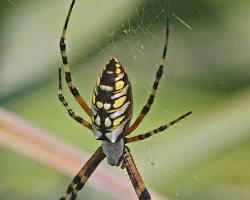
Black and Yellow Garden Spiders (Argiope aurantia), commonly known as Writing Spiders or Yellow Garden Spiders, are large orb-weaving spiders frequently found in gardens, fields, and landscaped areas throughout North America. These spiders are famous for their dramatic black and yellow coloration and the large circular webs they construct among tall plants and shrubs. Despite their intimidating appearance, they are considered highly beneficial predators that help naturally control populations of flies, grasshoppers, mosquitoes, beetles, and other nuisance insects.
The species is often called the “Writing Spider” because many webs contain a thick zig-zag silk pattern known as a stabilimentum. Scientists believe this unusual structure may help attract prey, stabilize the web, or warn birds away from accidentally flying into it. During late summer and early fall, these spiders become especially noticeable as their webs expand and insect activity increases.
Quick Facts
- Scientific Name: Argiope aurantia
- Family: Araneidae
- Common Names: Black and Yellow Garden Spider, Writing Spider, Yellow Garden Spider
- Habitat: Gardens, meadows, shrubs, woodland edges
- Diet: Flying insects and garden pests
- Status: Beneficial predator
- Web Type: Large orb web with zig-zag stabilimentum
Identification
Female black and yellow garden spiders are among the largest orb-weaving spiders commonly encountered in North America.
Key identification features include:
- Large rounded abdomen
- Bold black and yellow coloration
- Silvery cephalothorax
- Long black legs with orange or reddish highlights
- Large circular orb webs
- Zig-zag silk design in the center of the web
Adult females may reach:
- Over 1 inch in body length
- Several inches across including leg span
Males are much smaller and less noticeable than females.
Their webs are often constructed:
- Between shrubs
- Across tall grass
- Near gardens
- Around fences
- In open sunny areas
Distribution and Habitat
Black and yellow garden spiders occur widely throughout:
- The United States
- Southern Canada
- Mexico
- Parts of Central America
They prefer habitats with:
- Abundant flying insects
- Tall vegetation
- Warm sunlight
- Protected web-building locations
Common habitats include:
- Flower gardens
- Vegetable gardens
- Meadows
- Roadside vegetation
- Woodland edges
- Farms
- Orchards
- Backyards
The species is most visible during:
- Late summer
- Early autumn
Web Construction
The orb web built by the black and yellow garden spider is one of the species’ most recognizable features.
These webs may measure:
- Up to 2 feet wide
The web consists of:
- Sticky spiral silk
- Strong support strands
- A central stabilimentum
The stabilimentum appears as:
- A zig-zag band of silk
- An “X” pattern
- A vertical ribbon of dense silk
Possible purposes of the stabilimentum include:
- Web stabilization
- Prey attraction
- Bird deterrence
- Camouflage
The spider usually waits motionless in the center of the web with its legs paired together in an X-like posture.
Life Cycle
Black and yellow garden spiders undergo a typical spider life cycle involving:
- Egg
- Spiderling
- Juvenile
- Adult
Females produce large brown egg sacs during late summer or fall.
Each egg sac may contain:
- Hundreds of eggs
Egg sacs are often attached to:
- Vegetation
- Web supports
- Protected branches
Spiderlings hatch later but often remain protected within the egg sac during winter.
Young spiders disperse during spring using:
- Ballooning behavior
- Silk threads carried by wind
Behavior
These spiders are non-aggressive and spend most of their lives within or near their webs.
They feed on:
- Flies
- Grasshoppers
- Beetles
- Moths
- Mosquitoes
- Wasps
- Cicadas
When prey becomes trapped:
- The spider rapidly approaches
- Injects venom
- Wraps prey in silk
- Consumes liquefied tissues
These spiders are primarily:
- Diurnal during warm weather
- Most active during daylight hours
Pest Status
Black and yellow garden spiders are not considered pests.
Instead, they are highly beneficial predators because they naturally reduce populations of:
- Flying insects
- Garden pests
- Nuisance flies
- Mosquitoes
They rarely bite humans and generally avoid contact whenever possible.
Bites are:
- Extremely uncommon
- Usually mild
- Comparable to a bee sting in severity
Most problems involve:
- Accidental encounters with webs
- Fear of large spiders
- Web placement near walkways
Signs of Activity
- Large circular orb webs
- Zig-zag stabilimentum silk
- Large black and yellow spider resting in web center
- Insect remains wrapped in silk
- Brown egg sacs during fall
Prevention
Since these spiders are beneficial, prevention is usually unnecessary.
If webs become inconvenient:
- Remove webs from walkways
- Trim tall vegetation near entrances
- Reduce outdoor lighting that attracts insects
- Relocate webs carefully when possible
- Seal gaps around structures
Reducing insect populations near buildings will also reduce spider activity.
Control
Control is rarely recommended because these spiders provide valuable natural pest control.
When removal is necessary:
- Manual relocation is preferred
- Web removal may encourage movement
- Chemical treatment is usually unnecessary
Most populations remain seasonal and naturally decline after colder weather arrives.
Ecological Importance
Black and yellow garden spiders are important components of healthy ecosystems.
They help:
- Control pest insects
- Reduce mosquito populations
- Limit agricultural pests
- Support natural biological balance
They also serve as prey for:
- Birds
- Lizards
- Wasps
- Larger spiders
Interesting Facts
- The species is commonly called the “Writing Spider” because of the zig-zag silk pattern in its web.
- Females are dramatically larger than males.
- These spiders rebuild or repair their webs frequently.
- Their bright coloration helps warn predators.
- They can capture surprisingly large insects.
- Most webs appear in sunny open spaces.