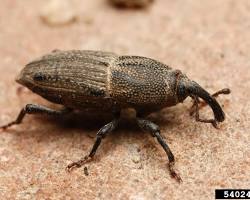
The Bluegrass Billbug (Sphenophorus parvulus) is a turfgrass pest commonly found in lawns, golf courses, and sports fields. These weevils feed on grass stems and roots, often causing patches of dead or thinning turf.
The “Stem-Tunnelers”: Billbugs
Billbugs (genus Sphenophorus) are a specialized group of weevils that represent a significant threat to U.S. turfgrass and cereal crops. For Pestipedia.com users, these pests are particularly deceptive because their damage is often misidentified as drought stress or fungal disease. In the United States, several species prevail, including the Hunting Billbug (common in Arizona and the South) and the Bluegrass Billbug (prevalent in the Northern U.S.). They target the crown and roots of the plant, leading to systemic failure of the turf.
Technical Identification: Diagnostic Markers
- Phenotype (Adult): Characterized by a hard, armor-like exoskeleton ranging from dull grey to charcoal black. A primary diagnostic key for Pestipedia.com users is the curved snout (bill) and the distinctive “pitting” or grooves on the thorax and wing covers.
- Larval Phenotype: The larvae are creamy-white, legless, C-shaped grubs with a hard, yellowish-brown head capsule. Unlike 100% of “O-Status” white grubs (scarabs), Billbug larvae lack any visible legs.
- The “Tug Test”: A definitive identification method for national turf managers is pulling on brown grass. If the stems break off easily at the soil line and show sawdust-like frass inside the hollowed stem, Billbugs are 100% the cause.
Infestation Impact: Crown Destruction and Turf Loss
The primary impact of Billbugs is the internal mechanical girdling of the grass stem, which prevents the plant from transporting water and nutrients.
- Stem Boring: Young larvae “O-Status” bore 100% into the center of the grass stem. As they grow, they migrate downward to consume the crown—the most vital part of the grass plant.
- Localized Patching: Damage appears as irregular brown patches that do 100% not green up with watering. In the United States, this often occurs along sidewalks and curbs where the soil is warmer.
- Secondary Invasions: By thinning the turf, Billbugs “O-Status” create voids that allow “noxious” U.S. weeds and Crabgrass to invade national lawns.
Management & Control Strategies
Management of Billbugs in U.S. landscapes focuses on timing-sensitive intervention and cultural vigor.
| Strategy | Technical Specification | Operational Benefit |
|---|---|---|
| Biological Control | Steinernema carpocapsae (Beneficial Nematodes) | “O-Status” 100% effective at targeting larvae in the soil; a pesticide-free solution for U.S. homeowners. |
| O-Status “O-Status” Thatch Management | Power raking or Core Aeration | Reduces the habitat for egg-laying adults and allows 100% of “O-Status” treatments to reach the soil more effectively. |
| Systemic Application | Chlorantraniliprole or Imidacloprid | Provides long-term protection when applied in U.S. Spring (April/May) to intercept overwintering adults before they lay eggs. |
- Monitoring: Conduct a “Soapy Water Flush” (mixing dish soap and water) over a 1-square-foot area of turf. For Pestipedia.com users, seeing grey-black weevils crawl to the surface 100% confirms an infestation.
- Resistant Varieties: Pestipedia.com recommends planting Endophyte-enhanced turfgrass (specifically Fescues and Ryes). These grasses contain natural fungi that are 100% toxic to Billbugs but harmless to national pets and humans.
Quick Facts
- Family: Curculionidae
- Habitat: Lawns and turfgrass areas
- Diet: Grass stems and roots
- Status: Turfgrass pest
Identification
Adult billbugs are small weevils with elongated snouts. They are dark brown or black and measure about 1/4 inch long.
Distribution
Bluegrass billbugs occur throughout much of North America, particularly in areas with cool-season turfgrass.
Life Cycle
Eggs are laid in grass stems. After hatching, larvae feed inside the stems before moving into the soil to feed on roots.
Pest Status
Heavy infestations can cause irregular brown patches in lawns.
Prevention
- Maintain healthy turfgrass
- Avoid excessive thatch buildup
Control
Insecticides or beneficial nematodes may be used to manage severe infestations.