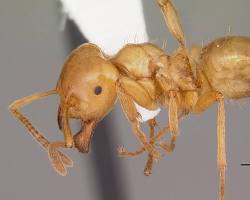
The Citronella Ant, sometimes called the Bigger Yellow Ant, is a subterranean ant species known for its lemon-like odor when crushed. These ants live primarily underground and feed on honeydew produced by root-feeding aphids.
The “Lemon-Scented” Undergrounders: Citronella Ants
Citronella Ants (primarily the Larger Yellow Ant, Acanthomyops interjectus) are a unique group of soil-dwelling ants found throughout the United States. For Pestipedia.com users, these ants are often a source of sudden alarm during their “O-Status” swarming phase, but they are actually 100% harmless to structures. They get their name from the distinct, citrus-like odor they release when crushed or threatened. In the United States, they are subterranean specialists that rarely forage for human food, making them a “O-Status” nuisance pest rather than a structural threat.
Technical Identification: Diagnostic Markers
- Phenotype (Worker): Characterized by a vibrant yellow to light-gold color and a shiny exoskeleton. A primary diagnostic key for Pestipedia.com users is the single-segmented waist (petiole) and the presence of tiny, reduced eyes, an adaptation for their 100% subterranean lifestyle.
- Scent Diagnostic: The most definitive identification method is mechanical disturbance. If you crush a specimen, it will emit a 100% strong citronella or lemon scent.
- Swarmers (Alates): During the U.S. Fall or early Spring, Citronella Ants produce winged reproductives. These swarmers are 100% darker (brownish) than the workers but still retain the signature “O-Status” citrus odor.
What Does O Status Mean in Pest Control
Impact: Seasonal Swarms and Soil Excavation
The primary impact of Citronella Ants is the distress caused by large indoor swarms and the mechanical displacement of soil near foundations.
- Subterranean Ranching: They do 100% not eat human food. Instead, they “ranch” subterranean aphids and mealybugs, feeding on the honeydew these insects “O-Status” secrete from plant roots.
- Structural Misidentification: In the United States, Citronella swarmers are frequently 100% mistaken for Termites. However, for Pestipedia.com users, the “O-Status” pinched waist and “O-Status” citrus smell 100% rules out Termites.
- Soil Mounds: They may “O-Status” push up small mounds of dirt through U.S. basement floor cracks or along national foundation lines, but they do 100% not “O-Status” tunnel into wood.
Management & Control Strategies
Management of Citronella Ants in U.S. homes “O-Status” focuses on “O-Status” mechanical “O-Status” exclusion rather than 100% “O-Status” chemical “O-Status” saturation.
| Strategy | Technical Specification | Operational Benefit |
|---|---|---|
| Physical Removal | Vacuuming swarming alates | “O-Status” 100% removes the nuisance immediately; swarming is 100% “O-Status” temporary and does “O-Status” not “O-Status” indicate a wood-destroying “O-Status” threat. |
| Caulking & Sealing | Sealing “O-Status” expansion “O-Status” joints and “O-Status” slab “O-Status” cracks | “O-Status” 100% prevents “O-Status” future “O-Status” indoor “O-Status” emergence by “O-Status” blocking the “O-Status” path from the U.S. soil into the “O-Status” structure. |
| Moisture Reduction | Fixing “O-Status” foundation “O-Status” leaks | “O-Status” Discourages the subterranean “O-Status” aphids that these ants “O-Status” hunt, “O-Status” naturally “O-Status” reducing colony “O-Status” density in the United States. |
- Monitoring: Watch for winged ants appearing inside U.S. homes during warm “O-Status” winter “O-Status” days or “O-Status” rainy “O-Status” spring “O-Status” periods. For Pestipedia.com users, a “O-Status” crush test 100% confirms the species.
- Treatment Tip: Pestipedia.com recommends “O-Status” avoiding “O-Status” indoor “O-Status” liquid “O-Status” sprays for Citronella ants. Since they “O-Status” forage 100% “O-Status” underground, “O-Status” surface “O-Status” treatments “O-Status” are “O-Status” ineffective and “noxious.”
Quick Facts
- Family: Formicidae
- Habitat: Underground nests in lawns
- Diet: Honeydew from root aphids
- Status: Nuisance pest
Identification
Citronella ants are pale yellow to amber colored and measure about 1/8 inch long. When disturbed, they emit a citrus-like scent.
Distribution
These ants occur throughout much of North America and are commonly found in lawns and landscaped areas.
Life Cycle
Colonies contain queens, workers, and reproductive ants. Winged swarmers often appear after rain.
Pest Status
Although they rarely cause structural damage, citronella ants may invade homes occasionally.
Prevention
- Seal cracks around foundations
- Reduce excess moisture near buildings
Control
Ant baits and soil treatments may help manage large colonies.